- May 14, 2026
- Gargi Joshi
Featured Articles
When Small Choices Become a National Offering
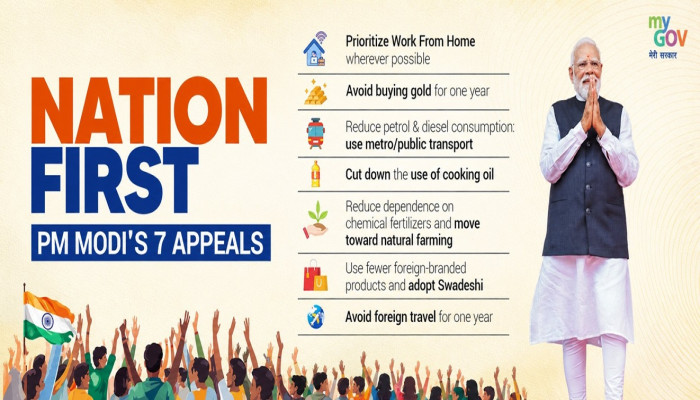
The other evening, while scrolling through family WhatsApp groups full of forwarded videos, fuel-price discussions, stock market anxieties, and someone inevitably joking that “winter is coming,” I realised something unusual: people are sensing that the world is entering a difficult phase again. Though it is not with panic. Not with the fear of collapse. But with that quiet Indian instinct that says: something is shifting globally, and we should prepare wisely. You can see it in everyday conversations now. Parents discussing household budgets more carefully. Young professionals wondering whether international uncertainty will affect jobs. Friends casually mentioning rising flight costs, inflation, or supply chain disruptions. Farmers worrying about fertiliser prices. Families reconsidering foreign vacations. The world feels less stable than it did a few years ago. And perhaps that is exactly why Prime Minister Narendra Modi’s recent public appeals matter beyond economics. They are not merely administrative suggestions. They are invitations to participate. Because this moment is not only about oil prices, imports, or geopolitics. It is also a test of whether India behaves merely like a market of consumers — or like a Rashtra: a living civilisational family bound by shared duty, memory, and responsibility. After all, we are the biggest living, thriving Democracy, and Democracy is participatory. In Bharat’s civilisational understanding, a nation is not just land, borders, and institutions. A Rashtra is emotional belonging. It is the feeling that strangers standing beside us in a metro station, farmers growing food hundreds of kilometres away, soldiers at the border, and families managing rising costs are all connected in a shared destiny. That is why democracy in India cannot be reduced to Parliament sessions, courtrooms, or government offices alone. A living democracy moves when ordinary citizens move together. When millions make small conscious decisions, the country becomes stronger without noise or spectacle. And perhaps this is what Modiji understands deeply as a leader shaped by civilisational thinking: a crisis should never be wasted. It should become an opportunity for discipline, participation, self-reliance, and emotional unity. Look closely at the appeals being made to citizens. None of them require heroism. None demand sacrifice beyond ordinary life. Yet together, they can quietly reshape national resilience. Take fuel consumption. India still imports the majority of its crude oil needs, which means every unnecessary litre burned affects not only household budgets but also forex reserves and national energy security. When people choose metros, buses, railways, or office carpools even once or twice a week, it may seem insignificant individually. But multiplied across millions, it becomes a collective strength. It also reduces congestion, pollution, and stress — things urban Indians complain about daily anyway. Similarly, the push towards electric mobility and energy-efficient practices is not just environmental idealism. It is future preparation. Every electric scooter, efficient appliance, or reduced electricity bill contributes to a more self-reliant energy ecosystem. Clean cities are not built only through government policy. They are built through habits. The suggestion to revive work-from-home and virtual meetings, where practical, sounded surprisingly sensible to many families. During the pandemic, we discovered that not every meeting requires a flight, a traffic jam, or three hours on the road. Saving fuel, time, and stress is not laziness; it is intelligent modernisation. Then comes something Indians often underestimate: domestic tourism and local purchasing choices. India spends enormous amounts on imports, while foreign exchange stability remains critical during uncertain global conditions. A family choosing to holiday in Coorg instead of overseas, buying Indian-made products where feasible, or supporting local artisans may not think of it as national service. But it is. Quietly. Gently. Without slogans. Even food habits become connected to resilience. India imports a significant quantity of edible oils, making households vulnerable to global price shocks. Reducing excessive oil consumption is not only healthier for families; it also eases import dependence. Sometimes national strength begins with something as ordinary as what we cook for dinner. The appeals to farmers are equally important. Chemical fertilisers have become expensive globally, and subsidy pressures on the government are enormous. Encouraging natural farming where feasible is not about romanticising agriculture. It is about preserving soil health, reducing dependence on imported inputs, and creating long-term sustainability. Likewise, solar-powered irrigation can reduce diesel and electricity burdens while making villages active participants in India’s energy transformation. None of these actions alone will “solve” geopolitics. But together, they create resilience. Our civilisational wisdom has always understood this interconnectedness through the idea of the Rinas — sacred debts we are born with. Not guilt, but responsibility. A debt to nature. To knowledge traditions. To ancestors. To society. To other living beings. Perhaps in modern language, this simply means: we inherit much, and therefore we must contribute something back. When we reduce waste, conserve fuel, support local enterprise, share knowledge, help neighbours, or act responsibly during uncertainty, we are repaying these debts in small ways. What looks like inconvenience becomes seva — service rooted in gratitude. I find this strangely comforting. Most ordinary citizens cannot control global conflicts, oil prices, or international trade tensions. We cannot negotiate supply chains or stabilise currencies from our living rooms. But we can still participate. Maybe participation looks like office carpool challenges. Maybe it is one “public transport day” every week. Maybe residential societies can organise energy-saving competitions. Maybe families can consciously prioritise Indian products for festivals and gifting. Maybe young people can create informative social media posts instead of spreading panic. Maybe schools can encourage discussions on conservation. Maybe children can help grandparents understand digital meetings, UPI savings, or government energy initiatives. These sound like small things. History often moves through small things. And that is why, strangely enough, this is an exciting time to be alive. Not because the world is unstable. But because moments of uncertainty force civilisations to remember themselves. They reveal whether people can rise above passive consumption and become participants in collective destiny. In Bharatiya thought, a Yagna is not merely a ritual fire. It is a shared offering for a larger good. Everyone contributes something according to their capacity. Perhaps this global moment is India’s modern maha yagna. One person saves fuel. Another supports local businesses. A farmer experiments with sustainable methods. A student spreads awareness. A housing society installs solar panels. A family cuts waste. A company reduces unnecessary travel. None of them look dramatic alone. Together, they become a national strength. So maybe the question before us is not, “How bad will the global crisis become?” Maybe the better question is: “How deeply are we willing to participate in India’s rise through our everyday choices?” I would genuinely love to hear how other citizens are thinking about this moment — the small habits, local solutions, and practical ideas emerging in homes, offices, schools, farms, and communities across the country. Because this maha yagna will need everyone’s offering. And if we respond with wisdom, discipline, and shared responsibility, then when this difficult global phase eventually passes, Bharat should not emerge merely “less damaged.” It should emerge more united, more self-aware, more rooted, and stronger as a Rashtra family.- May 14, 2026
- Ankita Dutta