




Where State Governance Meets National Security
- In Politics
- 01:07 AM, May 11, 2026
- Ramaharitha Pusarla
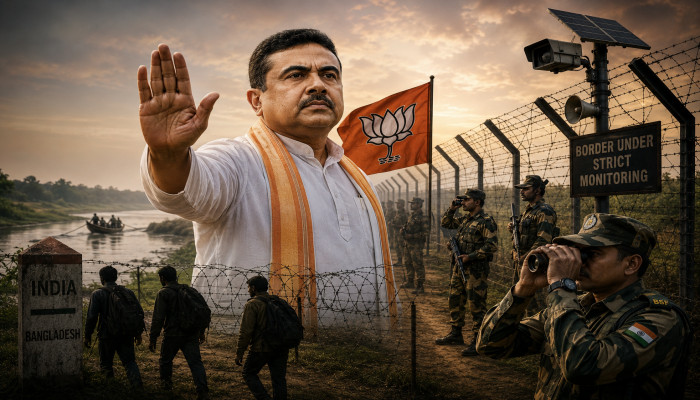
Pregnant with new hopes and anticipation of change, West Bengal is all set to enter a new political phase in its long journey. Suvendu Adhikari is now officially sworn in as the new chief minister after the BJP registered a landslide victory. Having actively engaged with the people of the state, the national party must have charted the priorities of governance.
Instructively, as the new Chief Minister hits the ground running, Mamata Banerjee’s resignation drama and reactions from across the border should ring bells. Alleging conspiracy, Mamata rejected the verdict of a free and fair election and refused to resign, defying the conventional practice. The unprecedented move, perhaps the first of its kind in Indian politics, sparked intense discussions. More than the recalcitrance of Banerjee, the strong backing from Bangladesh’s Jamaat leader, Mohammad Nurul Huda, has raised more eyebrows. He urged Banerjee to openly declare a war against New Delhi by announcing West Bengal’s independence, assuring her of the support of 170 million Muslims.
Addressing a large gathering, BNP leader Altab Hossain Molla threatened Suvendu Adhikari, “If Indian Muslims unite, they can rip India into pieces”. Bangladesh National Citizens Party MP and Chief Whip of Opposition, Nahid Islam, alleged that Muslims in Bengal were facing persecution and deprived of voting rights. A viral video of Hefazat-e-Islam leader, Maulana Fakhru, surfaced on social media warned that Bengali Muslims in West Bengal may start a Civil War since the BJP has won the elections.
The firm backing of radical elements in Bangladesh has brought into focus the Rs 750 Crore money laundering investigation reports in the Saradha Chit Scam. Saradha Group Chairman, Sudipto Sen, told ED that the money has been diverted to the Middle East and Bangladesh through Jamaat leaders. Sen stated that TMC Rajya Sabha leader, Ahmad Hassan Imran, introduced him to Jamaat leaders.
Hassan is the founding member and head of the Bengal Chapter of SIMI (Students Islamic Movement of India), the banned terrorist organisation and served as the Indian correspondent of the Bangladesh newspaper, Naya Diganta, a mouthpiece of Jamaat-e-Islami. He is also believed to be involved in 2013 Canning violence, where 100 Hindu homes were set on fire. Currently, he is the Chairman of the West Bengal Minorities Commission.
According to a ToI report, the proceeds of the Saradha scam parked in the Islami Bank of Bangladesh have made their way to the Jamaat outfit legally. The bank’s customer base included proscribed political organisations and individuals. Reportedly, these funds were distributed to them as “Corporate Zakaat”. The bank founded by Jamaat-e-Islami with links to Jamaatul Mujahedin Bangladesh (JMB) was under the scanner of the US agencies. Acting on the intelligence reports, the bank was hauled by the then-Bangladesh government for disbursing funds to terrorist agencies.
After over 13 years of investigation, the case reached a stalemate, accountability is yet to be established, and victims still await justice.
In 2014 op-Ed in The Daily Star, Brig Gen Shahedul Anam Khan of Bangladesh raised concerns that funds from Sharada scam were diverted by the TMC to the Jamaat, which was fuelling violent protests against the ruling Awami League to topple the government. He highlighted that the TMC-Jamaat nexus revolved around consolidating vote banks in West Bengal. Noting that Bangladeshi intelligence agencies had shared information with their Indian counterparts, Khan called for a thorough investigation into these allegations.
When the Awami League intensified its crackdown on Jamaat for their brutal killing of Hindus, minorities, secular bloggers and gay rights activists, most of them crossed over to India. They sought refuge in West Bengal. In India, Mamata refused permission to the investigation agencies to enter the state or interrogate the Islamists. The majority of the Jamaat cadre who escaped to India included Mullahs and Maulvis at Madrassas. Regularly increasing their perks, Mamata helped them to settle in the State to ensure the entire Muslim population votes for TMC en bloc. To appease the Muslims in the state, TMC shielded the Jamaat. In fact, Dhaka had started to believe that their counter terrorism operation would be ineffective unless the West Bengal government stopped being a safe haven for them.
JMB had houses in Bengal. This was exposed by the Khagragarh blast in October 2014. The blast occurred in a house in Burdwan where the JMB module was making bombs. NIA also recovered burnt pamphlets featuring Ayman Al-Zawahiri at the blast site. Investigations have found that the bombs made were similar to those used by the Indian Mujahideen (IM). After finding shelter in Bengal, JMB set up training centres in Madrassas of Malda and Burdwan. JMB, an Islamist Terrorist organisation, was founded by Abdur Rehman in 1998 to establish an Islamic State in Bangladesh under the jurisdiction of Sharia Laws.
The cadres arrested by the NIA were found to have close links with JMB. Mamata repeatedly scuttled all attempts by the investigation agencies to nab the Islamist radicals, turning the state into a fertile breeding ground for extremist ideology. Sheikh Hasina’s regime cracked a whip on these terror elements in Bangladesh and helped India in keeping insurgency movements under check in the North East.
After Hasina’s ouster, the Jamaat cadres brought out the genie of Greater Bangladesh and fed this concept to the protesting students, who quickly lapped it up. Under the anti-India regime of Yunus, adding fire to fuel, snapping ties with New Delhi, Bangladesh turned to Pakistan. With the state of West Bengal under the firm control of Islamist-friendly Mamata, Islamabad kick-started its Eastern agenda of destabilising India.
The humiliating defeat of Mamata has thus been a rude shock to Pakistan and its puppet Jamaat network. Jamaat had been hand in glove with Pakistan even during the 1971 Bangladesh Liberation War. BJP’s sweeping victory has come as a huge jolt to Pakistan’s eastern plans. Pakistan’s Interior Minister Mohsin Naqvi’s visit to Dhaka on May 8th, with a nine-member delegation (comprising ISI officials), has added more teeth to speculations of ISI’s plan of targeting India from its Eastern Front. While social media is abuzz with rumours that Ansar-Al Islam, a Bangladeshi affiliate of Al-Qaeda in Bangladesh, is planning attacks in West Bengal, a national alert has also been announced in Delhi.
During the fifteen years of TMC rule, Bengal has become a citadel of syndicate groups, Islamist outfits and illegal infiltrators. Having found a safe refuge in India, the Bangladeshi terrorist networks quickly mushroomed under the friendly TMC regime. This drastically changed the demography of border regions, constricting the freedom of the Hindu community and forcing them to flee their homes. Given the ease with which Jamaat operates without any restraints across two countries through porous borders, they have become the most favoured operatives of Pakistan’s ISI.
Indo-Bangladesh border regions have become bastions of Jamaat. Their sweeping victories, especially in regions abutting the border in the recent Bangladesh poll, validate the same. The provocative remarks of the Jamaat leaders and the fundamental elements in Bangladesh are an attempt to stoke communal tensions in India.
Reacting to the BJP’s win in Bengal, the Bangladesh Foreign Minister, Khalilur Rahman, said that Bangladesh will take action if “push-in” incidents occur. A day later, echoing the same sentiment, Home Minister Salahuddin Ahmed hoped that people would not be pushed into their country. Unlike the Awami League, which took Jamaat for task, the Bangladesh Nationalist Party (BNP) is ambivalent in its approach. From 2001 to 2006, the BNP and Jamaat-e-Islami coalition ran the government. After Hasina’s ouster, BNP distanced itself from Jamaat to position itself as a moderate, liberal and secular party. BNP has been infamous for its sympathetic approach towards religious extremism and patronising terrorism.
Bangladesh, under the BNP, while signalling an intent to renew ties with India that dived south under Yunus’s regime, is also expanding cooperation with Pakistan. On his recent Beijing visit, Foreign Minister Khalilur Rahman sought China’s help in the Teesta River Front Restoration. In the past, the cooperation with Bangladesh on certain aspects hit a roadblock due to the obstinate TMC government in West Bengal. With the BJP government at the helm in the State and Centre, Bangladesh can no longer accuse India of being non-cooperative. The Indian government has an unequivocal zero-tolerance policy towards terrorism. So, the onus is on Bangladesh to crack down on the terror elements emanating from its territory.
Unlike in the past, provocative statements that preceded acts of terror will now be reciprocated by massive retaliation by a New India, defined by its “ghar mein ghus ke marenge” resolve. Alongside, the state must crack down on syndicates collaborating with the Jamaat network by fast-tracking investigations into decade-old money laundering scam and dismantling the terror safe havens.
BJP’s victory in West Bengal carries a dual challenge- while aggressively expediting developmental projects, it must tenaciously repel the terror attacks and guard the nation’s sovereign borders.
References
- Bangladeshi Islamists Find Easy Shelter in West Bengal. Mamata’s Govt Won’t Let Police Go After Them
- Saradha funds deposited in Bangladesh’s Islami Bank? | Kolkata News - Times of India
- Ending the suspense: Mystery of Burdwan blast explained | India News
- Saradha links with Bangladesh's Jamaat-e-Islami probed | India News
- Trinamool-Jamaat nexus: A puzzle and a worry | The Daily Star
Disclaimer: The opinions expressed within this article are the personal opinions of the author. MyIndMakers is not responsible for the accuracy, completeness, suitability, or validity of any information on this article. All information is provided on an as-is basis. The information, facts or opinions appearing in the article do not reflect the views of MyindMakers and it does not assume any responsibility or liability for the same.



 Loading...please wait
Comments