




The Same Playbook, New Century: How the Contemporary Church Continues to Convert Poverty Into Conversion Part 3
- In Current Affairs
- 01:21 PM, Aug 06, 2026
- YagnaSri
Introduction
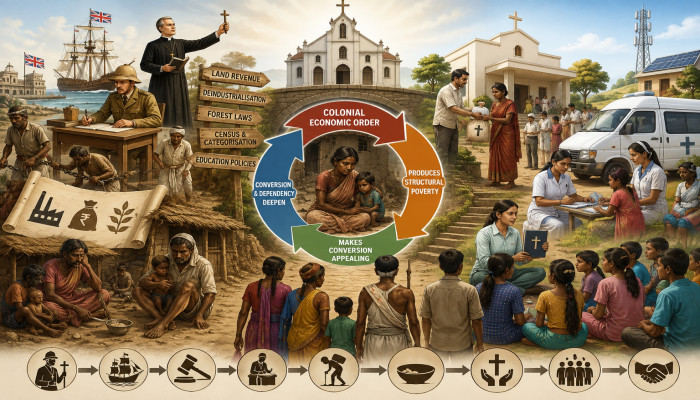
The two articles preceding this one traced how the Church supplied crucial ideological cover for British colonial rule, and how colonial economic policy de-industrialisation, land dispossession, and the imposition of a cash revenue system converted pre-existing ritual exclusion into the mass, structural poverty that came to define India's Depressed Classes. This final article completes the arc: it examines how the poverty legacy of that colonial economic order continues, nearly eight decades after Independence, to be the primary target of Christian conversion outreach in India using methods that mission scholars, courts, and even the Church's own global ecumenical leadership have identified and, in some cases, even explicitly condemned.
"Rice Christians": A Recognised Category, Not a Polemical Invention
It is sometimes suggested that the idea of poverty-driven conversion is a modern political accusation with no scholarly basis. The historical and academic record says otherwise. The term "Rice Christian" — describing converts whose primary motivation was material relief rather than religious conviction is a documented category in peer-reviewed mission history, not an invention of contemporary polemic. Scholarship on colonial South India, including Christhu Doss's 2014 study of conversion economics in the Madras Presidency and Chakali Chandra Sekhar's 2023 study of missionary relief during the Great Famine of 1876–78 in Rayalaseema, traces how missionary charitable relief during famine years produced identifiable spikes in baptism — the Church Missionary Society alone reportedly baptising over 23,500 converts across the Madras Presidency between 1877 and 1878, years of acute famine distress. This was not a fringe phenomenon later obscured by history; it was significant enough, and recognised enough within Christian missionary circles themselves, to generate its own descriptive vocabulary and sustained internal debate about missionary method.
That debate has not gone away with time; it has migrated into the Church's own contemporary governance documents. The World Council of Churches — Christianity's foremost global ecumenical body — issued a joint document in 2011, Christian Witness in a Multi-Religious World: Recommendations for Conduct, co-authored with the Vatican's Pontifical Council for Interreligious Dialogue and the World Evangelical Alliance, which states plainly that "the exploitation of situations of poverty and need has no place in Christian outreach," and warns that resort to "deception and coercive means" in evangelism betrays the gospel and causes suffering. This is, in effect, an admission from within global Christian leadership itself that the practice this series describes is real, recurrent, and serious enough to require an explicit ecumenical prohibition.
From Colonial Mass Movements to Present-Day Targeting
The specific communities targeted by twentieth- and twenty-first-century conversion outreach are, overwhelmingly, the same communities whose economic dispossession the previous article in this pair traced to colonial de-industrialisation and land settlement policy. The mass movements of 1870–1930 among the Malas and Madigas of the Telugu-speaking districts, the Chuhras of Punjab, and the Paraiyars of Tamil Nadu occurred, as the historical record shows, disproportionately during and immediately after periods of acute agrarian distress and famine, when the material relief missionaries could offer carried the greatest possible weight against a backdrop of colonial-manufactured destitution. That targeting pattern concentrated conversion outreach in India's poorest, most caste-marginalised, and least institutionally resourced communities has continued into the present, adapted to contemporary instruments of material assistance: free medical treatment, direct cash payments, access to education, and employment.
The pattern is not merely a matter of historical inference; it appears with striking regularity in contemporary Indian court records. In one case that reached the Allahabad High Court and, subsequently, the Supreme Court in 2025, a First Information Report recorded specific allegations against individuals connected to World Vision India and a mission hospital in Fatehpur, Uttar Pradesh, describing an approach in which a prospective convert was allegedly told that quitting Hinduism for Christianity would come with no cost to him personally, and would instead bring cash assistance, free medical treatment for his family, a job at an affiliated institution, and even help arranging marriage. Whatever the eventual judicial determination of any individual case, the structure of the allegation material inducement calibrated precisely to the vulnerabilities of poverty, ill health, unemployment, and family insecurity is the modern-day equivalent of the famine-relief conversions documented by mission historians a century and a half earlier.
What the Courts Have Said
Indian courts have engaged with this pattern directly and repeatedly, and their language is worth setting out precisely because it reflects judicial rather than polemical assessment. In Stanislaus v. State of Madhya Pradesh (1977), the Supreme Court upheld the constitutionality of state anti-conversion legislation, with the reasoning of the Madhya Pradesh High Court later affirmed capturing the core distinction the law has consistently drawn: organised conversion "by force or fraud or by providing help or allurement to persons, taking undue advantage of their poverty and ignorance, is anti-secular," because respect for all religions, not the intolerance implicit in planned conversion campaigns targeting the vulnerable, is what genuine secularism requires.
That reasoning has been revisited with renewed urgency in recent years. In late 2022, hearing a public interest petition on the enforcement of anti-conversion measures, a Supreme Court bench of Justices M.R. Shah and Hima Kohli described conversion achieved through force, allurement, or fraudulent means as a matter posing a potential danger to national security and to the constitutional right to freedom of religion and conscience, and directed the Union Government to place before the Court a considered response on the steps available to curb the practice. The Court was explicit that charitable and humanitarian assistance was not itself the concern, "if you believe that particular persons should be helped, help them, but it can't be for conversion," the bench observed — locating the constitutional problem precisely where the World Council of Churches' own 2011 document locates it: not in charity as such, but in charity deployed as an instrument of religious conversion among people whose poverty leaves them least able to resist the inducement.
This judicial concern has been translated into a substantial and growing body of state legislation. Beginning with Odisha's Freedom of Religion Act in 1967 and Madhya Pradesh's own Act the same year the statute at issue in Stanislaus case itself a succession of states have enacted comparable measures explicitly targeting conversion by force, misrepresentation, undue influence, coercion, or allurement: Tamil Nadu (2002, subsequently repealed), Gujarat (2003), Himachal Pradesh (2006), Rajasthan (2008), Jharkhand (2017), Uttarakhand (2018), and Uttar Pradesh (2020) among them. Whatever view one takes of the merits of any individual statute, their sheer number and geographic spread across nearly six decades reflect a consistent, cross-party, cross-regional legislative judgment that poverty-targeted religious conversion is a real and recurring phenomenon requiring statutory response — not a marginal or invented concern.
The Institutional Continuity: From Panchama Schools to FCRA-Funded Networks
The institutional mechanism has changed remarkably little in structure across a century and a half, even as its funding sources and legal form have modernised. Where nineteenth-century missions built Panchama schools, orphanages, and famine-relief stations financed by mission boards in Britain and North America, the contemporary equivalent is a network of hospitals, schools, and welfare organisations financed substantially through India's Foreign Contribution Regulation Act framework, several of which (Compassion International, World Vision India, and others) have had their registrations suspended or cancelled by Indian regulators over the past decade on grounds that included, in specific instances, the use of foreign-funded welfare activity for conversion purposes. Parliament's 2026 amendment to the FCRA, which explicitly bars the use of foreign contributions for religious conversion activity, is the direct statutory descendant of the same concern the Madhya Pradesh government's Niyogi Committee documented in its 1956 report on missionary methods, and that the Supreme Court itself articulated in 2022: that material assistance to India's poorest communities, when deliberately structured as an instrument of religious conversion, is not charity in the ordinary sense, but the twenty-first century continuation of a missionary strategy with roots reaching back to the famine-relief conversions of the 1870s.
The Deeper Irony
There is a historical irony worth stating plainly in closing this three-part examination. The poverty that has made and continues to make Scheduled Caste and Scheduled Tribe communities the primary target population for conversion outreach was not simply an unchanging fact of Hindu civilisation that the Church discovered and responded to with pure charity. As the second article in this series documented, that poverty was substantially manufactured within the colonial period itself, through a de-industrialisation and land-dispossession process that the Church's own theological and sociological framework — the Providential Theory of Empire, examined in the first article — helped legitimise as a benevolent civilising trust rather than an act of economic extraction. The contemporary Church's charitable and welfare work among these same communities today, whatever its sincere humanitarian content in individual instances, operates within a poverty landscape whose depth and permanence owes a great deal to the historical partnership between Church and Empire that this series has traced from its ideological foundations, through its economic mechanics, to its unmistakable continuities in the present day.
Anticipating the Objection: "This Unfairly Singles Out Christian Charity While Ignoring Genuine Need"
A fair objection to this article's argument is that India's Scheduled Caste and Scheduled Tribe communities have genuine, urgent, and well-documented material needs in health, education, and livelihood and that an argument focused on the conversion dimension of Christian welfare activity risks implying that such communities should not receive charitable assistance at all, or that every Christian hospital, school, and relief programme operating among them is presumptively suspect.
That is not this article's argument, and it is worth being explicit about the distinction the courts, the legislatures, and the World Council of Churches' own governance document all draw in the same place. Justice Shah's 2022 observation, "if you believe that particular persons should be helped, help them, but it can't be for conversion", is not a prohibition on charity; it is a prohibition on conditioning charity, explicitly or through calculated implication, on religious conversion. The Niyogi Committee's 1956 findings, similarly, did not conclude that missionary hospitals and schools should not exist; they concluded that inducement — education, healthcare, and financial assistance offered as leverage for conversion rather than as unconditional service — was a documented and problematic method requiring scrutiny. The distinction matters because it is the same distinction that allows this article to credit, without contradiction, both the genuine humanitarian record of institutions such as the historical Panchama schools and contemporary mission hospitals, and the equally well-documented pattern in which that same charitable infrastructure has, in specific and repeatedly litigated instances, been deployed as an instrument of religious conversion targeted at exactly the population least equipped to resist the inducement.
A Note on Scale and Proportion
It would also overstate this article's case to suggest that every act of conversion among India's Scheduled Caste and Scheduled Tribe communities today is the product of material inducement rather than genuine religious conviction, or that every Christian welfare organisation operating in these communities is engaged in the practices documented above. The Supreme Court's own 2022 proceedings proceeded on the basis that the Union Government itself was still in the process of gathering systematic state-level data on the scale of the phenomenon, an indication that even the state's own information base on this question remains a work in progress, not a settled statistical picture. What can be said with confidence, on the documented record assembled across this three-part series, is narrower and more precise: that poverty-linked conversion is a real, recurring, judicially and academically recognised phenomenon with a continuous documented history stretching from the famine conversions of the 1870s to litigated FIRs in 2022 and 2025; that the specific communities most exposed to it are disproportionately the same Scheduled Caste and Scheduled Tribe populations whose economic vulnerability has a substantially colonial economic origin, as the second article in this series documented; and that both Indian courts and the Church's own global leadership regard the practice, where it occurs, as illegitimate rather than as ordinary charitable outreach.
Conclusion
What this three-part examination has sought to establish is that the poverty which makes that conditioning effective concentrated overwhelmingly among India's Scheduled Caste and Scheduled Tribe communities has a specific, documented, and substantially colonial economic history, one in which the institutional Church was not a distant bystander but an active ideological and administrative participant. Any honest assessment of the present-day conversion debate, and of the demand examined throughout the companion five-part series to extend SC reservations to converts, has to begin from that full historical accounting not from a selective memory that credits the Church only with its charitable contributions while setting aside its role in legitimising the economic order that made those contributions so persuasive to the desperate.
Manufacturing Poverty: How Colonial Economic Policy Turned Artisan and Peasant Communities Into the "Depressed Classes" Part 2



 Loading...please wait
Comments