




Manufacturing Poverty: How Colonial Economic Policy Turned Artisan and Peasant Communities Into the "Depressed Classes" Part 2
- In Current Affairs
- 03:24 PM, Aug 05, 2026
- YagnaSri
Introduction
Untouchability existed in India long before the East India Company's flag was raised over Bengal; that much is not in dispute, and this article does not claim otherwise. But the sheer scale, permanence, and depth of landless destitution that came to define the communities colonial administrators eventually labelled "Depressed Classes" and, in the Madras Presidency, "Panchamas," was not simply an inheritance of pre-colonial social exclusion. It was substantially manufactured through the deliberate dismantling of India's rural manufacturing base, the commodification of land, and the imposition of a cash revenue system by colonial economic policy over a century and a half of British rule. This article traces that process and its direct link to the census categories examined in the companion article preceding it.
The Pre-Colonial Village Economy: More Than Landless Labour
It is a common and misleading assumption that the communities later classified as backward classes and untouchable were, before British rule, uniformly landless agricultural labourers with no independent economic base. In fact, pre-colonial rural India operated on a substantially integrated economy in which many lower-caste and outcaste communities held specialised, indispensable occupational roles beyond field labour. Weavers and spinners, communities such as the Julahas and Salias, were central to India's largest pre-colonial industry, handloom textile production, a trade so extensive that Indian cotton and silk goods were, before the Industrial Revolution, competitive exports to Europe itself. Leatherworking communities Chamars, Madigas, Mochis supplied tanning, harness-making, and water-lifting equipment essential to regional agriculture and trade. Blacksmiths, potters, rope-makers, and other village service communities rounded out a decentralised rural manufacturing economy that gave many of these communities an economic footing independent of their social position or caste status.
De-Industrialisation: The Destruction of the Native Manufacturing Base
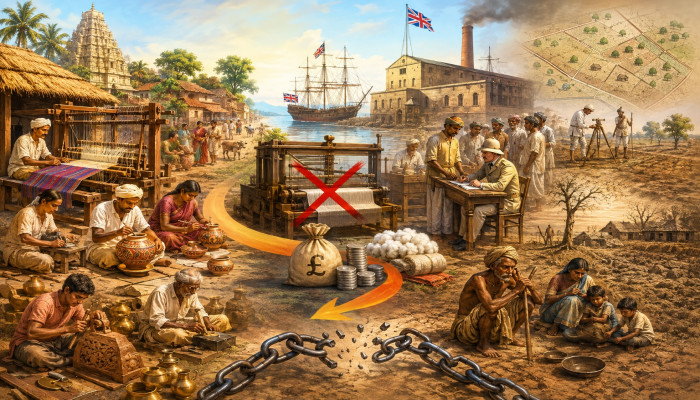
This economic footing was systematically destroyed over the first century of British rule. Following the East India Company's consolidation of political control and the imposition of imperial trade preferences favouring British manufactured goods, cheap machine-made textiles from Lancashire flooded Indian markets, undercutting handloom production on a scale traditional artisans could not withstand. The pattern was not confined to any one region or craft: within a few decades, millions of artisan households spinners, weavers, and allied trades lost their traditional livelihoods. This is among the best-documented facts of Indian economic history; it forms the empirical core of Dadabhai Naoroji's "drain of wealth" thesis, which argued, using the colonial government's own trade and revenue statistics, that Britain was systematically extracting Indian wealth through a combination of unfavourable trade terms, home-charges payments, and deliberate suppression of Indian manufacturing capacity in favour of British industry.
Displaced artisans, lacking the capital, land, or access to the new English-medium education system to transition into whatever limited modern industrial employment existed, had nowhere to go but into an already crowded agricultural labour market as landless wage labourers rather than as the independent artisans and village manufacturers and service specialists they and their families had been for generations.
Land Revenue Settlements: Turning Customary Rights Into Private Property
Compounding this industrial displacement was a parallel transformation of land tenure. Before British rule, village land in most of India was governed substantially by customary usage of communal grazing land, forest and wasteland access, and various forms of inam or service tenure rather than by the model of individual, transferable private property. The colonial state dismantled this system through a sequence of major land revenue settlements: the Permanent Settlement of 1793 in Bengal, which fixed land revenue in perpetuity and converted zamindars into hereditary landowners with wide powers over their tenants; the Ryotwari system, introduced progressively across the Madras and Bombay Presidencies from the 1820s under administrators such as Thomas Munro, which recognised the state as ultimate landowner and individual cultivators (ryots) as revenue-paying tenants; and the Mahalwari system, applied across much of North India from the 1820s and 1830s, which settled revenue with village or estate communities rather than individual cultivators.
Whichever specific model applied, the practical effect on communities was similar. Customary rights of cultivation, grazing, and access to communal wasteland the very "Panchama" lands later documented in the Tremenheere Report of 1891–92 were treated as legally unrecognised under the new property regime and were routinely absorbed by dominant landholding castes or auctioned to maximise state revenue. The high, fixed cash revenue demands imposed under these settlements pushed even landholding peasant castes into debt; that financial pressure was, in turn, passed further down the social hierarchy onto lower-caste agricultural labourers, through depressed wages, reduced grain shares, and, in many regions, various forms of unpaid or underpaid forced labour historically described as begar.
From Displacement to Bondage: The Rise of Landless Debt Labour
The combined effect of industrial displacement and land dispossession was the emergence, for the first time at this scale in Indian history, of a large, permanent class of purely landless rural wage labourers, with agricultural labour supply now vastly outstripping demand. High revenue burdens and the recurring famines of the colonial period, themselves substantially aggravated by colonial land-revenue policy and grain-export practices, as later economic historians including Amartya Sen have documented, forced these already vulnerable households into borrowing from village moneylenders and landlords to survive. Lacking any collateral beyond their own labour, they pledged themselves and their families into generational debt bondage, a pattern documented across the country under various regional names: the Halpati system in Gujarat, forms of bonded agricultural labour recorded across the Telugu-speaking districts of the Madras Presidency, and the Sagri system recorded in parts of Bihar, among other regional variants.
This transformation was accelerated by the colonial insistence that land revenue and rents be paid in cash rather than, as had traditionally often been the case, in a share of the harvest. This monetisation disrupted the reciprocal, locally calibrated jajmani exchange system that had previously governed relations between landholding and service castes in many villages, and left lower-caste labourers newly dependent on cash wages that consistently failed to keep pace with rising food prices during the recurrent famines of the eighteenth and nineteenth centuries.
Administrative Labelling: From Economic Catastrophe to Sociological Category
By the time the colonial administration began its decennial census operations from 1881 onward, and began formulating administrative welfare lists in the early twentieth century, it confronted a vast population marked by extreme poverty, illiteracy, landlessness, and social exclusion — the direct, compounding product of de-industrialisation and land dispossession layered atop pre-existing ritual exclusion. The administrative response was to classify this population through a predominantly sociological and religious lens "Panchamas" in the Madras Presidency of the 1890s, "Depressed Classes" in early twentieth-century reports, and eventually "Scheduled Castes" under the Government of India Act, 1935 and the 1936 Order without correspondingly acknowledging that colonial economic policy itself had been a primary engine of the very landlessness and poverty being catalogued and administratively labelled.
This is not a marginal observation. It means that the disability the colonial and later constitutional state set out to remedy through protective classification was a disability the same colonial state's economic policy had itself deepened over the preceding century. In the case of Communities suffering from untouchability, the pre-existing social fault line was supplied; colonial de-industrialisation and land settlement policy converted that fault line into permanent, structural mass poverty.
The Missionary Narrative and the Question of Blame
It is at precisely this point that the Church's sociological framing, discussed in the companion article to this one, becomes most consequential. Missionary literature of the period, describing the destitution of Depressed Classes communities for British and American readerships, routinely attributed that destitution to indigenous factors caste restriction, religious fatalism, and “want of moral character” rather than to the exploitative tariff structures and deliberate deindustrialisation that then dismantled India's own manufacturing economy. This was not necessarily conscious deception in every instance; many missionaries genuinely believed the moral-failure explanation for the poverty they observed around them. But the effect, whatever the intent, was to mask the colonial economic causation of the very poverty missionary charitable work then addressed allowing famine relief, education, and land advocacy (each, individually, often a genuine humanitarian contribution, as the Tremenheere-influenced Panchama land grants of the 1890s demonstrate) to be publicly framed as evidence of Western benevolence correcting native “moral failure”, rather than as a minuscule remediation of a massive crisis created by British colonial and economic administration itself.
Regional Evidence: The Textile Districts and the Chingleput Record
The abstraction of "de-industrialisation" can obscure how concentrated and severe its impact was in specific regions whose lower-caste populations later formed the core of the Depressed Classes category. Bengal's handloom weaving districts, among the most productive textile-manufacturing regions in the pre-colonial world, saw their export markets collapse within a few decades of the imposition of British tariff preferences and the flooding of Indian markets with Lancashire cloth; contemporary British administrators themselves documented the resulting distress among weaving communities in terms stark enough that the phrase "the bones of the cotton-weavers are bleaching the plains of India" is widely, if perhaps apocryphally, attributed to a mid-nineteenth-century Governor-General's report on the subject.
In the Madras Presidency specifically, the same region examined in the Tremenheere Report of 1891–92, the Depressed Class communities the report documented as landless and destitute were, in substantial part, precisely the population displaced from customary wasteland use by the Ryotwari settlement's redefinition of land rights a half-century earlier. The chronology matters: Tremenheere was not describing a static, ancient condition when he reported on the Pariahs of Chingleput in the early 1890s; he was describing the accumulated end-state of roughly seventy years of Ryotwari land settlement operating on top of pre-existing social exclusion.
Anticipating the Objection: "Untouchability Predates Colonialism and Would Have Produced Poverty Regardless"
A serious objection to the argument of this article is that untouchability and the social exclusion it entailed denial of temple entry, well access, and land ownership long predate British rule, and that lower-caste communities were therefore likely to have remained economically marginal under any political dispensation, colonial or indigenous. This is a fair point as far as it goes, and this article has been careful throughout not to claim that pre-colonial India was a condition of rough economic parity disrupted only by British arrival. But as Dharma Pal’s books and various British reports clearly show, the Sudra and other backward communities were not educationally deprived as they were portrayed later on and contended even today.
But the objection understates the specific character of the change colonial policy introduced. Pre-colonial social exclusion on some communities operated primarily through restricted access to temple worship, and certain public spaces and real and serious disabilities, but disabilities that coexisted, as this article has shown, with meaningful occupational independence for many lower-caste artisan communities, whose skills gave them a recognised place within the village economy. What colonial policy added was not a continuation of that pattern but a qualitatively different one: the wholesale destruction of the occupational base itself, through tariff-driven de-industrialisation, followed by the legal reclassification of customary land access as unrecognised under the new private-property regime. The resulting landless wage-labour class — permanent, generationally inherited, and vastly larger in scale than anything the pre-colonial economy had produced was a specifically colonial-era phenomenon layered onto, and substantially worsening, the pre-existing ritual exclusion rather than a simple continuation of it. The distinction is not a minor historiographical nicety; it is the difference between treating the Depressed Classes' poverty as an unchanging fact of Indian civilisation and recognising it, accurately, as a compounded product of colonial economic policy acting together with social backwardness.
Conclusion
The communities that the colonial state eventually scheduled as Depressed Classes, and that independent India's Constitution would go on to protect through Article 341, did not arrive at that condition of mass landlessness and poverty through caste stigma alone. They arrived there through a two-fold structure: pre-existing social backwardness, compounded by a full century of deliberate colonial economic extraction and de-industrialisation that destroyed independent artisan livelihoods, and land revenue settlements that stripped customary cultivators of their traditional rights and converted communal resources into private, revenue-yielding property. Understanding this economic history matters directly for the argument this series has made throughout: the poverty and backwardness that Christian mass-movement conversions of the same period addressed, and that the contemporary Church continues to invoke in its conversion outreach today, was not simply an ancient, unchanging fact of Hindu social organisation. It was, to a very substantial degree, manufactured within living historical memory by the same colonial economic and administrative order that the Church, as the previous article showed, provided crucial moral legitimacy to sustain. The final article in this pair turns to how that same poverty now, in most cases, several generations removed from its colonial origins but still concentrated overwhelmingly among the same Backward Classes, Scheduled Caste and Scheduled Tribe communities, continues to be targeted through remarkably similar methods by the contemporary Church.
Providence, Not Plunder: How the Church Supplied the Moral Architecture for British Rule in India Part 1
Disclaimer: The opinions expressed within this article are the personal opinions of the author. MyIndMakers is not responsible for the accuracy, completeness, suitability, or validity of any information on this article. All information is provided on an as-is basis. The information, facts or opinions appearing in the article do not reflect the views of MyindMakers and it does not assume any responsibility or liability for the same.



 Loading...please wait
Comments