




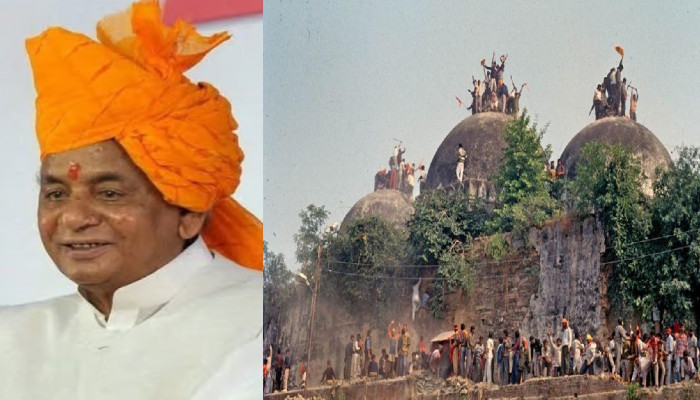
Kalyan Singh occupies a unique place in the political history of Uttar Pradesh and, by extension, in the history of Hindu civilisation's democratic assertion in modern India. A man of humble origins from the Lodh community of western UP, Kalyan Singh rose through the BJP's organisational ranks to become the Chief Minister who presided over the most consequential single event in post-independence Hindu political history: the demolition of the Babri Masjid and the reclamation of the Ram Janmabhoomi site on December 6, 1992. Whether one views that event as the fulfilment of a civilisational aspiration or as a breach of constitutional order, the BJP and its supporters have consistently argued that it was the former. Kalyan Singh's role in it was central, and his decision to accept political martyrdom rather than deploy force against the assembled Hindus defines both his character and the BJP's political tradition at its most consequential.
From Lodh Community to BJP Leadership: A Democratic Journey
Kalyan Singh's rise within the BJP was itself a significant political statement. The Jana Sangh and its early BJP incarnation had been primarily associated with the upper-caste trading communities of UP's cities, the Banias, Brahmins, and Kayasthas, who had provided the organisational backbone of the RSS's UP network. The emergence of a Lodh leader from one of the most numerous but historically subordinated OBC communities in western UP to the Chief Ministership signalled the BJP's evolution beyond its upper-caste social base.
Kalyan Singh had spent decades building his political presence in the Aligarh-Hathras belt of western UP, where the Lodh community formed a significant portion of the rural population. His organisational skills, his ability to communicate directly with ordinary people in their own idiom, and his personal reputation for integrity and courage made him the natural choice when the BJP needed to demonstrate that its culturally nationalist politics could transcend caste boundaries. His selection as Chief Minister after the 1991 landslide was not merely a reward for organisational work but a deliberate signal: the Hindu nationalist project was not an upper-caste project, and its leadership reflected the full breadth of Hindu society.
The 1991 Mandate: Governance with Cultural Conviction
Kalyan Singh's government, which took office in June 1991, faced an extraordinary challenge: governing a state of 130 million people while managing the most politically charged religious movement in post-independence India. The two tasks were not entirely separable: the same popular sentiment that had delivered the BJP's historic majority was also generating unstoppable pressure on the Ram Mandir front, but they required different skills and different calculations.
On the governance front, Kalyan Singh's administration demonstrated that cultural nationalism and developmental commitment were not incompatible. His government moved quickly on law and order, a priority given UP's descent into criminal anarchy under previous administrations. It made early attempts to address the administrative corruption and bureaucratic indiscipline that had accumulated over decades of Congress and Janata Dal misrule. Industrial investment, agricultural support, and infrastructure development were placed on the agenda with an energy that UP had not seen for years.
Kalyan Singh's approach to governance reflected a core BJP conviction that would find full expression only in the Yogi Adityanath era decades later: that good governance and Hindu cultural commitment are not in tension but are expressions of the same fundamental value system the dharmic conviction that the ruler's primary obligation is to the welfare of the ruled, and that this obligation is best fulfilled through honest, efficient, and firm administration. The 'double engine' concept that the BJP later deployed as electoral rhetoric had its organisational and intellectual roots in the Kalyan Singh era.
The Countdown to December 6: The Impossible Commitment
As 1992 progressed and the VHP's pressure for Karseva at the disputed site intensified, Kalyan Singh found himself in an increasingly impossible position. His government had assured the Supreme Court and the central government that it would protect the disputed structure; the same government was politically dependent on a mass movement demanding the opposite. The tension between constitutional obligation and political reality was irreconcilable, and Kalyan Singh knew it.
The central government under P.V. Narasimha Rao, a government later harshly criticised for failing to anticipate and prevent the events of December 6, received intelligence reports that made the situation's volatility clear. The Rao government's inaction in the days and hours before December 6, and its subsequent decision to impose President's Rule in UP in the aftermath, have drawn extensive historical analysis. The most credible interpretation is that Rao, himself a man of complex religious sensibilities and considerable political calculation, was not entirely displeased by the direction of events while maintaining plausible deniability.
On the morning of December 6, 1992, a crowd estimated at between 150,000 and 300,000 Karsevaks had assembled in Ayodhya. The security arrangements the Kalyan Singh government had put in place proved, by design or circumstance, entirely inadequate to protect the disputed structure. In the early afternoon, groups of young men began climbing the domes of the Babri Masjid. Within hours, using iron rods, hammers, and their bare hands, the crowd demolished the three-domed structure. By evening, a makeshift temple to Ram stood at the site.
The Aftermath: Resignation, President's Rule, and the Verdict of History
Kalyan Singh resigned as Chief Minister immediately after the demolition, accepting personal responsibility for the failure to protect the structure despite the government's assurances to the Supreme Court. His resignation was not a political manoeuvre but a statement of personal honour: he had given an undertaking, and it had not been fulfilled, and he took the consequences. The Supreme Court imposed President's Rule in UP; it dismissed the Kalyan Singh government.
The legal consequences followed Kalyan Singh for decades: the Supreme Court held him in contempt of court for failing to protect the structure, and sentenced him to one day's imprisonment and a fine. He accepted the sentence with dignity. The criminal cases arising from December 6, in which Kalyan Singh was among the accused, wound through the courts for almost three decades before being decided. In 2020, the CBI special court acquitted all 32 accused, including Advani, Joshi, Uma Bharati, and Kalyan Singh, finding insufficient evidence to establish criminal conspiracy.
The Supreme Court's verdict in the Ayodhya title suit in November 2019 was the most authoritative legal resolution of the Ram Janmabhoomi question. The court's five-judge unanimous bench found that the Hindu side had established a better legal claim to the disputed land and directed the central government to hand over the land to the deity Ram Lalla. The mosque's demolition was described as a breach of law, but the land award went to the temple. In a way, it vindicated the movement's core claim while condemning the method of its final resolution.
Kalyan Singh's Legacy: The OBC Chief Minister Who Changed History
Kalyan Singh's place in UP's political history cannot be reduced to any single dimension. He was the first OBC Chief Minister of UP, the leader who showed the BJP could govern the state and not merely oppose the Congress, and the man who presided over December 6 and bore its consequences with a personal dignity his critics could not diminish. His subsequent political career, which included a period outside the BJP, a reconciliation, and eventually the Governorship of Rajasthan, was less consequential than his years in power. Still, it reflected the complexity of a man whose political convictions were genuine even when his organisational choices were complicated.
His death in 2021 was mourned across the Hindu nationalist movement as the passing of a leader whose life embodied the movement's foundational conviction: that the claims of Hindu civilization on India's democratic politics are not the special pleading of a privileged majority but the democratic assertion of a civilisation that has an organic relationship with the land, the rivers, the temples, and the sacred geography of Bharatvarsha. Kalyan Singh, the wrestler's son from Atrauli, the Lodh leader from western UP, the Hindu Hriday Samrat, carried that conviction from the shakha grounds of Aligarh to the Chief Minister's office in Lucknow, and the mark he left on Indian political history is permanent.
The Dark Chapter of 1990: The Massacre of Ram Devotees under the Mulayam Singh Government Part 12
Disclaimer: The opinions expressed within this article are the personal opinions of the author. MyIndMakers is not responsible for the accuracy, completeness, suitability, or validity of any information on this article. All information is provided on an as-is basis. The information, facts or opinions appearing in the article do not reflect the views of MyindMakers and it does not assume any responsibility or liability for the same.



 Loading...please wait
Comments