




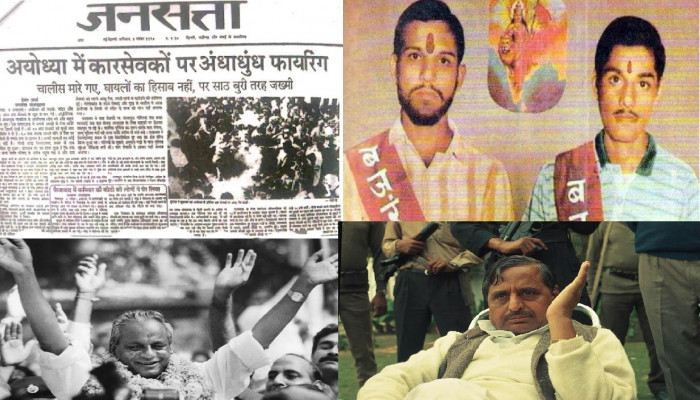
October 30, 1990, is a date that is seared into the collective memory of Hindus across Uttar Pradesh and India — though the mainstream secular establishment has done its best to ensure that it remains in historical obscurity. On that day, in the city of Ayodhya, thousands of unarmed Hindu Karsevaks — volunteers who had gathered to perform symbolic service (kar seva) at the Ram Janmabhoomi site — were fired upon by the Uttar Pradesh Police acting under the explicit orders of Chief Minister Mulayam Singh Yadav. The death toll remains disputed to this day: the official government figure was a handful; eyewitnesses and community organisations counted the dead in the dozens, some claiming over a hundred. Whatever the precise number, the moral reality of what happened at Ayodhya on October 30 and November 2, 1990, is unambiguous: unarmed citizens exercising their democratic right to peaceful assembly were killed by their own government for the political benefit of a Chief Minister who had decided that their lives were an acceptable price for retaining his Muslim vote bank.
The Mulayam Singh Government: Context and Character
Mulayam Singh Yadav had come to power in UP in December 1989, leading a Janata Dal government supported from outside by the BJP and the BSP. His ascent represented the culmination of the Yadav political mobilisation that had been building since the 1960s: the son of a small farmer from Etawah district, with no formal education beyond high school, Mulayam had constructed his political career through a combination of physical courage — he had been a wrestler — organisational tenacity, and skill at building the Yadav community's political consciousness.
Mulayam's political identity was defined by its opposition to what he called 'Manuvadi' — the ideology of Brahminical upper-caste dominance — and by his cultivation of Muslim support as a counterweight to Hindu nationalist mobilisation. His political strategy was simple and, for a time, highly effective: consolidate the Yadav vote through community solidarity, secure the Muslim vote through demonstrative opposition to the BJP and the Ram Mandir movement, and use this M-Y (Muslim-Yadav) coalition as the social base for political dominance.
By October 1990, with the Rath Yatra having mobilised hundreds of thousands of Hindus and the BJP's external support to his government already a source of political tension, Mulayam Singh faced a political crisis. The announced Karseva in Ayodhya on October 30 directly challenged his authority: if he allowed it to proceed, he would be seen as capitulating to Hindu nationalist demands and would lose his Muslim vote bank; if he suppressed it by force, he would demonstrate his seriousness as a secular leader. He chose suppression with a comprehensiveness that shocked even his own political supporters.
The Run-Up: Curfew, Prohibitory Orders, and the Gathering of Pilgrims
The Mulayam Singh government had imposed Section 144 (prohibitory orders) across Ayodhya and the surrounding districts well before October 30. The entire city was converted into a fortress: tens of thousands of police personnel were deployed, railway stations were sealed, roads leading to Ayodhya were blocked, and a massive security cordon was established around the Ram Janmabhoomi site. The government's stated intention was to prevent any Karseva that might damage the disputed structure or provoke communal violence.
Against this backdrop, hundreds of thousands of Karsevaks from across India made their way toward Ayodhya by whatever means available—on foot, by bicycle, through fields and forests, disguised as pilgrims, hiding in trucks, and crossing the Saryu River by boat at night. Their determination was extraordinary: confronted with the full machinery of state repression, they continued to converge on the sacred city because they genuinely believed that performing kar seva at their Bhagwan’s birthplace was a religious duty that superseded the government's prohibitory orders. This was, in its own way, an act of civil disobedience in the tradition of Thoreau and Gandhi — the refusal to comply with a law that the conscience deems unjust.
The Firing: What Happened on October 30 and November 2
The first firing on Karsevaks took place on October 30. Groups of volunteers who had penetrated the security cordon and reached the vicinity of the Babri Masjid-Ram Janmabhoomi site were confronted by police. When they refused to disperse, the police opened fire. The scenes that followed — documented by journalists despite the government's attempts to restrict media access — were of uniformed police shooting at unarmed men in devotional attire, running through the narrow lanes of an ancient temple town.
November 2 saw further firing when a second group of Karsevaks, who had gathered in defiance of the continued prohibitory orders, were again confronted by security forces. The deaths of Kothari brothers — Ram and Sharat Kumar Kothari from Mathura — became among the most symbolically significant of the entire episode. Their bodies, photographed lying in the lanes of Ayodhya, their devotional attire soaked in blood, became the iconic images of the government's brutality. The VHP and BJP published these photographs widely; they became recruitment posters for a generation of Hindu nationalist activists.
Mulayam Singh Yadav's public response to the killings was remarkable in its brazenness. Rather than expressing regret or ordering an inquiry, he celebrated the action as a necessary defence of the Constitution and secular values. His nickname 'Maulana Mulayam' — conferred mockingly by BJP leaders but worn almost as a badge of honour in his political communication with Muslim audiences — dates from this period. The message to his political base was unambiguous: this government would use force to protect Muslim interests against Hindu nationalist demands.
The Political Aftermath: Martyrdom, Memory, and Mobilisation
The killings at Ayodhya had the opposite political effect from what Mulayam Singh intended. Rather than intimidating the Ram Janmabhoomi movement into retreat, they transformed it. The Karsevaks who had been killed became martyrs — their deaths invested the movement with a moral seriousness that purely political agitation could never have achieved. The VHP and BJP's organisational machinery mobilised around the martyrs' memory with extraordinary effectiveness. Condolence meetings, observances, and commemorations were held in thousands of towns and villages across UP and northern India; each one reinforced the narrative that the Hindu devotee had been targeted by a government that valued Muslim votes above Hindu lives.
The electoral consequence was swift and decisive. In the 1991 UP Assembly elections, held in the shadow of Ayodhya, the BJP under Kalyan Singh swept to a historic majority. The party won 221 seats — an absolute majority in the 425-member Assembly — on a vote share of over 31 per cent. Mulayam Singh's Janata Dal fell to a distant third. The voters of UP had delivered their verdict on the government that had fired on Ram devotees at Ram's birthplace: it was among the most conclusive electoral repudiations in UP's democratic history.
The Secular Establishment's Silence: A Study in Double Standards
Perhaps the most revealing aspect of the 1990 Ayodhya firings is what the secular establishment did not do in their aftermath. The same commentators, academics, and political leaders who would claim profound moral outrage at any incident of anti-minority violence were conspicuously silent about the state-sanctioned killing of Hindu pilgrims at their most sacred site. No national human rights commission investigated the death toll—no prime-time editorial called for the Chief Minister's resignation. No PIL was filed in the Supreme Court demanding accountability for the killings.
This silence was not accidental. It reflected the structural bias of India's secular consensus: violence against Hindus by secular governments in defence of pseudo-secular politics was acceptable; violence against minorities was unconscionable. The asymmetry was not merely hypocritical but actively dangerous, because it sent a clear message to political entrepreneurs like Mulayam Singh: you can kill Hindu pilgrims and suffer no political cost from the national establishment. Only the BJP would hold you accountable — and that accountability would come from the people of UP through the democratic process.
The 1990 firings at Ayodhya remain a largely suppressed chapter of Indian political history. No government has conducted a proper inquiry; no official memorial marks the site of the killings; no school textbook mentions the Karsevaks who died. The BJP's consistent commemoration of these martyrs and its insistence on their place in the historical record is not merely political point-scoring — it is a necessary assertion that the lives of Hindu citizens have the same democratic and moral worth as the lives of any other community. That state violence against them demands the same accountability as state violence against any other.
Cultural Renaissance: The Ram Janmabhoomi Movement and L.K. Advani's Historic Rath Yatra Part 11
https://myind.net/Home/viewArticle/cultural-renaissance-the-ram-janmabhoomi-movement-and-lk-advanis-historic-rath-yatra-part-11
Disclaimer: The opinions expressed within this article are the personal opinions of the author. MyIndMakers is not responsible for the accuracy, completeness, suitability, or validity of any information on this article. All information is provided on an as-is basis. The information, facts or opinions appearing in the article do not reflect the views of MyindMakers and it does not assume any responsibility or liability for the same.



 Loading...please wait
Comments