


The Hidden Hand: External Interference in India since 1947, Seventy-Nine Years in Three Phases Part 3
- In Current Affairs
- 08:51 PM, Oct 27, 2026
- YagnaSri
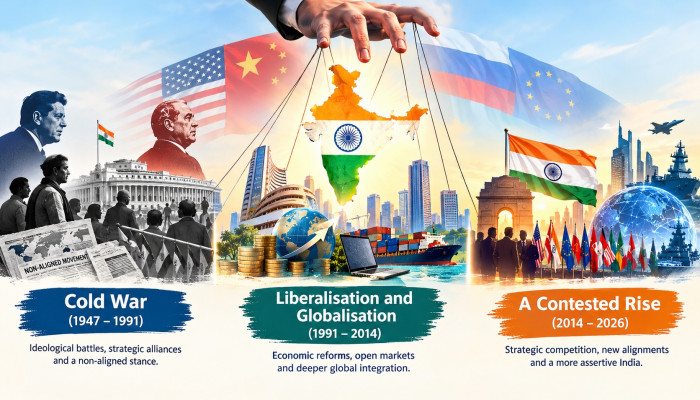
The methods of foreign interference in India have changed with the times: from suitcases of roubles to short-sellers' reports, and from tribal raiders to online honey-traps. The aims have changed much less. This article divides the seventy-nine years since Independence into three phases, each defined by a change in India's place in the world: the Cold War (1947–1991), liberalisation and globalisation (1991–2014), and a contested rise (2014–2026). For each phase, it identifies the principal foreign actors, their methods and India's response. It concludes that three features have remained constant: Pakistan's hostility, the use of money as the main instrument, and the dependence of every foreign effort on Indian partners.
Introduction: why Periodise?
Historians divide time into periods to make change visible. A period is useful when conditions within it are broadly similar and clearly differ from those before and after.
Three events divide India's experience of foreign interference since 1947. The first is the end of the Cold War and the 1991 balance-of-payments crisis, which together ended the superpower contest for India and opened its economy to the world. The second is the change of government in May 2014, which brought a markedly firmer approach to foreign funding, terrorism and China. The third, still unfolding, is India's emergence as a major economy and military power, which has drawn sharper scrutiny and pressure from abroad.
The dates are not walls. Pakistan's proxy war, for example, runs through all three phases. But each phase has a distinct character, and the distinction helps explain why the methods changed.
For its first four decades, independent India pursued non-alignment abroad and a planned, largely closed economy at home. It refused to join either Cold War bloc. That choice kept India free. It also made India a prize both blocs competed for within India itself.
The domestic setting helped them. One party, the Congress, dominated Indian politics, with a significant communist opposition in Kerala and West Bengal. The press was influential but financially weak. Socialist ideas strongly shaped intellectual life—and each of these features created openings.
Files copied by KGB archivist Vasili Mitrokhin and published in 2005 record that the KGB had ten Indian newspapers and a press agency on its payroll by 1973, and claimed to have planted 3,789 articles in Indian newspapers in 1972. They record that a trading company set up by the Communist Party of India to deal with the Soviet Union had contributed over one crore rupees to party funds by 1972.[1] (Grade B.)
On the other side, Daniel Patrick Moynihan, the American Ambassador from 1973 to 1975, wrote that the United States had twice funded the Congress party to prevent communist victories in state elections in Kerala and West Bengal.[2] (Grade B.) Archival research by the historian Paul McGarr has shown that Britain and the United States ran covert anti-communist programmes in Kerala in 1959, with the knowledge of senior Indian officials.[3] (Grade B.)
Both sides also worked through culture, because culture shapes the views of those who shape policy. The Indo-Soviet Cultural Society, peace committees and friendship societies spread Soviet views. Soviet publishing houses supplied cheap books in many Indian languages, which shaped a generation of readers. On the other side, the Congress for Cultural Freedom, secretly funded by the CIA, had an Indian branch from 1951 and published the journal Quest. The CIA's funding of the Congress for Cultural Freedom worldwide was exposed in 1966–67 and later admitted.[4] (Grade A.)
The espionage cases of this period reached the top of the State. In January 1985, authorities found a spy ring inside the Prime Minister's Office, passing papers to French and Eastern Bloc diplomats through businessman Coomar Narain. In 1987, K.V. Unnikrishnan, head of the Research and Analysis Wing's office in Madras, was exposed as an asset of the CIA, compromised through a honey-trap. (Grade A.) Article 4 examines these cases.
Pakistan fought India openly in 1947–48, 1965 and 1971. In each war, it also used irregulars and infiltrators. In 1947, tribal lashkars led by Pakistani officers invaded Jammu and Kashmir. In 1965, trained infiltrators entered the Kashmir valley under Operation Gibraltar. After its defeat in 1971 and the creation of Bangladesh, Pakistan turned increasingly to proxy war. In the 1980s, it backed Khalistani militants in Punjab. From 1989, it backed the armed insurgency in Jammu and Kashmir, which drove most of the Kashmiri Pandits from the valley in 1990. Module 3 examines this record.
China invaded India in 1962. In the 1960s and 1970s, it armed and trained Naga and Mizo insurgents, who travelled to Yunnan through Burma for training. The Communist Party of India split in 1964, partly over the question of loyalty to China, and the Union Government detained several leaders regarded as pro-Chinese during the 1962 war. (Grade B.)
The Cold War also brought open external pressure at moments of crisis. In December 1971, during the war for the liberation of Bangladesh, the United States sent a naval task force led by the aircraft carrier USS Enterprise into the Bay of Bengal. India had signed a Treaty of Peace, Friendship and Cooperation with the Soviet Union in August 1971. These were acts of open diplomacy and power, not covert interference, but they show how fully India's security was entangled in the superpower contest.
India's legal response in this phase was limited. Parliament enacted the first Foreign Contribution (Regulation) Act in 1976, during the Emergency, out of stated concern that foreign money was influencing Indian politics. The Act barred foreign contributions to candidates, legislators, political parties, judges, government servants and journalists. Its enforcement was weak. The Intelligence Bureau's 1967 study of foreign money in elections was never published.
The defining feature of this phase was competition between the superpowers for India's alignment, carried out through money, the press and political parties, alongside Pakistan's open and covert wars.
Phase Two: liberalisation and globalisation (1991–2014)
The 1991 balance-of-payments crisis changed India's position. With reserves sufficient for only a few weeks of imports, the Reserve Bank of India pledged 46.91 tonnes of gold with the Bank of Japan and the Bank of England in July 1991 to raise a loan of about US$405 million.[5] (Grade B.) The Government then opened the economy to foreign trade and investment.
The Soviet Union dissolved in December 1991. The superpower contest for India ended. New forms of influence took its place.
Openness brought prosperity. It also gave foreign actors new levers. International rating agencies, which had sharply downgraded India in 1991, gained lasting influence over its borrowing costs. Foreign portfolio investors gained influence over its stock markets. Foreign corporations gained access to its policy-makers.
The Enron affair illustrates the new methods. In January 1995, an Enron executive told the United States Congress that the company had spent US$20 million on the "education" of Indians about its Dabhol power project in Maharashtra.[6] (Grade B.) The American, British and French Governments pressed India to honour the project. Article 23 examines this and later cases of corporate pressure.
India's nuclear tests at Pokhran in May 1998 brought open economic sanctions from the United States, Japan and others. These were public pressure measures, not covert interference, and most were lifted within a few years.
Foreign funding of Indian voluntary organisations grew rapidly in this phase. Most of it supported genuine work in health, education and disaster relief. A part of it funded campaigns against major projects and large-scale religious conversion. In February 2012, Prime Minister Manmohan Singh told Science magazine that the nuclear programme had "got into difficulties because these NGOs, mostly I think based in the United States", did not appreciate India's need for energy.[7] (Grade A, as the Prime Minister's own statement.) In June 2014, an Intelligence Bureau report named foreign donors behind campaigns against nuclear power, coal, mining and genetically modified crops. Parliament replaced the 1976 law with the Foreign Contribution (Regulation) Act, 2010.
Pakistan's proxy war reached its most violent level in this phase.
|
Year |
Event |
Killed |
|---|---|---|
|
1993 |
Mumbai serial blasts |
257 |
|
1999 |
Kargil intrusion by Pakistani soldiers disguised as militants |
527 Indian service personnel |
|
1999 |
Hijacking of Indian Airlines flight IC-814 to Kandahar |
1 passenger |
|
2001 |
Attack on Parliament |
9, besides the attackers |
|
2002 |
Attack on the Akshardham temple, Gandhinagar |
33 |
|
2006 |
Mumbai suburban train blasts |
189 |
|
2008 |
Mumbai attacks |
166 |
The figures come from official statements and judgments. Pakistan's lobbying front in Washington, the Kashmiri American Council, operated throughout this period, until its head pleaded guilty in 2011 to concealing ISI funding.[8] (Grade A.)
China became one of India's largest trading partners. It began building influence through trade and links with Indian institutions. In August 2008, the Congress party signed a memorandum of understanding with the Communist Party of China on exchanges and consultations. The Rajiv Gandhi Foundation's annual report for 2005–06 listed the Embassy of the People's Republic of China among its donors. (Grade B.)
The defining feature of this phase was the opening of the economy and civil society, which multiplied the channels through which foreign money and influence could flow. At the same time, terrorism from Pakistan reached its height.
Since 2014, India has become one of the world's largest economies. In August 2025, S&P Global raised India's sovereign rating for the first time in eighteen years. India's rise has been accompanied by a much firmer response to interference, and by sharper pressure from abroad.
The Government tightened control of foreign funding. More than 16,000 organisations lost their registrations under the foreign contribution law between 2015 and 2024, most for failing to file returns.[9] (Grade B.) The Foreign Contribution (Regulation) Amendment Act, 2020, banned transferring foreign funds from one organisation to another. The Supreme Court upheld the amendments in Noel Harper v Union of India in April 2022. (Grade A.)
The Government also banned the Popular Front of India and its affiliates in September 2022 and Sikhs for Justice in 2019. After the Galwan clash in June 2020, it banned hundreds of Chinese apps and required government approval for investment from countries sharing a land border with India. It answered major terrorist attacks with cross-border strikes: the surgical strikes of September 2016, the Balakot air strike of February 2019 and Operation Sindoor in May 2025. On 1 April 2026, the Union Home Ministry announced that India was free of Naxal violence.
At the same time, a wider set of foreign actors began to portray India's democracy as in decline and Hindu nationalism as a threat.
-
In March 2021, Freedom House downgraded India from "Free" to "Partly Free", and Sweden's V-Dem Institute classified it as an "electoral autocracy". Article 22 examines these indices.
-
In January 2020, the financier George Soros described India as the "biggest and most frightening setback" for open societies. In February 2023, after the American short-seller Hindenburg Research published a report that wiped close to US$150 billion off the Adani Group's market value, he predicted "a democratic revival in India". Articles 18 and 19 examine these events.
-
Foreign media, campus conferences such as "Dismantling Global Hindutva" in September 2021, United Nations human rights offices and the United States Commission on International Religious Freedom added their voices. Articles 30 and 31 examine them.
Interference tools also moved online. Pakistani operatives now use fake social media profiles to entrap defence scientists and engineers. A BrahMos Aerospace engineer was convicted in June 2024 for passing information to such handlers. Chinese-linked loan apps and phone makers have faced money laundering cases. The explosion near the Red Fort in Delhi on 10 November 2025 revealed a terrorist cell of educated professionals linked to Jaish-e-Mohammed.
The defining feature of this phase is a contest of narratives, fought through indices, media, campuses and international bodies, alongside the continuing proxy war. One central question this series examines is whether the convergence of foreign criticism is coordinated or simply parallel. So far, the evidence points to convergence, not a single plan.
What changed, and what did not
|
Phase |
Main foreign actors |
Main methods |
India's main response |
|---|---|---|---|
|
1947–1991 |
Soviet Union, United States, Britain, Pakistan, China |
Secret party funding, planted stories, cultural fronts, espionage, open war, proxy insurgency |
Non-alignment; first foreign contribution law (1976) |
|
1991–2014 |
Pakistan, Western donors and corporations, rating agencies, China |
Proxy terror, NGO funding, market and rating pressure, corporate lobbying |
New anti-terror and money laundering laws; Foreign Contribution (Regulation) Act, 2010 |
|
2014–2026 |
Pakistan, China, global finance, foreign media, academia, indices and international bodies |
Proxy terror, economic leverage, narrative campaigns, online espionage |
Strict FCRA enforcement, bans on organisations, investment screening, cross-border strikes |
Three features have stayed constant across all three phases.
First, Pakistan's hostility has never paused. Only the methods have changed: tribal raiders in 1947, infiltrators in 1965, disguised soldiers in 1999 and proxy terrorist groups throughout.
Second, money has always been the main instrument. The rouble, the dollar and the yuan have changed hands, and so have the routes, from cash in diplomatic bags to grants, investments and short positions. The method of buying influence has not changed.
Third, interference has always depended on Indians willing to help it. In every phase, foreign money found Indian editors, politicians, activists or recruits ready to take it. That is why the response to interference cannot be only a matter of foreign policy. It is equally a matter of domestic governance, law and justice.
Conclusion
The history of foreign interference in India is not one story but three, each shaped by India's changing place in the world. In the Cold War, India was a prize. In the age of globalisation, it was an open market and an open society. In its present phase, it is a rising power whose rise others seek to shape or slow.
The next module turns from the broad picture to the record's details, beginning with the spies who reached the heart of the Indian State.
(To be Contd..)
Why India Is a Target: The Hidden Hand: External Interference in India since 1947 Part 2
Disclaimer: The opinions expressed within this article are the personal opinions of the author. MyIndMakers is not responsible for the accuracy, completeness, suitability, or validity of any information on this article. All information is provided on an as-is basis. The information, facts or opinions appearing in the article do not reflect the views of MyindMakers and it does not assume any responsibility or liability for the same.



 Loading...please wait
Comments