



Why India Is a Target: The Hidden Hand: External Interference in India since 1947 Part 2
- In Current Affairs
- 02:54 PM, Oct 26, 2026
- YagnaSri
International relations students usually explain foreign interference in terms of the interfering state's interests. A great power interferes when it stands to gain, and the target is receptive. The American scholar Dov Levin found that great powers intervene most often when they see a significant interest at stake and a local actor is willing to cooperate.[1]
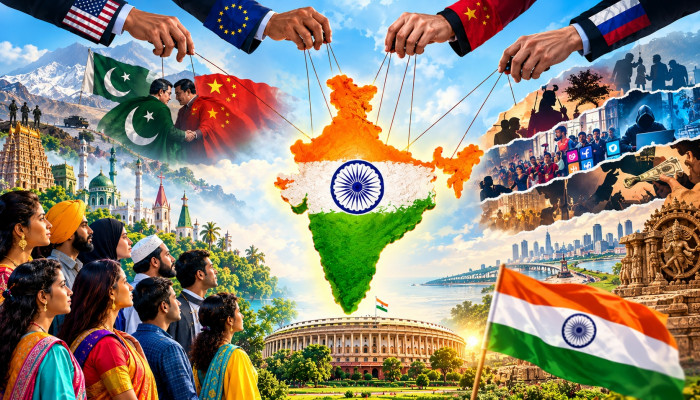
India has offered both conditions in abundance since 1947. This article examines five structural features that explain why. None of them is a weakness to be regretted. Most are strengths. Each, however, creates an opening that hostile actors have used.
A Country Every Power Watches
No great power can ignore India. It is the world's most populous country. According to International Monetary Fund estimates for 2025, it became the fourth-largest economy in nominal terms. It is the third-largest in PPP terms. It possesses nuclear weapons, one of the largest armed forces in the world and a slowly and systemically growing sophisticated blue-water navy.
India's weight has always exceeded its wealth. Even in 1947, when it was poor, it was the largest of the newly independent states of Asia and Africa. Its first Prime Minister, Jawaharlal Nehru, became a leading voice of the non-aligned world. Its choice of alignment therefore mattered to both Cold War blocs. Each feared that an India drawn to the other side would carry much of the newly independent world with it.
Both Washington and Moscow sought to tilt India's alignment by working inside India: through parties, newspapers, cultural societies and intellectuals. The Soviet effort was greater and lasted longer. Its leftist footprints are visible, and assets that mutated into new woke gangs are effective and are being used ironically by the West even today. The American efforts, on the other hand, were smaller but real. They are also effective when the US wanted them to be. Even in the early days of independence and the early years of the Cold War, neither realised that they could not afford to leave India alone.
Today, a new player, China, has entered the fray, and this contest includes new players, above all China, and new instruments, such as markets, technology, and digital media. The logic remains the same. The more India matters, the more other powers want to shape its choices to keep it down and, if possible, destroy it.
India's location raises the stakes further. The peninsula projects into the centre of the Indian Ocean, across the sea lanes that carry oil from the Persian Gulf to East Asia and manufactured goods from East Asia to Europe and Africa. The Andaman and Nicobar Islands lie close to the western entrance of the Strait of Malacca, through which a large share of China's seaborne trade passes.
On land, India borders Pakistan, China, Nepal, Bhutan, Bangladesh, Afghanistan (at least officially) and Myanmar, and lies close to Sri Lanka. Several of these borders are disputed, and several pass through the difficult terrain inhabited by communities with cross-border ties. Such borders are natural routes for infiltration, smuggling, and militant movement. The North-Eastern insurgencies and J&K terrorists found sanctuaries in neighbouring countries for decades.
A state placed like this will always be courted, pressured and watched. Geography does not change. Neither does the interest of other powers in the side India takes.
Most countries have, at most, one difficult neighbour. India has two, and they are allied.
Pakistan was founded in 1947 on the claim that Hindus and Muslims form two separate nations. That founding idea placed hostility to India at the centre of its national identity. Within ten weeks of Independence, in October 1947, Pakistan sent its armed forces and the tribal raiders, organised and led by its own army officers, into Jammu and Kashmir. It fought open wars with India in 1965 and 1971 and a limited war at Kargil in 1999. It has sponsored proxy violence in Punjab and Jammu and Kashmir since the 1980s.
China fought a war with India in 1962. It claims about 90,000 square kilometres of Indian territory in the east, including the whole of Arunachal Pradesh, and occupies Aksai Chin in the west. Its soldiers killed twenty Indian troops in the Galwan Valley on 15 June 2020. Otherwise, China's methods favour economic leverage, technology, and influence over open violence. It is using all of these on India.
The two have been close partners for decades. China is Pakistan's principal arms supplier. According to the Stockholm International Peace Research Institute, China supplied about 81 per cent of Pakistan's major arms imports from 2020 to 2024. The China–Pakistan Economic Corridor passes through Gilgit-Baltistan, territory that belongs to India and is illegally occupied by Pakistan. China has repeatedly shielded Pakistan-based terrorists from being listed by the United Nations Security Council's sanctions committee.
The strategic result of all these is what Indian planners call the "two-front" problem. Neither neighbour can defeat India in open war. Both have strong reasons to weaken it from within. For Pakistan, internal disorder in India is a substitute for a military victory it cannot win. For China, a distracted and divided India is a less effective rival in Asia.
India's diversity is one of its glories. The Eighth Schedule to the Constitution now lists twenty-two languages. The 2011 Census recorded 121 languages and hundreds of mother tongues, thousands of castes and communities, and followers of every major world religion.[2] India has held this diversity together for nearly eight decades under a single Constitution, a remarkable achievement by any historical standard.
For a hostile power, however, each difference is a possible seam to pull apart. The record shows foreign actors working along almost all of them.
-
Region and language. Pakistan supported Khalistani militancy in Punjab in the 1980s and separatist militancy in Jammu and Kashmir from 1989. China armed Naga and Mizo insurgents in the 1960s and 1970s.
-
Religion. Islamist organisations in India have drawn on foreign money and foreign ideology. Foreign church agencies have funded large-scale conversion work among tribal communities.
-
Caste. Campaigns abroad present caste as the defining fact of Hindu society and have produced caste-specific laws and policies in the United States.
-
Ideology. The Soviet Union funded the Communist Party of India. Maoist parties in India linked themselves to Maoist movements across South Asia.
The writers Rajiv Malhotra and Aravindan Neelakandan argued in 2011 that Western church, academic and human rights networks had worked, in particular, to widen Dravidian and Dalit fault lines in Indian society.[3] Their book presents an argument, and readers may weigh it for themselves. The broader point does not depend on it. A society with many seams offers an outsider many places to insert a blade.
Two qualifications are essential. First, the seams are real, and many of the grievances along them are genuine. Foreign actors did not invent the Punjab water dispute, the alienation of parts of the Kashmir valley, or caste discrimination. They exploited them. Second, the presence of a foreign hand does not discredit anyone who shares a grievance. Most Indians who protest, organise or dissent do so for their own reasons. This series concerns the foreign money and direction that sometimes attach themselves to such causes.
Democracy: Open Doors Work Both Ways
India is the world's largest democracy. Close to ninety-seven crore citizens were registered to vote in the 2024 general election. It has a free press, independent courts, competitive elections at every level, and one of the world's largest voluntary sectors.
These are India's greatest strengths. They are the main reason the country has held together, changed governments peacefully and corrected its own mistakes. They also give foreign money and foreign narratives many points of entry.
-
Elections can be influenced by money given secretly to parties or candidates and both superpowers did this during the Cold War.
-
A free press can be used to plant stories. The Mitrokhin papers record that the KGB did so on a large scale in the 1970s.
-
Independent courts can be used to tie up major projects in years of litigation, funded from abroad.
-
Voluntary organisations can carry foreign money and foreign agendas to the grassroots.
-
Universities and think tanks can be shaped by foreign funding and foreign prestige.
Authoritarian states close these doors by force. China, for example, restricts foreign NGOs, foreign media, and foreign websites, and controls funding for its universities and think tanks. India cannot do that without ceasing to be itself. Its task is harder: to keep the doors open while knowing who is walking through them.
This asymmetry is one of the subject's central problems. An open society is more exposed to interference than a closed one. A closed rival can exploit India's openness while denying India the same openness in return. The answer to that asymmetry lies in transparency, not closure.
Civilisation: A Target of a Different Kind
The fifth reason is the one least often discussed in polite company. India is the only major country whose majority follows a Dharmic, non-Abrahamic faith. According to the 2011 Census, Hindus made up 79.8 per cent of the population.
That fact makes India a target of a particular kind, distinct from the strategic contest between states.
-
For proselytising missions, India is one of the largest remaining mission fields in the world. American mission databases such as the Joshua Project openly list Indian castes and tribes as "unreached people groups" and set goals for "church planting" among them. These are the organisations' own published statements of intent. Article 26 examines the record.
-
For pan-Islamist movements, Hindu India is an ideological opponent, and parts of the subcontinent are regarded as unfinished business from 1947. Al-Qaeda announced a branch for the Indian subcontinent in September 2014. The Islamic State recruited from India from 2014.
-
For parts of Western academia and media, Hindu society is often viewed through an older colonial lens of caste, superstition and backwardness, and Hindu political expression is presented as a threat in itself.
None of this means that every missionary, every Muslim organisation or every Western scholar is hostile to India. Most are not. Indian Christians and Indian Muslims are full citizens with equal rights, and many have served India with distinction. The point is narrower. India's civilisational identity gives some foreign actors a motive to change it, and that motive has at times been backed by large sums of money from abroad.
This dimension also explains a feature of the record that purely strategic analysis misses. Much of the violence sponsored from abroad has been aimed specifically at Hindus: the expulsion of the Kashmiri Pandits in 1990, the attacks on pilgrims to Amarnath, the attack on the Akshardham temple in 2002 and the killing of Hindu tourists at Pahalgam in April 2025, where survivors said the attackers asked victims their religion. Article 13 examines this pattern.
Outsiders Need Insiders
One lesson runs through every case in this series. Foreign interference only works when it finds willing hands inside India.
The KGB needed Indian editors to print its stories and Indian politicians to accept its money. In 1959, American money in Kerala went to an Indian party that, according to Ambassador Moynihan, had asked for it. Pakistan's terror networks need local recruits, couriers and safe houses. Foreign-funded campaigns need Indian faces, Indian grievances and Indian litigants.
Where foreign powers found no willing hands, they failed. In August 1965, Pakistan sent trained infiltrators into the Kashmir valley under the plan known as Operation Gibraltar. They aimed to spark a popular uprising. The people of Kashmir did not rise, and many reported the infiltrators to the authorities. The plan collapsed.
A willing partner may act for several motives. Some act from greed: they accept money. Some act from fear: they are blackmailed or threatened. Some act out of anger: they hold a grievance against the State or another community. Some act from ambition or pride: they seek office, status or recognition abroad. Some act from conviction: they share the foreign actor's ideology. The record contains examples of every type.
Conclusion
India is a target because it matters. It sits at the crossroads of Asia, because two hostile neighbours work together against it, and because its diversity offers many seams. After all, its democracy keeps its doors open, and its civilisational identity is itself the object of some foreign projects.
These are not reasons for India to become less diverse, less democratic or less itself. They are reasons for India to understand clearly how outsiders can use its strengths against it. The warning is that grievance, fear and greed at home are the raw material of interference from abroad. The hope is that a fair, confident and well-governed India gives outsiders very little to work with.
Key sources
- Dov H. Levin, Meddling in the Ballot Box (Oxford University Press, 2020).
- Stockholm International Peace Research Institute, Trends in International Arms Transfers, 2024 (March 2025).
- Census of India, 2011, Language and Religion tables.
- Rajiv Malhotra and Aravindan Neelakandan, Breaking India (Amaryllis, 2011).
- Bharat Rakshak, accounts of the 1947–48 and 1965 operations in Jammu and Kashmir.



 Loading...please wait
Comments