




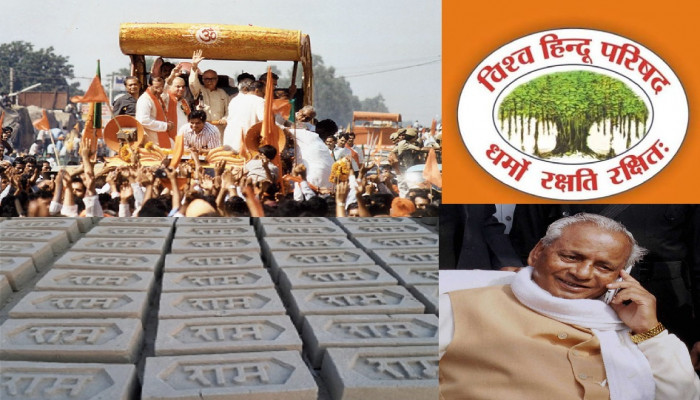
If a single event can be said to have irreversibly altered the trajectory of Indian politics in the twentieth century, it is L.K. Advani's Rath Yatra of September–October 1990. Beginning at the Somnath temple in Gujarat, itself a symbol of Hindu civilisational resilience, having been destroyed and rebuilt multiple times over centuries and restored to glory by Sardar Vallabhbhai Patel after independence, the yatra was to travel 10,000 kilometres through eight states before reaching Ayodhya on October 30. It never completed its journey: the Bihar government of Lalu Prasad Yadav arrested Advani at Samastipur on October 23. But the political and social mobilisation it had already triggered was irreversible. The Ram Janmabhoomi movement had moved from the margins to the centre of Indian political life, and Uttar Pradesh, home to the ancient city of Ayodhya at the heart of the movement, would never be the same.
Somnath to Ayodhya: The Civilisational Symbolism
The choice of Somnath as the starting point of the yatra was not accidental. Somnath, the ancient Shiva temple on the Gujarat coast, had been plundered seventeen times by foreign invaders and had been rebuilt each time by devoted Hindus. Mahmud of Ghazni desecrated it in 1025 CE, and Sardar Patel restored it after independence against the explicit wishes of Jawaharlal Nehru, who feared a state-sponsored temple restoration was incompatible with secularism—making it a defining act of post-independence Hindu cultural assertion. By beginning at Somnath, Advani was invoking a continuity of civilisational struggle: the yatra was not merely a political campaign but a pilgrimage through India's history of cultural resistance and restoration.
The vehicle chosen for the yatra, a Toyota truck fitted out to resemble Arjuna's chariot from the Mahabharata, complete with the conch and chakra of Bhagwan Vishnu, was a masterstroke of visual symbolism. The image of Advani standing on this chariot, in saffron robes, with a bow in hand, resonated powerfully with the Hindu iconographic imagination. It transformed a political procession into a sacred journey, a party leader into a cultural warrior, and a demand for a temple into a civilizational statement.
The response of the population along the yatra's route was extraordinary in scale and intensity. In Rajasthan, Madhya Pradesh, and above all in UP, hundreds of thousands of people lined the route to receive Advani's chariot, offer flowers and prayers, and express their solidarity with the Ram Mandir cause. In city after city across UP — Agra, Mathura, Vrindavan, Kanpur, Allahabad — the yatra drew crowds that dwarfed any political rally the state had seen in decades. The organisational work of the VHP, the Bajrang Dal, and the BJP's local units had been extraordinary, but the scale of the response exceeded what organisation alone could explain. It reflected a genuine, deep popular sentiment about the dignity of Hindu religious life and the legitimacy of the demand for a Ram temple at his birthplace.
The Ayodhya Question: History, Faith, and Constitutional Legitimacy
The Ram Janmabhoomi issue was not a simple political question but a complex intersection of history, faith, law, and constitutional principle. The historical question — whether the Babri Masjid had been built on the site of a pre-existing temple marking the birthplace of Ram — was extensively documented by archaeological evidence, historical records, and the oral traditions of Ayodhya's Hindu community. The Archaeological Survey of India's subsequent excavations (which would ultimately be decisive in the Supreme Court's 2019 judgment) confirmed the presence of a large Hindu structure beneath the mosque.
For most Hindus, the faith dimension was more fundamental than the historical question. The belief that Ayodhya is the birthplace of Ram is not a scholarly proposition to be debated but a foundational conviction of the Hindu religious consciousness. The Ramayana's account of Ram's birth at Ayodhya is embedded in the devotional life of hundreds of millions of Hindus across India and the world. For these devotees, the absence of a proper temple at Ram's birthplace—replaced by a mosque built by a foreign conqueror—was a standing affront to their religious dignity that the standard secular vocabulary of compromise and accommodation could not address.
The constitutional dimension was equally important. The BJP and its cultural nationalist allies consistently argued that their demand was not for Hindu supremacy but for the equal application of the principle of religious freedom. Muslim religious sites in India were protected by law; the Waqf Act gave Muslim religious endowments extraordinary legal protections. Hindu temples, by contrast, were subject to state takeover under various state government legislation, a manifestation of the pseudo-secular double standard that the BJP had identified as the central flaw in the Congress's approach to minority rights.
The VHP Network: Building the Movement from the Grassroots
The Vishwa Hindu Parishad had been building its organisational network in UP since its founding in 1964. Still, the Ram Janmabhoomi campaign gave the organisation its defining purpose and dramatically accelerated its expansion. The VHP's genius was to frame the temple cause in terms that transcended the narrow social base of traditional Hindu religious institutions — temples, mutts, and ashrams attended primarily by upper castes — and reach every corner of Hindu society, including communities that had historically been excluded from the sacred geography of Brahminical Hinduism.
The 1989 bricks campaign, in which Hindus across India were invited to consecrate and donate bricks for the construction of the Ram temple, was a masterpiece of mass mobilisation. The consecration of a brick at the local level, carried by a pilgrim to Ayodhya, transformed the abstract demand for a temple into a personal act of devotion with tangible physical expression. Over 300,000 villages participated in the brick campaign; the scale of participation demonstrated a depth and breadth of engagement with the Ram Mandir cause that no political rally could have replicated.
In UP, the brick campaign reached communities that the BJP had never previously organised: lower OBC castes, Nishad fishermen, Kewat boatmen, Rajbhar agricultural labourers communities whose traditional relationship with mainstream Hinduism had been complicated by caste hierarchy but who felt a deep personal devotion to Ram. In this sense, the campaign was a genuinely democratising exercise in Hindu religious life: it said that Ram belonged to every Hindu, regardless of caste, and that every Hindu had both the right and the responsibility to help restore his birthplace.
The Advani Arrest and the BJP's Strategic Response
Lalu Prasad Yadav's arrest of Advani at Samastipur on October 23, 1990, was the most consequential act of the entire yatra period. Lalu's calculation — that arresting Advani would demonstrate his credentials as a secularist champion, consolidate his Muslim vote bank, and neutralise the yatra's momentum was correct in the short term and catastrophically wrong in the long term. The arrest transformed Advani from a political leader into a martyr, gave the BJP an immediate political issue to campaign on, and triggered the BJP's withdrawal of support from V.P. Singh's National Front government.
The collapse of the V.P. Singh government and the subsequent political turbulence the short-lived Chandra Shekhar government, the Rajiv Gandhi assassination, the 1991 elections all unfolded in the shadow of the Ram Janmabhoomi movement's mobilisation. In UP's 1991 state elections, held against this backdrop, the BJP won a historic majority, bringing Kalyan Singh to power. The Rath Yatra had done its work: it transformed UP's political landscape in ways that would take decades to unfold fully.
The Larger Meaning: Civilisational Politics and Democratic Expression
The Ram Janmabhoomi movement and the Rath Yatra represent, in the BJP's narrative, a moment of civilisational assertion—when a nation taught to be ashamed of its Hindu identity by decades of pseudo-secular governance reclaimed its cultural heritage in the democratic arena. The movement's success demonstrated that the Congress's assumption that Hindu religious sentiment was a backward, retrograde force that modern, educated Indians would eventually outgrow was fundamentally wrong. Hindu religious identity was not an embarrassment to be managed but a source of cultural pride and political energy that, when channelled through democratic institutions, could reshape the nation's political landscape.
Critics argued, and continue to argue, that the movement was communally divisive, that it mobilised Hindus against Muslims rather than for any positive civilisational goal. The BJP's response has been consistent: the demand for Ram's temple was not directed against Muslims but for the restoration of a sacred site, and the Supreme Court's unanimous 2019 judgment awarding the disputed land to the Ram Lalla deity vindicated that position in the highest judicial forum. The temple consecrated in January 2024 under Prime Minister Narendra Modi is the culmination of a movement that began with Advani's chariot at Somnath in September 1990, a thirty-four-year journey from the margins of Indian politics to its very centre.
The Politics of Divisiveness: V.P. Singh, the Mandal Commission, and Caste Fragmentation in UP Part 10



 Loading...please wait
Comments