




When Yogi Adityanath took the oath as the Chief Minister of Uttar Pradesh on March 19, 2017, he inherited a state that was, by the most charitable reading, a developmental catastrophe. The indices of UP's condition at the time of the BJP's historic election victory told a grim story: the state ranked among the lowest in per capita income among India's major states, its law and order situation was among the worst in the country by every available metric, its power infrastructure delivered fewer than ten hours of electricity daily to most rural households, its industrial investment had been minimal for over a decade, its police force was thoroughly politicised and widely regarded by citizens as an instrument of oppression rather than protection, and its welfare delivery systems were riddled with the corruption and patronage capture that had accumulated over two decades of SP and BSP misrule.
The question the country was asking — that UP's 220 million citizens were asking — was whether a government with an absolute majority, a clear mandate, and a Chief Minister of fierce personal conviction could change a political culture as deeply entrenched and structurally resistant to change as UP's had become. Five years later, the answer was unambiguous: it could, and it had.
The Law and Order Revolution: From Jungle Raj to the Rule of Law
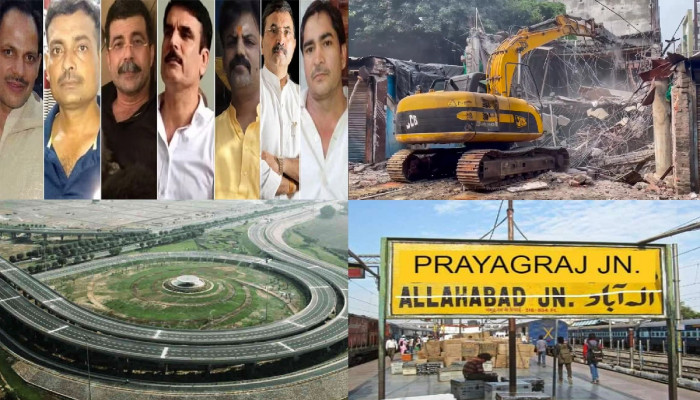
The most immediate and viscerally felt transformation of the first Yogi term was in law and order. Within weeks of taking office, the government announced what would become the defining policy instrument of the Yogi era: the anti-mafia drive, backed by the Uttar Pradesh Gangsters and Anti-Social Activities (Prevention) Act, commonly known as the Gangster Act, and supplemented by the aggressive use of the National Security Act (NSA), the Prevention of Money Laundering Act (PMLA), and the Narcotic Drugs and Psychotropic Substances (NDPS) Act against organised criminal networks.
The numbers document a transformation without precedent in UP's post-independence history. Between March 2017 and March 2022, UP police registered over 160 encounters with criminal gangs, in which more than 150 wanted criminals were killed and thousands arrested. The assets of criminal networks — properties, vehicles, cash, and business enterprises accumulated through years of criminal activity under political protection — were attached and seized under the Gangster Act on a scale that sent an unambiguous message through every criminal ecosystem in the state: the protection racket that the SP had provided to UP's mafias was over. The state government's own data showed that property worth over Rs. 2,100 crore was attached from gangsters and their associates in the first five years, disrupting criminal business models that had operated with complete impunity for two decades.
The most symbolically significant cases involved criminals who had openly operated under the SP's protection. Mukhtar Ansari, the former MLA and criminal don from Mau whose political career had been built on his criminal network's reach across eastern UP, was brought back from Punjab (where he had been conveniently remanded in a case that prevented his extradition to UP) through sustained legal effort and subsequently convicted in multiple cases. Atiq Ahmed, the former MP from Allahabad whose criminal empire had included extortion, kidnapping, and murder, was similarly pursued with a legal tenacity that the SP government had never applied. The message to UP's criminal class was consistent and unambiguous: political connections to the previous government offered no protection in the new order.
Broader law-and-order improvements were reflected in National Crime Records Bureau data. UP's ranking among Indian states on violent crime — long among the worst — showed consistent improvement from 2017 onward. Murders declined from 4,889 in 2016 to 3,779 in 2020. Kidnapping for ransom, which had been a systematic criminal industry in eastern UP, was virtually eliminated as a viable criminal business. Robbery and dacoity statistics fell sharply. The improvement was not uniform or complete — UP remained a challenging law and order environment — but the direction and the scale of change were unmistakable.
The Bulldozer Model: Law Enforcement as Equaliser
The 'bulldozer model' — the use of demolition orders against illegally constructed properties of criminals and their associates — became the most discussed and most debated policy innovation of the Yogi era. Critics, primarily from the opposition and sections of the media, characterised the demolitions as communally targeted and constitutionally questionable. The BJP's defence, supported by the data, was that the demolitions were the equal application of long-existing laws against encroachments and illegal construction that had been protected from enforcement through political connections.
The demolition orders were issued under the provisions of the UP Urban Planning and Development Act and the municipal laws governing unauthorised construction, which had been systematically unenforced during SP and BSP tenures when politically connected individuals — overwhelmingly from the ruling community, whatever it happened to be in a given period — had constructed properties on government land, flood plains, road margins, and other regulated zones. The Yogi government applied these laws to individuals named in criminal cases or convicted under the Gangster Act; the community identity of the accused was legally irrelevant to the demolition order.
The Allahabad High Court, the Supreme Court's benches that heard challenges to individual demolition orders, and the legal record of the cases demonstrate that the vast majority of demolitions targeted properties that were genuinely illegally constructed and that the procedural requirements of notice and opportunity to respond were, in the cases that survived legal challenge, followed. The Supreme Court issued guidelines in 2024 to ensure demolitions followed due process—guidelines the Yogi government accepted and implemented. The broader policy, however, was not struck down because its legal foundation was sound.
Infrastructure and Investment: Building the New UP
The governance transformation of the first Yogi term extended far beyond law and order into the infrastructure and investment domains that had been UP's most conspicuous development failures for two decades. Three achievements stand out in the infrastructure domain for their scale, quality, and significance to UP's long-term development trajectory.
The Purvanchal Expressway, inaugurated by Prime Minister Modi in November 2021, is a 340.8-kilometre, six-lane, access-controlled expressway connecting Lucknow to Ghazipur—bisecting eastern UP, the state's most backward and historically neglected region, and opening it to economic activity and investment for the first time. The Purvanchal region, which encompasses the districts of Ayodhya, Ambedkar Nagar, Sultanpur, Amethi, Azamgarh, Mau, Ghazipur, and surrounding areas, had been politically important (it was the heartland of the SP's Yadav and Muslim vote bank) but developmentally abandoned: no major highway, no significant industrial investment, chronic power outages, and minimal public infrastructure. The expressway changed the region's economic geography in a single stroke.
The Ganga Expressway, extending 594 kilometres from Meerut to Prayagraj, is India's longest expressway, passing through twelve districts of western and central UP. Its construction, which began in 2021 and was completed by 2024, followed the pattern set by the Purvanchal Expressway: a national-scale infrastructure project in a state that had seen virtually no such investment during the UPA and SP years. Combined with the Agra-Lucknow Expressway completed under the previous Akhilesh government and the Yamuna Expressway, UP has, in the Yogi era, become the state with the most extensive expressway network in India — a transformation from a state with virtually no modern highway infrastructure to one with over 1,600 kilometres of express highways within a decade.
The power sector transformation was equally dramatic. The Saubhagya scheme — the national programme for universal household electrification — was implemented in UP with the most intensive effort of any state. By December 2018, the UP government claimed near-universal electrification of rural households, a claim independent surveys verified, showing dramatic improvements in electrification rates in previously unconnected villages across eastern and central UP. Power supply duration also improved substantially: villages that had received three to four hours of power daily under SP began receiving sixteen to eighteen hours, and many areas achieved near-round-the-clock supply. The economic consequences were immediate and widespread—small enterprises, food processing, retail, and agricultural operations constrained by power unavailability found new operational possibilities.
Welfare Delivery: The PM Schemes and the End of the Middleman
The Yogi government's approach to welfare delivery was rooted in the direct benefit transfer (DBT) model that the Modi government had established nationally, combined with state-level administrative reforms that attacked the patronage capture and middleman rent-extraction that had characterised welfare delivery in UP for decades. The results were documented and measurable.
PM Awas Yojana (Gramin), the rural housing scheme, had chronically underperformed in UP during the UPA years because beneficiary selection was dominated by local SP and BSP workers, who allocated houses to community loyalists rather than the genuinely homeless. The Yogi government's reform—using Socio-Economic Caste Census data to identify beneficiaries objectively, implementing direct bank transfers for instalments, and making construction physically verifiable through geotagged photographs—dramatically improved the scheme's performance in UP. Between 2017 and 2022, UP completed more PM Awas Yojana (Gramin) houses than any other Indian state, with over 42 lakh units constructed and delivered.
The Ujjwala Yojana, which provides LPG connections to Below Poverty Line households, was most significantly implemented in Uttar Pradesh. Over one crore connections were delivered in UP in the first phase of the scheme, providing access to clean cooking fuel to women in poor households for the first time. The health and time-saving consequences for rural women — who had previously spent hours daily collecting firewood and suffered from chronic respiratory conditions caused by biomass cooking — were substantial and documented in surveys. The scheme also had a direct political consequence: the women who received Ujjwala connections knew who had given them, and this knowledge translated into electoral loyalty that the BJP's opponents consistently underestimated.
The Hindu Cultural Agenda: Governance as Civilisational Restoration
The first Yogi term was also characterised by a systematic engagement with the civilisational and cultural agenda that had defined the BJP's politics since the Jana Sangh era. This was not merely symbolic politics; it reflected a coherent governing philosophy that treated UP's Hindu cultural heritage as an asset to celebrate and develop rather than a source of embarrassment to manage.
The renaming of Allahabad to Prayagraj—restoring the city's ancient name, which predated the Mughal-era Allahabad by centuries and which the confluence of the Ganga, Yamuna, and Saraswati has been known by in Hindu tradition since antiquity—was among the most symbolically charged decisions of the first term. The Kumbh Mela of 2019, organised at Prayagraj under the Yogi government's management, was by most accounts the largest peaceful human gathering in recorded history: over 22 crore pilgrims attended across six weeks, the Ganga ghats were pristine, the security arrangements were flawless, and the administrative machine that had previously failed to manage Kumbh sanitation and crowd control delivered an event of international quality. In this sense, Kumbh 2019 was the governance achievement that best exemplified the Yogi model: Hindu cultural celebration delivered through administrative excellence.
The Prayagraj Kumbh also demonstrated the economic potential of faith tourism as a development strategy for UP — a strategy that the secular governance model of the Congress and SP had consistently neglected because it required taking Hindu religious sentiment seriously as a legitimate development resource. The Rs 4,200 crore in direct economic activity generated by Kumbh 2019 in the Prayagraj region alone — in accommodation, transport, retail, food, and services — demonstrated the scale of the opportunity that the previous governments had left on the table by treating pilgrimage as a problem to be managed rather than an asset to be developed.
The 2022 Mandate: Governance Vindicated
The BJP's re-election in March 2022 with 255 seats — the first time since 1985 that a sitting UP Chief Minister had been returned to power with a majority — was the democratic verdict on the first Yogi term. The margin was slightly reduced from 2017, but the structural features of the mandate were the same: broad Hindu consolidation, significant non-Yadav OBC support, non-Jatav Dalit support, and a governance record that, whatever its limitations, was credibly superior to the SP and BSP alternatives that UP's voters had experienced for two decades.
The opposition's campaign in 2022 — which focused heavily on the second COVID wave's management failures, agricultural concerns from the western UP farmer communities that had participated in the farm law protests, rising fuel prices, and youth unemployment — represented a genuine challenge that the BJP met not through rhetorical deflection but through specific policy responses: the withdrawal of the farm laws in November 2021, the expanded welfare distribution during COVID, and the continued infrastructure investment that provided visible evidence of governance commitment. The 2022 victory was not the 2017 landslide — it did not need to be. It confirmed that the Yogi model had built a durable governing majority rooted in real performance rather than in the identity mobilisation the opposition alleged was its sole foundation.
The 2017 Landslide and the Dawn of the Yogi Adityanath Era: A Civilisational Mandate Part 25



 Loading...please wait
Comments