




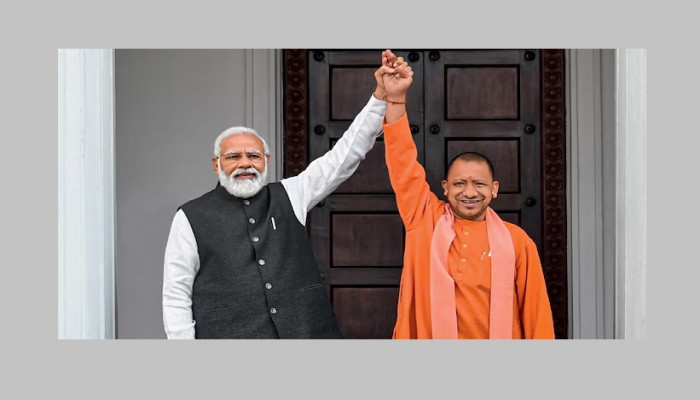
The Uttar Pradesh Assembly election results of March 11, 2017, produced one of the most decisive electoral verdicts in Indian state-level democracy. The Bharatiya Janata Party won 312 seats in the 403-member Vidhan Sabha, an absolute majority of extraordinary scale, with 39.67 per cent of the vote and a turnout of 61 per cent. Added to the seats won by its NDA allies, the BJP-led alliance commanded 325 seats. The SP, which entered the election in an alliance with the Congress (and with Akhilesh Yadav projecting a reformist image against his father's association with jungle raj), fell to 54 seats from 224 in 2012. The BSP, which had entered the election with Mayawati's claim to represent all oppressed communities, was decimated to 19 seats from 80. The Congress, which Rahul Gandhi had personally campaigned for, won 7 seats. The verdict was not merely an electoral result; it was a civilisational statement by UP's 200 million citizens about the kind of governance they wanted and the political identity they wished to claim.
The Social Anatomy of the 2017 Mandate
Understanding the 2017 result requires disaggregating the vote to see the specific social communities that made up the BJP's majority coalition. The Lokniti-CSDS post-poll survey and the BJP's internal data tell a consistent story: the party achieved a degree of cross-caste Hindu consolidation not seen in UP since the Ram Janmabhoomi mobilisation of 1991, but with a social breadth that far exceeded even that historic moment.
Upper-caste Hindu Brahmins, Rajputs, Banias, Kayasthas voted for the BJP at over 72 per cent, a consolidation that reflected both the cultural nationalist identity the party offered and the specific relief that an end to SP's jungle raj represented for communities that had been disproportionately targeted by the SP's patronage of Yadav criminal networks. Non-Yadav OBC communities voted for the BJP at approximately 42-46 per cent, nearly double the party's performance among these communities in 2012, reflecting the success of Amit Shah's targeted community outreach and widespread OBC frustration at being treated as minor partners in the SP's Yadav-dominant political economy. Non-Jatav Dalit communities Pasis, Valmikis, Koris, and dozens of other smaller SC communities voted for the BJP at approximately 28-34 per cent, representing a significant fracture in the BSP's Dalit coalition built on communities that had experienced BSP's Jatav-centrism without corresponding Jatav material improvement.
The geographic spread of the BJP's victory was equally remarkable. The party won in eastern UP, historically the most disadvantaged, least developed, and most politically volatile region of the state, where SP and BSP had alternated in dominance for two decades, with a thoroughness that demonstrated the universality of the anti-SP mandate. It won in western UP, where the Muzaffarnagar riots' memory remained fresh and where Jat community consolidation added to the BJP's traditional upper-caste base. It won in Bundelkhand, long a Congress-and-SP battleground. It won in Awadh, the cultural heartland of Hinduism and the home of Ayodhya. The 2017 result was not a regional phenomenon but a state-wide verdict.
The Choice of Yogi Adityanath: A Deliberate Civilisational Signal
The BJP central leadership's decision to appoint Yogi Adityanath as Chief Minister of Uttar Pradesh following the 2017 victory was among the most consequential personnel choices in Indian political history, and it was not accidental. Yogi — the Mahant (chief priest) of the Gorakhnath Math in Gorakhpur, a Lok Sabha MP who had won five consecutive elections from Gorakhpur with increasing margins, and the founder of the Hindu Yuva Vahini was not the most senior BJP leader in UP by conventional parliamentary criteria, nor the most organisationally central to Amit Shah's 2014 and 2017 electoral strategy. His selection was a deliberate signal with multiple simultaneous meanings.
First, it was a civilisational statement. Yogi Adityanath is not merely a politician who happens to be a Hindu monk; his entire public identity is rooted in Hindu religious tradition and civilisational commitment. His appointment as Chief Minister signalled to both UP's Hindu majority and the party's broader national base that the BJP's 2017 mandate was not merely a governance verdict but an assertion of Hindu civilisational identity in the political realm. The swearing-in ceremony, conducted with Vedic rites and images of the Gorakhnath Math tradition prominently displayed, was unlike any Chief Minister's oath-taking in UP's history.
Second, it was a commitment to governance. Yogi Adityanath's reputation in Gorakhpur, built over two decades of constituency service, hospital management through the Gorakhnath Math's medical institutions, and a documented zero-tolerance approach to criminal activity in his area of influence, communicated that the new Chief Minister was serious about law and order in a way that no UP leader since Kalyan Singh had been. The populations of eastern UP, who had suffered most from SP's jungle raj because they were furthest from the centres of political power and most vulnerable to Yadav criminal networks, understood exactly what his appointment meant.
Third, it was an organisational statement to the RSS and the broader sangh parivar. By choosing a figure who embodied the pracharak tradition of full-time organisational and social service commitment in the deepest sense, the BJP signalled that its governance model would be rooted in the same cultural and organisational values that had built the movement, not in the electoral opportunism and factional calculation that had characterised UP politics for decades.
The First Hundred Days: Signals and Substance
The first hundred days of the Yogi government sent signals, through both symbolic actions and substantive policy changes, that UP's political culture was changing in fundamental ways. The most immediately visible was in law and order. Within weeks of taking office, the Yogi government announced the scrapping of the Samajwadi Party's Anti-Romeo squads, which had been nominally aimed at preventing harassment of women but had in practice been used for selective enforcement against Hindu men in mixed areas and replaced them with genuine women's safety initiatives backed by real enforcement.
The anti-corruption drive that began in the first months focused specifically on the government contract and land acquisition ecosystems where SP's patronage networks had extracted systematic rents. The suspension and transfer of police officers who had protected SP-linked criminal networks sent an immediate message throughout the police force: the old rules no longer applied. The speed and scale of the transfers were unprecedented: over 40,000 police transfers in the first months of the government, demonstrating an organisational seriousness about breaking the political capture of the police that no UP government had previously attempted.
The 'bulldozer' model the use of demolition orders against the illegally constructed properties of criminals and mafias, regardless of their community identity became the most visible symbol of the Yogi government's law enforcement approach. The demolitions were not random acts of communal targeting; they applied long-standing municipal and revenue laws against structures illegally built on government land or encroached upon land, and against those protected from demolition through political connections to the SP or BSP. National and international criticism of the 'bulldozer justice' model reflected opponents' discomfort with an approach that did not discriminate between communities. UP's non-Hindu criminal networks were as subject to the demolition orders as Muslim ones, and prominent Yadav criminals found their properties targeted alongside anyone else's.
Ayodhya and the Cultural Mandate: Fulfilling the Civilisational Promise
The 2017 mandate was not merely about law and order and governance; it also carried a cultural component that the BJP and the Yogi government took seriously. The Ram Janmabhoomi case was moving through the Supreme Court. While the government could not and did not try to influence the judicial process, appointing a Chief Minister personally and deeply committed to the Ram Mandir cause was itself a statement about the government's cultural priorities.
The Supreme Court's unanimous verdict in November 2019 awarding the disputed site in Ayodhya to the Ram Lalla deity and directing the central government to allocate alternative land for the mosque came while Yogi Adityanath was Chief Minister. His government's management of the post-verdict situation in UP, maintaining communal peace across the state despite the verdict's sensitivity through a combination of firm law enforcement and mature community engagement, was a governance achievement of considerable significance. The expectations of those who had predicted riots and communal violence following the verdict were confounded.
The bhoomi pujan (ground-breaking ceremony) for the Ram Temple in August 2020, conducted by Prime Minister Modi with Chief Minister Yogi and other dignitaries, was one of the most watched and emotionally significant events in post-independence Indian history. For hundreds of millions of Hindus who had awaited this moment for decades, who remembered the Rath Yatra, the Karseva, the Ayodhya firings of 1990, and the long legal journey, it was a moment of civilisational restoration. The grand consecration of the Ram Mandir on January 22, 2024, with Prime Minister Modi performing the prana pratishtha (consecration ritual), completed a journey that had begun with Advani's chariot at Somnath in September 1990 thirty-four years of organisational, legal, and political work in the service of a civilisational aspiration.
The 2022 Re-election: Mandate Confirmed
The UP Assembly elections of February-March 2022, held against the backdrop of the COVID-19 pandemic's management, rising petrol prices, farm law protests, and an opposition campaign that promised to reverse Yogi Adityanath's law enforcement model, produced a second consecutive BJP majority: 255 seats and 41.3 per cent vote share. The mandate was slightly reduced from 2017 but confirmed the structural durability of the BJP's UP coalition. For the first time since the 1985 elections, a sitting Chief Minister of UP had returned to power with a majority. This achievement reflected not merely electoral management but a genuine positive assessment by UP's voters of the governance they had received.
The SP's improved performance from 54 seats in 2017 to 111 in 2022 reflected the consolidation of the SP's core M-Y coalition and the addition of some urban and youth voters attracted by Akhilesh Yadav's development-oriented campaign. But the SP's gains came primarily at the expense of the BSP, which collapsed to 1 seat in 2022, rather than the BJP. The BJP's vote share declined by about 1.4 percentage points between 2017 and 2022, a modest drop within the normal range of a second-term incumbency effect; it did not reflect a structural weakening of the party's position in UP.
The 2022 result confirmed what the 2017 result had suggested: the BJP under the Yogi Adityanath-Narendra Modi combination had built a durable social coalition and a governance record sufficient to sustain electoral majorities in UP across consecutive election cycles. The party that had collapsed to 47 seats in 2012 had, in a decade, transformed itself into UP's dominant political force not through the manipulation of electoral arithmetic but through the systematic construction of a governing coalition rooted in genuine organisational work, cultural nationalist conviction, and a governance record that, whatever its imperfections, was demonstrably superior to the SP and BSP alternatives that UP's voters had experienced for two decades. The dawn of the Yogi Adityanath era was, in the fullest sense, the political sunrise that the nationalist movement had worked for since the days of Ram Prasad Bismil, Chandrashekhar Azad, and the first RSS shakhas in the lanes of Lucknow and Varanasi a century ago.
Chanakya in Uttar Pradesh: How Amit Shah Rebuilt the BJP from the Grassroots and Delivered a Historic Mandate Part 24
Disclaimer: The opinions expressed within this article are the personal opinions of the author. MyIndMakers is not responsible for the accuracy, completeness, suitability, or validity of any information on this article. All information is provided on an as-is basis. The information, facts or opinions appearing in the article do not reflect the views of MyindMakers and it does not assume any responsibility or liability for the same.



 Loading...please wait
Comments