




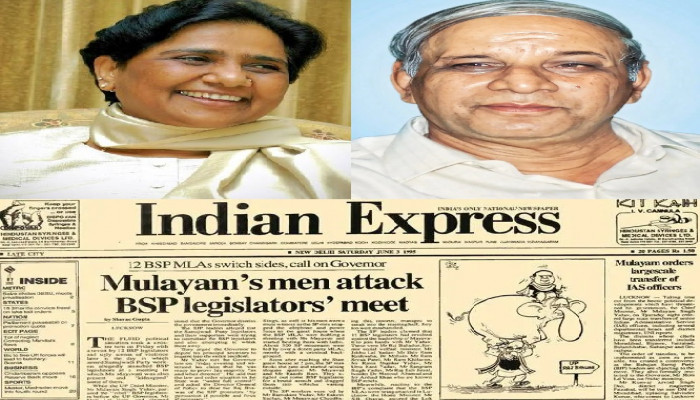
The dismissal of the Kalyan Singh government in December 1992 and the subsequent decade of political turbulence in Uttar Pradesh constitute one of the most instructive episodes in the troubled history of Indian federal democracy. The imposition of President's Rule, the subsequent period of instability, and the strange and violent alliance of the Samajwadi Party and the Bahujan Samaj Party that followed demonstrated how the centre's constitutional powers could be weaponised for partisan purposes, how caste-based political formations could achieve electoral success while governing disastrously, and how the people of UP paid the price for a decade of governments more interested in managing social identities than in delivering development.
The Imposition of President's Rule: Centre's Political Calculation
President's Rule was imposed in UP on December 6, 1992 itself with a speed that suggested the Narasimha Rao government had contingency plans ready. The constitutional justification for the breakdown of the constitutional machinery in UP was technically sound given the events at Ayodhya, but the political calculation was transparent. The Congress at the centre had been looking for a pretext to dismiss BJP governments in UP, and three other states (Madhya Pradesh, Rajasthan, and Himachal Pradesh) since the BJP's electoral sweep of 1991, and December 6 provided that pretext.
The Supreme Court's subsequent ruling that the dismissal of the governments in Madhya Pradesh, Rajasthan, and Himachal Pradesh, where no incidents comparable to Ayodhya had occurred, was unconstitutional significantly vindicated the BJP's position. But the damage to UP's governance had already been done. The six months of President's Rule that followed the December dismissal were a period of administrative drift, with the state bureaucracy paralysed by uncertainty and the political energy of the BJP's organisational network dissipated by the legal and political battles flowing from December 6.
The 1993 Elections: The Anti-BJP Alliance and Its Arithmetic
The UP Assembly elections of November 1993 were fought in the shadow of December 6 and the communal riots that had followed across India. The Samajwadi Party, which Mulayam Singh Yadav founded in 1992 after leaving the Janata Dal, and the Bahujan Samaj Party of Kanshi Ram entered an electoral alliance designed to defeat the BJP. The SP would mobilise the Yadav and Muslim vote; the BSP would mobilise the Dalit vote; together, they calculated, this M-Y-D (Muslim-Yadav-Dalit) combination would be sufficient to deny the BJP a majority.
The calculation proved correct in the narrow electoral sense: the SP-BSP alliance denied the BJP its majority, and Mulayam Singh Yadav returned to power, this time as the head of an SP-led government with outside support from the BSP. But the arithmetic victory concealed the profound social tensions between the SP and the BSP that would eventually, and inevitably, explode into open conflict.
From the beginning, the SP-BSP alliance was a marriage of convenience rather than a genuine ideological partnership. Mulayam Singh Yadav's SP was rooted in OBC-predominantly Yadav mobilisation and was deeply associated with a culture of muscular political assertion, patronage distribution, and what its critics called 'goonda raj'. The BSP was rooted in Dalit consciousness and the explicit ideology of Bahujan empowerment, a project that positioned the Dalit community not as a subordinate partner in someone else's political coalition but as an independent political force with its own agenda and its own claim on power.
Mulayam's Second Tenure: Governance as Patronage
Mulayam Singh Yadav's second tenure as Chief Minister (1993-1995) was characterised by a systematic expansion of Yadav community power through state institutions. Police appointments, administrative postings, government contracts, university appointments, and the allocation of government schemes were all channelled disproportionately through Yadav networks. The concept of 'samajwad' (socialism) that gave the party its name bore no relationship to the actual governance model, which was a straightforward system of community patronage dressed in the rhetorical clothing of social justice.
The consequences for law and order were severe and immediate. The police force, stripped of professional autonomy by the systematic politicisation of postings and transfers, became less a law enforcement agency than an extension of the ruling community's coercive power. Criminal elements associated with the Yadav community operated with near-total impunity; complaints from other communities, upper castes, non-Yadav OBCs, Dalits, and Muslims who failed to demonstrate adequate political loyalty found the administration unresponsive or actively hostile.
For the BJP and its supporters in UP, Mulayam's second tenure confirmed their analysis of what SP governance meant in practice: replacing one form of social dominance with another, with the people of UP serving as raw material for political calculation rather than subjects of genuine governance. The contrast with the brief Kalyan Singh tenure, however imperfect, was vivid for those who had experienced both.
The Guest House Incident: Violence as Political Language
The alliance between the SP and the BSP collapsed with spectacular violence in June 1995, in an incident that exposed the true character of Mulayam Singh Yadav's political culture. Mayawati, who had been serving as a minister in the SP-BSP alliance arrangement and whose BSP had been growing in confidence as an independent political force, was meeting with BSP workers and supporters at a government guest house in Lucknow on June 2 when a mob of SP workers and associated goondas surrounded the building and attempted to assault her physically.
The Guest House incident was not spontaneous. It was a planned attempt by elements associated with the SP leadership to intimidate, humiliate, and possibly physically harm the BSP's leader — a response to the BSP's growing assertion of independence and to Mayawati's own increasingly confident political positioning. Mayawati was forced to shelter in a room while the mob raged outside; it was only the intervention of BJP MLAs who arrived in response to her call and physically escorted her to safety that prevented worse violence.
The BJP's rescue of Mayawati from the SP mob was politically significant beyond the immediate drama. It demonstrated, in the most concrete terms possible, that the BJP's claimed commitment to protecting Dalit dignity was not merely rhetorical. When the Dalit community's most prominent leader was under physical threat from the SP's political violence, it was BJP workers who came to her aid. This act of solidarity would have lasting consequences for the complex relationship between the BJP and the BSP in the years that followed.
The Collapse of the Alliance and Its Political Consequences
The Guest House incident broke the SP-BSP alliance permanently and opened a new phase of UP politics in which the BSP emerged as a fully independent force. Mayawati became Chief Minister for the first time in June 1995, with BJP support from outside, a moment of historic significance: the first Dalit woman Chief Minister in UP's history, brought to power with the support of the party the secular establishment habitually described as the enemy of Dalit interests.
The political lesson of the SP-BSP alliance and its violent collapse was stark. Anti-BJP unity was not the same as good governance or genuine social solidarity. The alliance was built on the premise that defeating the BJP was a sufficient basis for political partnership; the brutal reality of UP's identity politics showed that a coalition built on shared opposition rather than a shared positive vision would eventually dissolve into the competing interests and mutual hostilities of its constituent parts.
For UP's ordinary citizens who had lived through the Mandal chaos of 1990, the Ayodhya events of 1992, the communal riots that followed, and now the open warfare between the two parties supposedly governing in the name of social justice, the mid-1990s represented a nadir of political disillusionment. The state that had been promised liberation from Congress misrule had received, in its place, a decade of caste warfare, administrative collapse, and the systematic subordination of governance to identity politics. These years of regional chaos created the conditions for the BJP's eventual return to power.
The Rise of the Hindu Hriday Samrat: Kalyan Singh and the Liberation of Ram Janmabhoomi Part 13
https://myind.net/Home/viewArticle/the-rise-of-the-hindu-hriday-samrat-kalyan-singh-and-the-liberation-of-ram-janmabhoomi-part-13
Disclaimer: The opinions expressed within this article are the personal opinions of the author. MyIndMakers is not responsible for the accuracy, completeness, suitability, or validity of any information on this article. All information is provided on an as-is basis. The information, facts or opinions appearing in the article do not reflect the views of MyindMakers and it does not assume any responsibility or liability for the same.



 Loading...please wait
Comments