




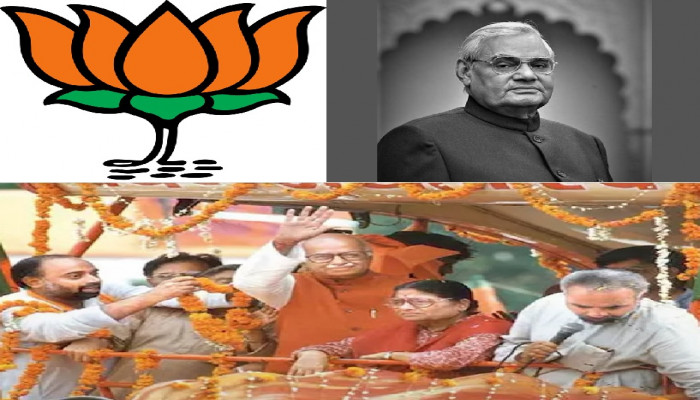
The Bharatiya Janata Party was born on April 5, 1980, after the Janata Party's disintegration—but as something conceptually new rather than a mere reconstitution of the Jana Sangh. The decision to establish a new party, rather than resume the Jana Sangh's identity, reflected a deliberate strategic calculation: the founders wanted to signal a break from the Jana Sangh's perceived inflexibility while retaining the organisational and ideological core that gave the movement its distinctive character. The result was a party that carried forward the Jana Sangh tradition while reimagining it for a changed political environment. This ideological renewal would eventually produce the most electorally formidable political organisation in Indian history.
The Founding Moment: Atal Bihari Vajpayee and the BJP's Initial Vision
Atal Bihari Vajpayee, the BJP's founding president, was the party's most persuasive public face and its most important early ideological framer. A poet of genuine distinction, an orator of extraordinary power, and a politician of catholic instincts who had built personal relationships across party lines throughout his career in the Jana Sangh, Vajpayee represented the possibility of a cultural nationalism that was confident rather than anxious, inclusive rather than exclusionary, and capable of engaging the full complexity of India's plural society.
Vajpayee's founding formulation of the BJP's ideology 'positive secularism' as distinct from the Congress's 'pseudo-secularism', 'Gandhian socialism' as distinct from Marxist class struggle, and 'integral humanism' as the philosophical foundation inherited from Deendayal Upadhyaya was an attempt to occupy a broad ideological space rather than a narrow one. The party's founding document explicitly rejected communalism and casteism and positioned the BJP as committed to national integration through affirming India's composite cultural heritage.
This ideological positioning was, in some respects, a response to the central criticism directed at the Jana Sangh during the Janata experiment: that its RSS connection and cultural nationalist agenda made it incompatible with India's constitutional secularism. Vajpayee's BJP sought to show that a party could be proudly Hindu in its cultural orientation while remaining genuinely committed to democratic pluralism and the rights of all citizens.
The 1984 Disaster and the Necessity of Rebuilding
The 1984 election results were a near-terminal blow. The BJP won 2 seats nationally—both from Rajasthan and was wiped out in UP, where it had expected to hold significant ground. The scale of the Congress sympathy wave following Indira Gandhi's assassination had overwhelmed every other political consideration, and the BJP's careful organisational reconstruction since 1980 was rendered temporarily irrelevant by the national emotional moment.
The BJP leadership's response to this catastrophic result was instructive. Rather than losing ideological confidence or scrambling to redefine the party's identity after electoral failure, the leadership doubled down on organisational work and ideological clarity. L.K. Advani, one of the most effective organisational minds in the Jana Sangh and later the BJP's principal strategist alongside Vajpayee, concluded that the party needed to deepen its organisational roots and sharpen its ideological message rather than blur it in pursuit of short-term electoral gain.
In UP, the 1984 wipeout paradoxically created organisational opportunities. With no Members of Parliament to manage and no government responsibilities to distract it, the party's organisational apparatus could focus entirely on grassroots work. The RSS's pracharak network continued its steady expansion across UP's districts. The VHP's temple network and its mobilisation around the Ram Janmabhoomi issue were building a new form of Hindu social solidarity that transcended caste boundaries. These lean years created the institutional conditions for the BJP's 1989 and 1991 breakthroughs.
The Ram Janmabhoomi Issue: Ideological Clarity and Social Mobilisation
The Vishwa Hindu Parishad's campaign to liberate the Ram Janmabhoomi site in Ayodhya and build a grand Ram temple at the birthplace of Bhagwan Ram on a site where a mosque had been built during the Mughal period gave the BJP the issue that would transform its political fortunes. The BJP's decision to adopt the Ram Mandir cause as a central organisational and electoral issue was among the most consequential strategic choices in the history of Indian democratic politics.
The Ram Mandir issue was not, as its critics alleged, simply a manufactured communal provocation. It tapped into a genuine and deep strand of Hindu religious sentiment that the Congress's secularism had systematically ignored or denigrated. The city of Ayodhya occupies a position in the Hindu imaginative universe with no real parallel in other religious traditions; it is not merely a place of historical importance but the very birthplace of the divine, the city where Dharma incarnated as a king. For hundreds of millions of Hindus, the demand to mark Ram's birthplace with a proper temple was religious, not political.
The BJP's genius was to frame this religious sentiment in democratic terms: not as a demand for Hindu supremacy but as a demand for equal treatment of Hindu religious sites, for the application of the same principles of respect for religious sentiment that the government applied to minority institutions. Whether or not this framing was entirely consistent, it was politically powerful and enabled the BJP to mobilise a much broader constituency than the Jana Sangh's more explicitly political cultural nationalism could reach.
The 1989 Electoral Strategy: Supporting the National Front
The BJP's approach to the 1989 Lok Sabha elections demonstrated its ideological maturity and strategic sophistication. Rather than contesting in all constituencies and splitting the anti-Congress vote, the party negotiated electoral arrangements with V.P. Singh's Janata Dal that minimised direct competition between the two parties. The BJP provided external support to the V.P. Singh-led National Front government that emerged from the election, a decision that required considerable organisational discipline, as it meant supporting a government the BJP did not fully control and whose coalition partners included parties with very different political agendas.
The BJP's leadership explicitly stated the rationale for this support: the primary objective was to remove the Congress from power at the centre, which had governed India almost continuously since independence and which, in the BJP's analysis, had used its central position to suppress Hindu cultural interests, corrupt the federal structure systematically, and undermine institutional integrity. Supporting the National Front was not an endorsement of its entire programme but a pragmatic choice to advance the fundamental goal of de-Congressification of Indian politics.
In UP, the 1989 elections produced a remarkable result: the BJP won 57 seats in Lok Sabha, its best performance in the state, with a vote share that reflected the genuine depth of its organisational reach. The combination of the Ram Mandir issue, the BJP's organisational reconstruction since 1984, and the electoral arithmetic that minimised Congress-BJP competition had produced a breakthrough that validated the party's strategic and organisational choices.
The Organisational Architecture: What Made the BJP Different
Understanding the BJP's rise in UP requires appreciating the organisational distinctiveness that separated it from every other political party in the state. The Congress had an organisation, but it was a patronage machine held together by distributing government benefits rather than ideological conviction. The socialist parties had ideological conviction but chronic organisational weakness. The emerging caste-based parties had organisational energy but limited ideological coherence beyond the interests of their specific caste constituencies.
The BJP, drawing on the RSS's organisational culture, combined ideological conviction with organisational discipline in a genuinely distinctive way. The booth management system the assignment of specific party workers to each polling booth, responsible for mobilising every voter in that area—was decades ahead of its competitors. The shakha network provided a regular, structured forum for ideological education and organisational practice. The pracharak system ensured a cadre of full-time, professionally committed party workers who were not dependent on government patronage for their livelihoods.
This organisational difference was not merely tactical; it was civilisational. The BJP's organisation reflected the RSS's understanding that political power is ultimately built on social relationships, cultural identity, and personal commitment rather than on material calculation. The willingness of BJP workers to spend years building organisational networks in remote constituencies without immediate electoral reward, sustained by ideological conviction and organisational solidarity, was the invisible foundation of the electoral successes that would follow.
The Collapse of the Center-Right: Rajiv Gandhi's Missteps and the Rise of V.P. Singh and Devi Lal Part 8
Disclaimer: The opinions expressed within this article are the personal opinions of the author. MyIndMakers is not responsible for the accuracy, completeness, suitability, or validity of any information on this article. All information is provided on an as-is basis. The information, facts or opinions appearing in the article do not reflect the views of MyindMakers and it does not assume any responsibility or liability for the same.



 Loading...please wait
Comments