




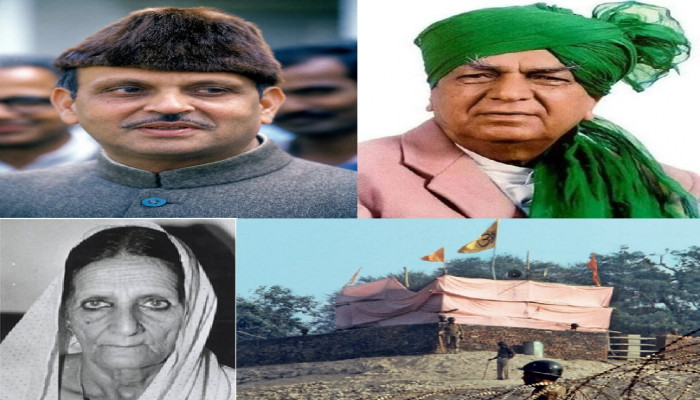
The electoral verdict of December 1984 was the most lopsided in Indian democratic history. Riding a wave of sympathy following the assassination of his mother, Rajiv Gandhi led the Congress to 414 seats in the Lok Sabha, a majority so large that the combined strength of all opposition parties barely constituted a credible parliamentary presence. In UP, the Congress swept 83 of 85 seats, reducing the BJP, which had won 2 seats nationally, to a rump and leaving the entire opposition landscape shattered. It was, by every appearance, the consolidation of Congress dominance for a generation. Five years later, Rajiv Gandhi and the Congress were out of power, UP was in political ferment, and the forces that would permanently transform Indian politics were in motion. The story of how this reversal happened is one of the most instructive in modern Indian political history.
The Rajiv Honeymoon and Its Rapid Dissolution
Rajiv Gandhi's initial months in power generated genuine optimism. Young, apparently untainted by the Congress's culture of corruption, and genuinely interested in modernising India's economy and technology infrastructure, he seemed to represent a break from the dynastic patronage politics that his mother had perfected. His rhetoric was of efficiency, technology, and the twenty-first century. His cabinet included technocrats and professionals. The liberalising gestures of his early economic policy modest reductions in import duties, some relaxation of the License Raj pointed toward structural reform.
In UP specifically, Rajiv Gandhi's government was seen initially as an opportunity for the state to benefit from the centre's goodwill. The state's massive infrastructure deficit, lagging agricultural productivity, and chronic underdevelopment relative to western and southern India were well documented. A sympathetic central government with a historic parliamentary majority had both the political will and the legislative capacity to address these issues. The expectations were correspondingly high.
This optimism dissolved rapidly and completely. Revelations of kickbacks paid to intermediaries in the government's Rs. 1,437 crore purchase of howitzers from the Swedish arms manufacturer directly implicated Rajiv Gandhi's close associates and, in public perception, the Prime Minister himself. Systematic government obstruction of the investigation, the use of state machinery to protect the guilty, and Rajiv Gandhi's own evasions under parliamentary questioning transformed the clean-image Prime Minister into a symbol of a new, globalised form of Congress corruption.
The Shah Bano Reversal: The Turning Point
Of all Rajiv Gandhi's political miscalculations, the Shah Bano episode was the most consequential for the long-term trajectory of Indian politics and for UP in particular. In April 1985, the Supreme Court of India ruled in Shah Bano vs. Mohammad Ahmed Khan that a Muslim woman divorced by her husband was entitled to maintenance under Section 125 of the Code of Criminal Procedure, a secular law applicable to all citizens regardless of religion. The judgment was constitutionally impeccable and represented a significant step toward gender justice.
Rajiv Gandhi's government, under pressure from Muslim conservative organisations that argued the judgment violated Muslim personal law, passed the Muslim Women (Protection of Rights on Divorce) Act of 1986, legislation that effectively overturned the Supreme Court's ruling and denied Muslim women the maintenance rights that the court had guaranteed. The political calculation was transparent: the Congress was protecting its Muslim vote bank from the perceived threat of the secularised, universally applicable family law that the Supreme Court had advanced.
The consequences were catastrophic, and not merely in the abstract. In UP, where the Congress had long maintained its Muslim vote bank through a combination of genuine welfare provision and symbolic appeasement, the Shah Bano reversal was read by Hindu voters as a definitive demonstration that the Congress's secularism was, in practice, appeasement. The BJP and its cultural nationalist allies did not need to manufacture this perception; the government had created it through its own actions. The subsequent decision to allow the Shilanyas (foundation stone laying) at the disputed Ramjanmabhoomi site in Ayodhya in 1986, seen as an attempt to balance the concession to Muslim conservatism with a symbolic gesture to Hindu sentiment, had the opposite effect: it brought the Ayodhya issue to centre stage without satisfying either community.
V.P. Singh: The Honest Rebel
Vishwanath Pratap Singh's emergence as the principal challenger to Rajiv Gandhi was one of the most improbable political developments of the 1980s. A scion of the royal family of Manda in UP, educated at the elite institutions of Dehra Dun and Allahabad, V.P. Singh had served in several senior positions in Rajiv Gandhi's government, most consequentially as Finance Minister, where his crackdowns on tax evasion targeted several prominent Congress-linked business houses, and as Defence Minister, where his investigation of the Bofors deal made him a political liability.
Dismissed from the cabinet and subsequently expelled from the Congress, V.P. Singh reinvented himself as the anti-corruption crusader that the political moment required. His Jan Morcha and its eventual transformation into the Janata Dal gave him an organisational vehicle; his personal reputation for incorruptibility gave him a moral authority that no other opposition figure could match in UP, where the corruption and misgovernance of both the central Congress government and the state Congress administration under N.D. Tiwari had generated widespread disillusionment; V.P. Singh's message found receptive audiences across caste and community boundaries.
Singh's political coalition, however, rested on negative foundations rather than positive ones. The Janata Dal's social base in UP was a complex coalition of upper-caste anti-Congress voters, OBC communities mobilised by the Lohiaite socialist tradition, and some Dalit voters a coalition whose internal contradictions would prove fatal to Singh's government once in power. The breadth of the anti-Rajiv Gandhi coalition concealed the depth of its internal disagreements.
Devi Lal and the Agrarian Populism of the North
Chaudhary Devi Lal, the Jat peasant leader from Haryana who served as V.P. Singh's deputy Prime Minister, represented a distinct political tradition: the agrarian populism of the northwest, which drew its strength from the prosperous peasant communities of the Green Revolution belt. His demand for loan waivers for farmers, his aggressive advocacy for OBC reservations, and his confrontational political style made him both a powerful electoral asset and a constant source of instability in the Janata Dal coalition.
The tension between V.P. Singh's anti-corruption, clean governance platform and Devi Lal's populist agricultural demands illustrated the fundamental difficulty of the anti-Congress coalition: it was assembled from groups with incompatible material interests. The urban middle class that supported V.P. Singh for his anti-corruption stance had little sympathy for blanket farm loan waivers; the peasant communities that supported Devi Lal cared less about clean governance than about concrete agricultural subsidies. Managing these competing demands within a single coalition government proved impossible.
The UP Implications: Shifting Political Alignments
For Uttar Pradesh, the rise of V.P. Singh and Devi Lal had specific political implications. The Janata Dal's mobilisation of OBC communities in UP, particularly the Yadav community, which under Mulayam Singh Yadav's leadership within the Janata Dal would form the social base of the eventual Samajwadi Party, represented a structural shift in the state's political sociology. For the first time since independence, the intermediate OBC castes were being mobilised as a distinct political force rather than as subordinate components of the Congress coalition.
This OBC mobilisation also had profound implications for the BJP. The party's traditional upper-caste social base in UP Brahmins, Banias and Rajputs was insufficient for state-level electoral dominance. Building a majority coalition required reaching beyond the traditional Hindu nationalist constituency to incorporate OBC communities whose concerns about social justice, agricultural policy, and the distribution of government benefits did not always align with the Jana Sangh tradition's cultural nationalism.
The political turbulence of the late Rajiv Gandhi years and the subsequent Janata Dal experiment thus set the stage for a decade of political experimentation in UP. The Congress's weakening, the emergence of OBC political consciousness, the growing salience of the Ayodhya issue, and the BJP's own organisational rebuilding under the post-Janata restructuring were all in motion simultaneously — and their interaction would produce one of the most politically turbulent decades in UP's history.
The Fragmentation of the Left and Centre: Anti-Congress Coalitions and the Socialist Factions in UP Part 7
Disclaimer: The opinions expressed within this article are the personal opinions of the author. MyIndMakers is not responsible for the accuracy, completeness, suitability, or validity of any information on this article. All information is provided on an as-is basis. The information, facts or opinions appearing in the article do not reflect the views of MyindMakers and it does not assume any responsibility or liability for the same.



 Loading...please wait
Comments