




Before the Constitution: How 'Scheduled Caste' Was Born a Hindu Category — And Why the British Kept It That Way Part 1
- In Current Affairs
- 02:06 PM, Aug 10, 2026
- YagnaSri
Introduction
Every argument about who is entitled to Scheduled Caste (SC) status in India today is, at bottom, an argument about history. Proponents of extending SC status to Dalit converts to Christianity and Islam often present the current religion-linked definition — Hindus, Sikhs, and Buddhists only — as a post-1950 anomaly, an accident of drafting that a more enlightened Republic ought to correct. The historical record says otherwise. The link between Scheduled Caste status and the Hindu social order was not invented by the Constituent Assembly in 1949. It was inherited, fully formed, from more than two decades of colonial administrative and political practice — practice that itself confronted, and rejected, the demand to extend caste-based protections to Christian and Muslim converts. This first article in the series traces that history.
Untouchability as an Administrative Fact, Not a Legal Category
Before "Scheduled Caste" existed as a term, the colonial state grappled with the reality of untouchability as a sociological fact peculiar to Hindu society. The 1881 census and subsequent decennial enumerations recorded a large population subjected to social disabilities on account of birth communities barred from temples, wells, schools, and public roads, and confined hereditarily to degrading occupations. British ethnographers and administrators, working through successive census operations, consistently identified this system of graded exclusion as an internal feature of Hindu social organisation, rooted in notions of ritual pollution that had no doctrinal counterpart in Islam or Christianity, notwithstanding that both faiths had, by then, acquired converts from the same untouchable communities.
This is the crucial starting point often erased from public memory: the British did not invent the idea that untouchability was a Hindu phenomenon. They found it that way, documented it that way, and built their entire administrative response around that understanding.
The Simon Commission and the Depressed Classes
The Indian Statutory Commission of 1927 — the Simon Commission — was among the first bodies to give the phrase "Depressed Classes" (the pre-Independence term for what became Scheduled Castes) an administrative shape. Its enquiries, like the census operations before it, confirmed that the disabilities in question attached to caste communities within Hindu society. The Commission's engagement with the question set the template that later instruments would follow: identify the castes suffering ritual and social disability, and confine protective measures to the community that generated and sustained that disability in the first place.
The Communal Award of 1932: The First Legal Separation of Converts from Depressed Class
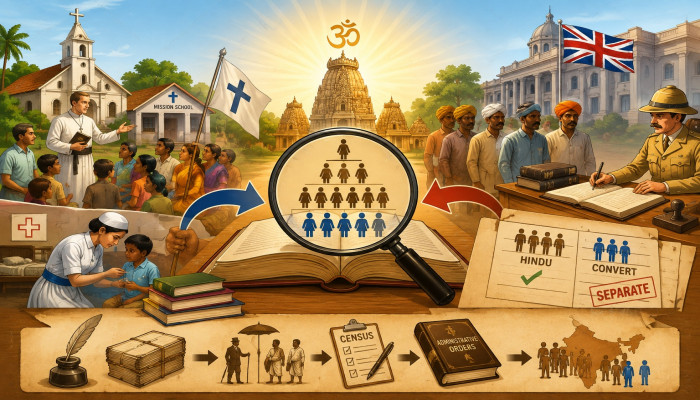
The decisive administrative moment came in 1932. Prime Minister Ramsay MacDonald's Communal Award, framed to allocate separate electorates among India's communities, drew a sharp and deliberate line: it treated "Indian Christians" as a distinct political and electoral minority, wholly separate from the Depressed Classes. A Dalit who had converted to Christianity was, under the Award, an Indian Christian for electoral purposes, not a member of the Depressed Classes. Such a person could neither vote in, nor contest, the seats specifically reserved for the Depressed Classes.
This was not an oversight. The British administration, dealing daily with the realities of caste, religion, and colonial governance, took the considered position that conversion to an Abrahamic faith changed a person's political and social classification. It dissolved, for electoral law, the individual's identity as a member of the Depressed Classes. The Poona Pact of the same year, the settlement between Gandhi and Ambedkar that replaced separate electorates with reserved seats within the general electorate, likewise operated within this same framework: the reserved seats were for the Depressed Classes as a Hindu social category, not for a religion-neutral class of the economically disadvantaged.
The Government of India Act, 1935 and the 1936 Order
Three years later, the Government of India Act, 1935 authorised the Governor-General to specify, by order, which castes, races, or tribes would be treated as Scheduled Castes for representation and administration. Acting under this power, the colonial government issued the Government of India (Scheduled Castes) Order, 1936, the instrument that coined the very term "Scheduled Castes." The 1936 Order restricted the definition strictly to persons professing the Hindu religion. Indian Christians of Dalit origin were explicitly and knowingly excluded.
It is worth pausing on the significance of this. The post-Independence Constitution (Scheduled Castes) Order, 1950, the instrument at the centre of today's controversy, did not invent the religion criterion. It inherited it, almost verbatim, from an instrument that had already been in continuous administrative use for over a decade. When Dr Ambedkar and the framers of India's Constitution came to address the question of Scheduled Castes in 1949, they were not writing on a blank slate. They were ratifying and, in the case of Sikhs and later Buddhists, cautiously extending a classification that colonial administrators, working from census data and ground-level observation rather than any ideological programme, had already settled a generation earlier.
Early Representations for Inclusion — and Their Rejection
The demand to bring Christian Dalits within the ambit of Depressed Classes protections is not a new one; it is, in fact, older than Independence itself. Christian organisations in South India — where a substantial proportion of Dalit conversions to Christianity had occurred through nineteenth and early twentieth-century missionary activity — periodically pressed the colonial government to recognise continuing caste-based disadvantage among converts and extend the same statutory protections available to Hindu Depressed Classes.
These representations were considered and were not accepted. The colonial state's position — later inherited without significant modification by the Constituent Assembly, as the second article in this series will show — was that the disability in question was untouchability, a phenomenon rooted in the Hindu social order, and that the act of conversion to a faith which formally repudiated caste distinctions was itself evidence that the convert had exited the social system generating the disability. The state did not deny that Christian converts of Dalit origin might continue to face economic hardship or informal social prejudice. It declined, however, to treat that hardship as equivalent to the specific, ritualised, birth-imposed disability of untouchability for which the Depressed Classes framework existed.
Why This History Matters Today
Three points emerge from this record that bear directly on the contemporary debate.
First, the religion criterion in Indian reservation law long predates the Constitution. It cannot be dismissed as a parochial choice made by a Hindu-majority Constituent Assembly. It was the settled position of a foreign, religiously disinterested colonial administration operating from empirical census data across more than two decades: the Simon Commission (1927), the Communal Award (1932), and the 1936 Order.
Second, the demand for extension to Christian converts is not a modern innovation responding to newly discovered facts about post-conversion discrimination. It was raised, considered, and rejected under conditions where the colonial government had every institutional incentive to accommodate minority religious demands as part of its wider strategy of communal balancing, and it still declined to do so, because the underlying rationale (untouchability as a Hindu-specific disability) did not fit the facts of the Christian convert population as understood at the time.
Third, and most importantly, the historical record shows that the exclusion was never framed as hostility to Christianity or Islam as religions. It was framed, consistently, as a definitional judgment about what untouchability is and who continues to suffer from it a judgment that the Constituent Assembly would revisit in even greater depth after 1947, as the next article in this series will show.
Anticipating the Objection: "Colonial Categories Should Not Bind a Free Republic"
A natural rejoinder to the account given above is that India's Constitution was written precisely to break from colonial categories, not to ratify them, and that the mere fact that the British classified Scheduled Castes as a Hindu-specific category tells us nothing about what independent India's Constitution ought to have done. This objection deserves to be taken seriously rather than waived away, because in many areas of law and policy the Constituent Assembly did exactly that: it dismantled colonial structures of separate electorates, princely privilege, and racial hierarchy without a backward glance.
But the objection proves too little here, for a specific reason: the Constituent Assembly did not simply inherit the 1936 Order by default or oversight. As the second article in this series details, it examined the question of extending Scheduled Caste protections to Christian converts afresh, through a dedicated Sub-Committee process, heard directly from Christian representations pressing for exactly the change the objection now urges, and reached the same conclusion as the colonial administration but for its own, independently stated reasons, rooted in the specific character of untouchability as a Hindu social phenomenon rather than in any deference to British precedent. The continuity between the colonial and constitutional position is therefore not a case of inertia; it is a case of two very differently motivated bodies — an empire concerned with administrative and electoral management, and a sovereign constituent assembly concerned with remedying a specific historical injustice — independently arriving at the same definitional boundary because the underlying social fact (the confinement of ritual untouchability to the Hindu social order) had not changed between 1936 and 1949. Where the Assembly judged a colonial category ill-suited to independent India's needs, it discarded it. Where it judged the category factually sound, as it did here, it kept it — and said so, in terms, through the debate examined in Part 2.
A Note on the Mass Movements and Missionary Motives
It would be a distortion of the colonial-era record to suggest that Christian missionary interest in Dalit communities was purely opportunistic or free of genuine humanitarian motive; mission schools, hospitals, and orphanages provided real and valued services in regions the colonial state itself under-served. But it would be an equal distortion to ignore that the same missions were, as a matter of institutional record, actively engaged in organised "mass movement" conversion campaigns specifically targeting Depressed Classes communities in the Telugu-speaking districts, coastal Andhra, and parts of Tamil Nadu and Kerala precisely during the decades of the 1870s through the 1930s when the administrative categories discussed in this article were taking shape. The colonial state's decision to treat converts as a separate electoral and administrative category from the Depressed Classes cannot be understood in isolation from its awareness of this ongoing missionary activity; the 1936 Order's religion criterion was, among other things, a recognition that the pool of persons converting out of Depressed Classes status during this very period needed to be administratively distinguished from those who remained within it. This institutional backdrop, examined in far greater depth in Part 4 of this series, is essential context for understanding why the religion criterion was drawn precisely where it was.
Looking Ahead
The Constituent Assembly did not write on a blank page when it came to defining Scheduled Castes in independent India's founding document. It inherited a settled colonial classification, a settled colonial rejection of extension to converts, and as the next article will demonstrate, it would go on to debate the question afresh, in far greater depth, and reach the same conclusion, this time with the explicit participation and endorsement of the Christian community's own accredited representatives in the Assembly. That story of Dr Ambedkar, Sardar Patel, Dr H.C. Mookerjee, and Rajkumari Amrit Kaur — is the subject of Part 2.
‘A Patch on the Hindu Religion’: What the Constituent Assembly Actually Decided About Scheduled Castes and Conversion Part 2



 Loading...please wait
Comments