




‘A Patch on the Hindu Religion’: What the Constituent Assembly Actually Decided About Scheduled Castes and Conversion Part 2
- In Current Affairs
- 12:43 PM, Aug 11, 2026
- YagnaSri
Introduction
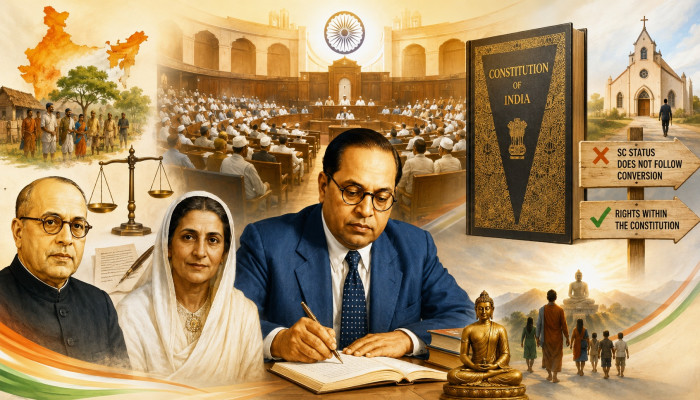
If there is one historical claim that does the most damage to the case for extending SC status to Christian and Muslim converts, it is this: the men and women who wrote India's Constitution considered the exact question now before the country — and answered it, deliberately and on the record, in the negative. This was not a silence later exploited by a hostile bureaucracy. It was a live, contested issue placed squarely before the Constituent Assembly, argued from multiple sides, and resolved through the direct participation of the Christian community's own elected representatives within the Assembly. This article reconstructs that debate.
The Sub-Committee on Minorities and the 1947 Memoranda
As early as August 1947, the Sub-Committee on Minorities of the Constituent Assembly examined written representations from Christian organisations in South India — the Madras Provincial Christian Association, the Travancore-Cochin Native Christian Association, and the South Indian Christian Dalit Federation among them — each pressing the same claim later revived by the Ranganath Misra Commission six decades on: that conversion to Christianity had not materially altered the economic condition of Dalit converts, and that they should therefore continue to receive the protections available to Hindu Depressed Classes.
The Sub-Committee considered these memoranda and declined to accept them. It refused to create any sub-category of "Christian Scheduled Castes," choosing instead to group all Indian Christians regardless of caste origin under the single, undifferentiated category of "Indian Christian" minority. The reasoning offered was not administrative convenience; it reflected a considered view that a change of religious identity carried consequences for how the Constitution would classify the person, consistent with the position the colonial state had taken since 1932.
Christian Representatives Who Renounced the Claim Themselves
What distinguishes the Constituent Assembly debate from the colonial-era rejections that preceded it is that the decisive voices against extension were not only Hindu. They included the Christian community's most senior representatives in the Assembly.
Dr H.C. Mookerjee, Vice-President of the Constituent Assembly and the principal accredited representative of Indian Christians, stated on 25th May 1949 that the Christian community did not seek separate electorates or caste-based reservations of the kind available to Hindu Scheduled Castes, and expressed the community's wish to merge fully into the national mainstream rather than seek a protected constitutional category defined by caste.
Rajkumari Amrit Kaur, another senior Christian member of the Advisory Committee on Minorities and independent India's first Health Minister, went further in her memorandum. She argued that the very phrase "Christian Scheduled Castes" was a contradiction in terms, since Christianity as a faith recognised no caste distinctions. Reservation on caste lines within a professedly casteless religious community was, in her submission, incompatible both with the secular character of the emerging Republic and with the theological commitments of her own faith.
It is difficult to overstate the significance of this fact for the present debate. The demand for extending SC status to Christian converts is regularly framed today as a matter of belated justice denied to a community that has always wanted it. The Constituent Assembly record shows the opposite: the community's own highest-standing representatives at the founding moment of the Republic disclaimed the demand as inconsistent with their faith and their vision of a secular, casteless national identity.
Sardar Patel's Formulation: A "Patch," Not a Minority Right
Presenting the Report of the Advisory Committee on Minorities on 25 May 1949, Sardar Vallabhbhai Patel offered what remains the single most quoted characterisation of what Scheduled Caste status is, and is not. Patel described the Scheduled Castes as a mark of injury on the Hindu social body itself a wound requiring urgent remedy and was explicit that the reservation was never conceived as a political safeguard for a religious minority. It was, in his formulation, a remedial measure directed specifically at erasing the age-old stigma of untouchability from within Hindu society.
The distinction Patel drew is the analytical key to the entire debate, then and now: religious minorities (Muslims, Christians, Sikhs, Parsis, and others) received one kind of constitutional protection, calibrated to minority-rights concerns: protection of religious and cultural practice, minority educational institutions, and so on. Scheduled Castes received a categorically different kind of protection, calibrated to the specific historical wrong of untouchability within Hindu society. Conflating the two, in Patel's presentation to the Assembly, would have been a category error.
Ambedkar's Own Words: "They Cannot Carry the Label With Them"
Nobody’s testimony carries more weight on this question than Dr B.R. Ambedkar's not merely because he chaired the Drafting Committee, but because he was himself a member of a Scheduled Caste and the foremost champion of Dalit rights in the Assembly. While explaining the provisions relating to political reservation for Scheduled Castes (the draft article that became Article 330), Ambedkar drew an unambiguous distinction between Scheduled Castes as a technical, legally defined category and religious minorities as a separate constitutional category altogether.
His clarification, recorded in the Constituent Assembly Debates, established three propositions that remain dispositive:
- "Scheduled Caste" is a technical legal designation, not a general term for social or economic disadvantage. It applies specifically to those who have suffered the particular stigma of untouchability within the Hindu social order, not to backwardness at large, for which the Constitution provides separately through Articles 15(4) and 16(4).
- A group that "steps out" of the Hindu social system Ambedkar's own phrase, understood by every member of the Assembly as a direct reference to religious conversion — thereafter falls to be governed by the general constitutional provisions applicable to all citizens or to religious minorities, not by the special compensatory regime built around untouchability.
- Critically, Ambedkar held that such a group cannot carry the Scheduled Caste label with them upon leaving that system. The label, in his construction, belongs to the social order that produced the disability, not to the individual as a portable, inheritable entitlement detachable from that order.
This is not a marginal aside in the Constituent Assembly Debates. It is Ambedkar's structural account of what Scheduled Caste status is, delivered by the person who did more than anyone alive at the time to define, defend, and constitutionally entrench the rights of India's Dalit communities. Any argument that Ambedkar would have supported extending SC reservations to converts has to explain away somehow this express, on-the-record clarification by Ambedkar himself.
What the Assembly Chose to Build Instead
Having rejected the demand for religion-neutral SC status, the Constituent Assembly did not leave Christian and Muslim citizens of Dalit origin without any constitutional recourse. It built, deliberately, a differentiated architecture:
- Article 15(4) and 16(4) created reservations for "socially and educationally backward classes" generally, a category open to backward communities regardless of religion, and the correct constitutional home for claims of general economic and social disadvantage.
- Article 30 guaranteed religious and linguistic minorities, including the Christian community, the right to establish and administer their own educational institutions — a substantial institutional advantage that Hindu Scheduled Castes, lacking any comparable community-run network on the same scale, did not possess.
- Article 341, read with the inherited 1936 Order (soon reissued as the Constitution (Scheduled Castes) Order, 1950), preserved the specific, untouchability-linked SC category for Hindus — later extended, on the same logic, to Sikhs in 1956 and Buddhists in 1990, in each case because the empirical evidence showed continuing caste-based disability within those communities specifically.
This was not an oversight correctable by later amendment. It was a considered constitutional design, in which each community's needs were addressed through the mechanism suited to the nature of the disadvantage — general backward-class reservation for socio-economic disadvantage, minority-institution rights for religious and cultural protection, and the specific SC category reserved for the specific historical wrong of untouchability.
Anticipating the Objection: "Debates Are Not Law"
It is sometimes argued that Constituent Assembly Debates are, at best, an interpretive aid and cannot override the plain text of the Constitution or bind later generations to the specific policy views of individual framers, however eminent. This is a fair statement of orthodox constitutional method — courts do treat the text as primary and debates as extrinsic aid, to be used chiefly where the text is genuinely ambiguous. But the argument does not assist the case for extension here, for two independent reasons.
First, the operative text is not itself ambiguous. Clause 3 of the Constitution (Scheduled Castes) Order, 1950, issued under the express constitutional authority of Article 341(1), states in unqualified terms that no person professing a religion different from Hinduism, Sikhism, or Buddhism shall be deemed a member of a Scheduled Caste. This is not a case of the Assembly's debates being invoked to fill a textual gap; the text itself already answers the question, and the debates merely confirm that the text means what it says and was drafted with this precise scenario in view.
Second, and more importantly for this article, the Constituent Assembly material recounted above is not being offered as a free-floating expression of individual opinion to be weighed against the text. It is being offered as direct evidence of what the Assembly understood itself to be doing when it authorised the very Presidential power — Article 341 — under which the 1950 Order was subsequently issued. Sardar Patel's characterisation of Scheduled Castes as a matter internal to Hindu society, and Ambedkar's clarification that the designation cannot travel with a convert, were not stray remarks in an unrelated debate; they were offered in the course of explaining the constitutional provisions establishing political reservation for Scheduled Castes, the direct textual sibling of Article 341. Read together, text and debate point in the same direction, which is precisely the condition under which Indian constitutional courts have historically treated Constituent Assembly Debates as carrying real interpretive weight, not merely persuasive colour.
Conclusion: A Settled Question, Revisited by Ambedkar Himself
The Constituent Assembly did not overlook the question of extending SC status to converts. It examined the question through a dedicated Sub-Committee process beginning in 1947, heard directly from the Christian community's own senior representatives, received Sardar Patel's foundational characterisation of what Scheduled Caste status means, and closed the matter with Dr Ambedkar's own authoritative clarification that the label cannot travel with an individual who steps outside the Hindu social order.
The next article in this series turns to a question that campaigners for extension rarely engage with directly: what did Ambedkar himself say and do about this question after Independence — particularly in the two decades between 1936 and his own historic conversion to Buddhism in 1956 — and how do the positions taken today by groups invoking his name compare with the positions he actually held?
Before the Constitution: How 'Scheduled Caste' Was Born a Hindu Category — And Why the British Kept It That Way Part 1
Disclaimer: The opinions expressed within this article are the personal opinions of the author. MyIndMakers is not responsible for the accuracy, completeness, suitability, or validity of any information on this article. All information is provided on an as-is basis. The information, facts or opinions appearing in the article do not reflect the views of MyindMakers and it does not assume any responsibility or liability for the same.



 Loading...please wait
Comments