Reclaiming Hinduism as a Religion. Liberal in debate, Generous in its tests
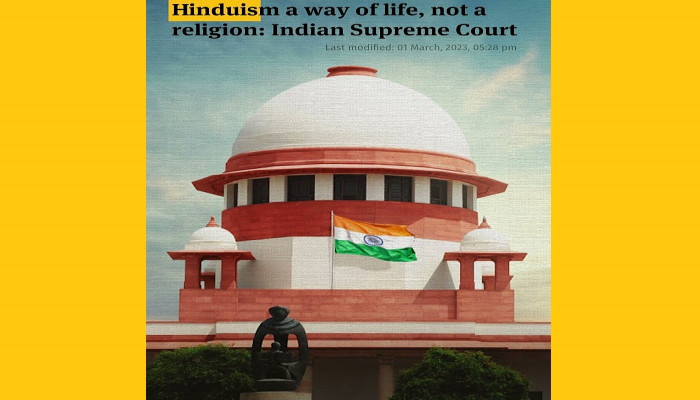
There is a formula that has become almost reflexive in the way Hindu leadership and thinkers present Hindu identity to the world: Hinduism, we are told, “is not a religion; it is a way of life.” It even surfaces regularly in the writings and addresses of prominent Hindu leaders of various fields, where Hindu identity is described as a civilisational, cultural and national inheritance rather than “a rigid set of religious rituals,” and where religion, if it means anything narrower than that, is treated as a category native to “the Western sense,” ill-suited to describe what Hindus actually have.
The formula is offered as a generosity, an invitation to Muslims, Christians, Sikhs and everyone else to find room inside a broad Hindu civilisational tent without converting or conforming. It is meant to sound expansive. It is, in fact, a serious category error, and on inspection it turns out to be neither theologically accurate nor strategically safe. Hinduism is a religion. It has a scriptural foundation, a coherent metaphysics, and a transmitted body of practice built on both. What distinguishes it from the Abrahamic faiths is not the absence of these things, but their unusually liberal internal architecture: openness to multiple valid paths, multiple valid interpretations, and multiple valid images of the divine, all traceable to a shared textual and metaphysical root. All these traits of a religion. It is not a description of the absence of one.
What the “Way of Life” Formula Gets Wrong on Its Own Terms
Start with the plainest objection, the one that follows almost as a matter of logic rather than theology. The Vedas are regarded, across every Hindu denomination without exception, as eternal apaurusheya, not of human authorship, transmitted rather than composed. Every subsequent layer of the tradition, however far it appears to travel from the Vedic hymns the Puranas, the Agamas, the Smritis, the bhakti literature devoted to a chosen personal deity is understood by its own tradition as an extension or elaboration of that Vedic foundation, not a departure from it. The worship of a particular ishta-devata, whichever form or name a devotee chooses, is grounded in a shared metaphysical claim: that God, Atman and Sat are ultimately one, and that the personal deity is a manifestation of that single underlying reality. This is not folklore. It is the explicit position of Vedanta across its major schools, which disagree sharply on how the one and the many relate, but never disagree that a single ultimate reality is approached through different forms.
It is simply not coherent, then, to say in one breath that Hindus lack a central text or a settled doctrinal core, and in the next breath to insist that Hinduism cannot be called a religion because it lacks a central text or a settled doctrinal core. If the metaphysics is there and it plainly is, running in an unbroken line from the Upanishads through the classical darshanas to the temple traditions practised today, then the “way of life” formula is not describing Hinduism accurately. It is describing a caricature of Hinduism built to fit a narrow, book-and-prophet definition of religion that Hindus are then declared to fail. The honest response to that narrow definition is to reject the definition, not to concede the premise and abandon the word.
Where the Formula Actually Comes From
It is worth being candid about the formula's real origin, because it is not primarily theological; it is judicial and political. The Supreme Court of India, in Sastri Yagnapurushdasji v. Muldas Bhundardas Vaishya (1966) and later in the so-called Hindutva cases, most prominently Ramesh Yeshwant Prabhoo v. Prabhakar Kashinath Kunte (1996), characterised Hinduism as a “way of life” or “state of mind” rather than a narrow religious creed. The Court's purpose in doing so was pragmatic: it wanted a broad, non-sectarian umbrella that could accommodate reformist legislation, extend statutory Hindu personal law to Sikhs, Jains and Buddhists without treating that extension as majoritarian religious imposition, and permit “Hindutva” to be invoked in election speeches without automatically falling foul of the Representation of the People Act's ban on appeals made “on the ground of religion.” These were reasonable goals for the specific legal problems the Court was solving. But a formula devised to solve a jurisdictional and electoral-law problem in India is not a theological finding about the nature of Hinduism. It was never meant to be exported wholesale as a definitional slogan for how the faith should be described to the rest of the world, least of all by the faith's own most visible cultural leadership.
The Domestic Cost: An Asymmetry the Tradition Does Not Deserve
The “way of life” formula has a price, and Hindus in India are already paying part of it. Article 25 of the Constitution protects the right to profess, practise and propagate “religion.” Indian courts have developed the Essential Religious Practices test to decide which specific practices fall inside that protection. Faiths believed to be built around a single canonised text the Quran, the Bible clear that test relatively easily: courts can most of the time point to an explicit scriptural mandate and call it essential.
But that is not the real and correct position. Even in the Bible, the New Testament has 4 books by 4 writers; the Old Testament, which is contradicted by the content of the New Testament, is a part of their religious corpus. Christians even now have several major and countless minor denominations (the word in the Indian Constitution, in fact, taken from this Christian idea) and internally disagree on a lot of fundamental issues. Islam also has several major and numerous minor divisions, and these divisions are very profound. Both religions fought massive wars to settle these disputes, resulting in massive bloodshed and still struggle today to reconcile their differences. Even Judaism has many sects going back centuries. So the religions of the book are, in fact, not as united as being said by the people apply their features to define the word “religion” A tradition rhetorically flattened into a diffuse “way of life,” with no single book and no central authority, need not struggle to clear the same bar.
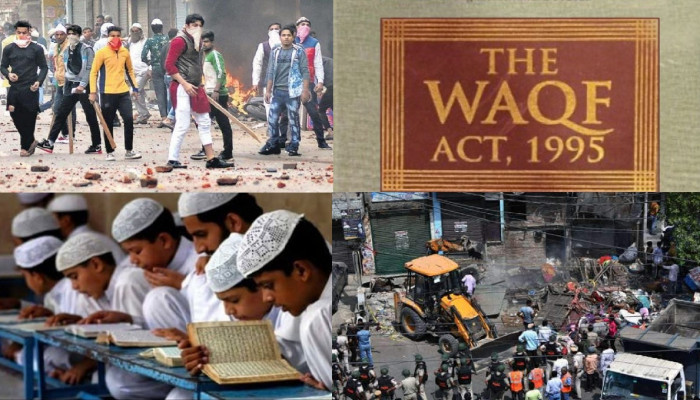
Yet the courts in India routinely find it easier to declare a given Hindu temple custom, a hereditary priesthood, or a specific ritual sequence a “non-essential social custom” rather than an indispensable religious command precisely because the tradition has been described, by its own most prominent spokesmen, as something looser than a religion to begin with. That classification then licenses direct state administration of Hindu temples through Hindu Religious and Charitable Endowments boards in state after state. At the same time, Waqf properties and Church trusts remain substantially shielded under Articles 26 and 30. Hindu institutions did not ask for this asymmetry. The “way of life” formula supplies its legal justification.
The Diasporic Cost: A Formula That Does Not Travel
The domestic cost, real as it is, was at least incurred inside a legal system built to accommodate it. The cost abroad is more dangerous, because Western jurisprudence does not carry the same accommodating instincts. American and European constitutional law draws a hard line between religion, which receives specific and powerful protection, and culture or personal philosophy, which generally does not.
In the United States, the First Amendment's Free Exercise Clause and the Religious Freedom Restoration Act protect “sincerely held religious belief,” a standard that a “cultural lifestyle” does not automatically meet. A Tilak, a Janeu, a dietary observance, a request for leave on Diwali: all of these are well-protected as religious practice, and considerably more exposed if Hinduism is publicly described, by its own leadership, as a civilisational ethos rather than a religion.
The same gap opens under Title VII's duty on employers to reasonably accommodate religious practice, which does not extend to mere cultural preference. It opens again under Section 501(c)(3) of the US tax code, where “churches”, a category temples qualify for as places of religious worship, receive an automatic, lightly audited exemption that a “cultural centre” or “philosophical society” would not enjoy in the same way. And it opens under hate-crime and discrimination statutes in both the US and UK, which name religion specifically alongside race and national origin; prosecuting an attack on a mandir as a religiously motivated hate crime becomes measurably harder to argue if the community itself has spent decades insisting its faith is not, strictly, a religion. Europe's framework under Article 9 of the European Convention on Human Rights runs the same way, drawing its own sharp distinction between protected religious obligation and unprotected personal philosophy.
None of these consequences is hypothetical scaremongering. They are the direct, foreseeable operation of legal systems that were never built with a “way of life” category in mind, applied to a diaspora that is simultaneously growing in number, increasingly visible, and already contending with temple vandalism, hate incidents and a genuine security climate that a diffuse cultural-identity framing does nothing to help address. A community that wants the specific legal shields religion carries cannot simultaneously disclaim being a religion for the sake of sounding inclusive on a podium.
The Better Argument: Religion, Yes, but a more liberal one
None of this requires retreating into the kind of rigid, single-text, single-authority model that the “way of life” formula was trying, however clumsily, to avoid. The honest and more defensible position is different: Hinduism is a religion grounded in a real scriptural and metaphysical core, and what makes it distinctive is not the absence of that core but the exceptional liberality of what is built on top of it.
The Vedic tradition itself supplies the material for this argument, and it does so without borrowing a Western template. The six classical darshanas - Nyaya, Vaisheshika, Samkhya, Yoga, Mimamsa, and Vedanta disagree with one another on fundamental questions of metaphysics and epistemology, while each claims Vedic legitimacy.
Adhikara-bheda, the principle that different seekers at different levels of readiness are given different paths suited to their capacity, builds pluralism into the tradition's own internal logic rather than treating it as an accommodation forced on the tradition from outside. Ekam Sat Vipra Bahudha Vadanti, properly read, addressed to those learned in the Vedas, not as a blank cheque for equating every claim to religious truth everywhere, describes exactly this: one reality, described and approached in more than one legitimate way by those within the fold who have earned the standing to describe it. A tradition that permits a devotee to worship Krishna, Shiva, Devi or a formless Brahman, that permits fierce philosophical disagreement between Advaita, Vishishtadvaita and Dvaita on the nature of that very reality, and that has never required a single creed to be recited as a condition of belonging, is not a tradition without religious content. It is a religion whose internal constitution happens to be federal rather than centralised.
This distinction is not merely a religion, but a liberal one, and it also solves the practical legal problem that the “way of life” formula creates and cannot itself solve. Indian courts currently strain to find an “essential” practice because they are implicitly hunting for a single, Vedic-wide mandate on the Abrahamic model, something the tradition was never structured to supply. A more honest test, consistent with how the tradition actually organises itself, would ask not “is this practice essential to Hinduism as a monolith” but “is this practice traceable, through a recognisable line of textual, Agamic or sampradaya authority, to the Vedic corpus that every Hindu denomination accepts as foundational.” That is a generous test, considerably more generous than the ERP doctrine as currently applied. However, it is not infinitely open, because it still requires a real chain of authority to a real textual root. It stops well short of licensing the state to treat every temple custom as an arbitrary, disposable social habit. It gives Hindu institutions, in India and abroad, a coherent and defensible answer to “what makes this religious” that does not depend on borrowing Islam's or Christianity's structure and does not depend on disclaiming religious status altogether.
What Hindu Leadership should actually be saying
The Hindu leadership are not wrong to resist a narrow, imported definition of religion that measures Hinduism against a single book and a single prophet and finds it wanting. That resistance is correct. But the answer to a bad definition is a better definition, not a retreat from the category altogether. What should be said is not that Hinduism is “not a religion, but a way of life”, a formula that concedes the very ground it should be contesting, weakens Article 25 protection for temples at home, and strips the diaspora of First Amendment, RFRA, Title VII and hate-crime protections abroad. What should be said is that Hinduism is a religion in the fullest sense rooted in the Vedas, structured around a coherent, if internally debated, metaphysics of Brahman, Atman and Sat, and expressed through millennia of textual, Agamic and devotional elaboration and that its particular genius is a liberality of interpretation and practice that Abrahamic frameworks were never built to contain. That is a claim Hindus can defend in an Indian courtroom, in an American federal court, and before a European human-rights tribunal alike.
“Way of life” cannot be defended in any of the three, and every year it goes uncorrected is a year the tradition's own legal shields, at home and abroad, grow thinner.
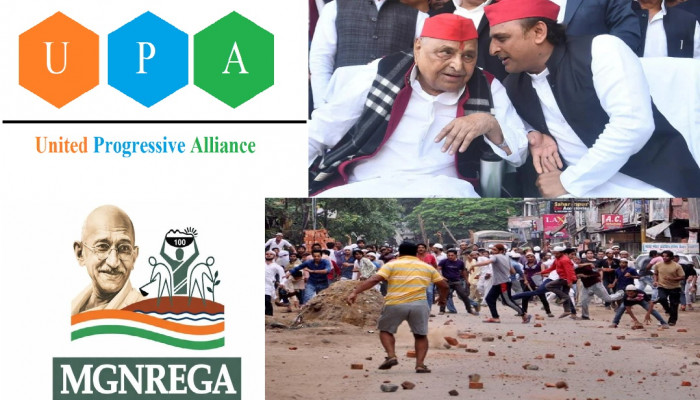
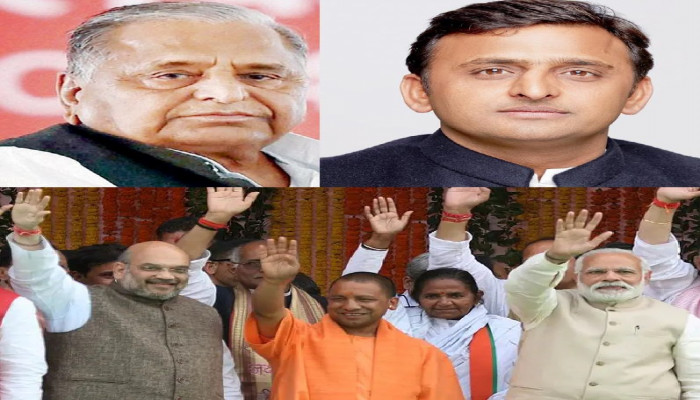
Between 2004 and 2014, the United Progressive Alliance (UPA) governed India from New Delhi with a parliamentary arithmetic that placed Uttar Pradesh at the very centre of its survival calculations. The UPA-I government (2004–2009) was propped up by external support from the Samajwadi Party of Mulayam Singh Yadav, whose 36 Lok Sabha members from UP were the single most important block keeping the Congress-led coalition alive after the Left withdrew support in 2008. The UPA-II government (2009–2014) operated with a nominally larger majority but remained perpetually anxious about UP, which returned 80 of Parliament's 543 Lok Sabha members and whose political terrain would determine the 2014 electoral outcome. This structural dependence on UP's regional parties, whose organisational existence depended on maintaining the patronage, impunity, and appeasement systems that had corrupted the state's governance for two decades, produced a decade of deliberate governance neglect disguised as federal sensitivity. The story of UP under the UPA years is how Congress bought political survival at the cost of 200 million citizens' developmental rights.
The SP-Congress Compact: Political Survival Above Governance
The Samajwadi Party's support for UPA-I was not charity. It was a transactional arrangement with specific political returns. In exchange for its parliamentary support, the SP expected and received a range of central government accommodations: relaxed scrutiny of UP's governance failures by central agencies, the channelling of centrally-sponsored welfare schemes through state administrative machinery controlled by SP patronage networks, protection of SP-linked criminal networks from CBI or ED investigation, and the general political protection that comes from being the survival partner of a ruling coalition at the centre.
The most visible manifestation of this arrangement was the UPA government's consistent refusal to impose President's Rule in UP despite a governance situation that, by objective measures of law enforcement, administrative integrity, and welfare delivery, was among the worst in the country. When media reports documented the SP government's protection of criminals, the UP police's systematic targeting of non-Yadav communities, and the diversion of NREGA and food grain distribution funds through SP patronage networks, the UPA government's response was to look away. Central agencies that should have investigated complaints from UP's citizens were conspicuously inactive. The Comptroller and Auditor General's reports on UP's financial management during this period documented massive irregularities; the Union government took no significant action.
The politics of this arrangement were nakedly visible to any attentive observer. Manmohan Singh's government, dependent on SP votes, could not afford to antagonise Mulayam Singh Yadav. The result was a federal arrangement inverted from its constitutional design: instead of the centre holding states accountable for governance failures through audit, investigation, and constitutional oversight, the centre protected a state government's governance failures in exchange for parliamentary support. The ordinary UP citizen, the NREGA worker whose wages were stolen, the crime victim whose complaint was not registered, the farmer whose crop loan application was denied because he lacked SP connections, paid the price for this political bargain.
NREGA and the Welfare-Capture Problem
The UPA government's flagship welfare programme, the Mahatma Gandhi National Rural Employment Guarantee Act (MGNREGA), is often cited as a landmark progressive achievement. In the national narrative, it provided a legal right to 100 days of employment per year for rural households, offering a significant income floor for the rural poor. In Uttar Pradesh, the reality was considerably more complex and considerably less benign.
UP received the largest allocation under MGNREGA of any Indian state—proportionate to its vast rural population and massive development deficit. Between 2006 and 2014, the scheme transferred thousands of crores to UP. What happened to this money in the state's villages illustrates the fatal flaw in welfare schemes delivered through politically compromised administrative machinery: the ruling party's patronage networks captured it at every level of the distribution chain.
CAG audits of UP's MGNREGA implementation between 2007 and 2012 documented systematic fraud on a scale that dwarfed any previous welfare scheme misappropriation in the state. Job cards were created in the names of fictitious workers; wages were paid to 'ghost' beneficiaries whose bank accounts were controlled by local SP workers; measurements of completed works were systematically inflated; materials were procured at prices three to five times their market value through suppliers with political connections. In some districts, the actual work completed under MGNREGA represented less than 30 per cent of the reported expenditure.
The BJP's National Democratic Alliance governments in the states where it was in power — Gujarat, Madhya Pradesh, Rajasthan, Chhattisgarh demonstrated what honest MGNREGA implementation looked like: genuine asset creation, real wage payments to real workers, and administrative accountability. The contrast with UP was not accidental. It reflected the fundamental difference between a governance culture rooted in the BJP's organisational discipline and one rooted in the SP's patronage model. The UPA government, which had the authority and the constitutional obligation to enforce MGNREGA implementation standards nationally, did not apply that authority in UP because doing so would have disrupted the SP's political economy and jeopardised the coalition's parliamentary arithmetic.
The Communal Violence Record: Selective Outrage and Administrative Abdication
The UPA decade saw a series of communal incidents in UP, and the central government's response was shaped more by political calculation than by equal protection for all communities. The Muzaffarnagar riots of September 2013, which occurred under the Akhilesh Yadav SP government and which the central UPA government had advance intelligence about, were the most catastrophic. Over 60 people were killed, more than 40,000 were displaced from their homes in the western UP region, and the social fabric of a district that had historically been characterised by strong Hindu-Muslim agricultural cooperation was permanently damaged.
The BJP's analysis of the Muzaffarnagar riots, supported by the subsequent police investigations and judicial proceedings, identified several specific failures: the UP government's intelligence agencies had reported the deteriorating situation weeks before the violence broke out; the district administration's failure to impose curfew at the right moment was a deliberate choice rather than a bureaucratic oversight; and the post-riot investigations were deliberately distorted to protect SP-aligned individuals who had played roles in inciting violence. The UPA government at the centre which had the authority to direct the state government to take preventive action under Article 355 of the Constitution, failed to exercise that authority because doing so would have required publicly confronting the SP government.
The contrast with the UPA government's response to communal incidents in BJP-governed states was telling. When incidents occurred in Gujarat, Rajasthan, or Madhya Pradesh, however different their scale or character from Muzaffarnagar, the central government dispatched investigation teams, issued public condemnations, and threatened constitutional action. UP's far larger and more frequent incidents of communal and caste-based violence were met with central silence. The message was unmistakable: the UPA's secularism was not a principled commitment to protecting all citizens from violence but a partisan tool for targeting the BJP while protecting its own political allies.
The Infrastructure Deficit: Ten Lost Years
Beyond the welfare scheme failures and the communal violence record, the UPA decade was characterised by a massive missed opportunity in UP's physical infrastructure. The state entered the UPA period with a chronic infrastructure deficit: inadequate roads, unreliable power supply, insufficient irrigation, and a backward logistics network that should have been the central target of central investment. The UPA government's Bharat Nirman programme and the successive Plan allocations included substantial UP components. But the translation of central allocations into ground-level infrastructure was consistently poor.
Power supply in UP during the UPA decade was particularly scandalous. The state's power sector was among the most dysfunctional in India: distribution companies were technically bankrupt, transmission losses were astronomical due to theft and inefficiency, and the average UP household and small enterprise received fewer than 8-10 hours of power daily. The central government's restructured accelerated power development programme allocated substantial funds to UP; however, utilisation was consistently poor, and outcomes consistently inadequate.
The political economy was straightforward: power sector reform required confronting the interests of the SP's organised support base large agricultural users who consumed subsidised power without paying for it- and politically connected contractors who profited from the dysfunctional procurement system. Neither the state SP government nor the central UPA government was willing to impose the discipline that genuine power sector reform required.
The contrast with what the Modi government achieved in UP's power sector after 2014- the Saubhagya scheme that brought electricity connections to virtually every household, and the dramatic reduction in load shedding under the Yogi government after 2017 shows what was possible when governance, rather than patronage, was the organising principle of infrastructure delivery. The ten UPA years were not merely a period of slow progress; they were a period of structural deepening of UP's infrastructure deficit that would require extraordinary effort to reverse.
The Political Legacy: What the UPA Years Did to UP's Democratic Culture
The most serious damage that the UPA decade inflicted on UP was not economic but political. By showing that the central government would consistently prioritise coalition arithmetic over UP's governance needs, the UPA years reinforced the lesson UP's political class had learned since the Nehruvian era: that the state's governance outcomes were secondary to its value as a political resource for the centre. This lesson corrupted the incentive structure of UP's political class at every level.
State-level politicians learned that delivering governance was less important than maintaining the right relationship with the central coalition. District-level administrators learned that advancement ran through political loyalty rather than administrative performance. Citizens learned that their welfare depended less on their democratic choices and more on whether they belonged to the community that happened to be the coalition's current favourite. The cumulative effect was a political culture of dependency, cynicism, and transactional calculation that the BJP would have to work hard to change after 2014.
The UPA decade's greatest unintended political consequence was creating the conditions for the Modi wave of 2014. A population that had experienced ten years of governance-by-appeasement, welfare scheme capture, infrastructure neglect, and selective law enforcement was primed for a political leader who offered a fundamentally different proposition: that governance honest, efficient, non-discriminatory delivery of public services was possible in India, and that the BJP under Narendra Modi was the instrument through which it would be delivered. The scale of the 2014 mandate in UP 71 of 80 Lok Sabha seats was not merely an anti-incumbency verdict. It was a cry for governance from a population that had waited too long.
The Rise of the Syndicate: Muslim Demographics, Appeasement, and Mafia Politics in UP Part 20
https://myind.net/Home/viewArticle/the-rise-of-the-syndicate-muslim-demographics-appeasement-and-mafia-politics-in-up-part-20






 Loading...please wait
