




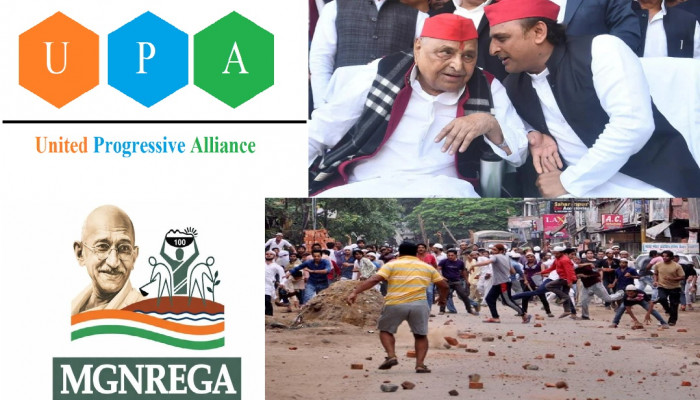
Between 2004 and 2014, the United Progressive Alliance (UPA) governed India from New Delhi with a parliamentary arithmetic that placed Uttar Pradesh at the very centre of its survival calculations. The UPA-I government (2004–2009) was propped up by external support from the Samajwadi Party of Mulayam Singh Yadav, whose 36 Lok Sabha members from UP were the single most important block keeping the Congress-led coalition alive after the Left withdrew support in 2008. The UPA-II government (2009–2014) operated with a nominally larger majority but remained perpetually anxious about UP, which returned 80 of Parliament's 543 Lok Sabha members and whose political terrain would determine the 2014 electoral outcome. This structural dependence on UP's regional parties, whose organisational existence depended on maintaining the patronage, impunity, and appeasement systems that had corrupted the state's governance for two decades, produced a decade of deliberate governance neglect disguised as federal sensitivity. The story of UP under the UPA years is how Congress bought political survival at the cost of 200 million citizens' developmental rights.
The SP-Congress Compact: Political Survival Above Governance
The Samajwadi Party's support for UPA-I was not charity. It was a transactional arrangement with specific political returns. In exchange for its parliamentary support, the SP expected and received a range of central government accommodations: relaxed scrutiny of UP's governance failures by central agencies, the channelling of centrally-sponsored welfare schemes through state administrative machinery controlled by SP patronage networks, protection of SP-linked criminal networks from CBI or ED investigation, and the general political protection that comes from being the survival partner of a ruling coalition at the centre.
The most visible manifestation of this arrangement was the UPA government's consistent refusal to impose President's Rule in UP despite a governance situation that, by objective measures of law enforcement, administrative integrity, and welfare delivery, was among the worst in the country. When media reports documented the SP government's protection of criminals, the UP police's systematic targeting of non-Yadav communities, and the diversion of NREGA and food grain distribution funds through SP patronage networks, the UPA government's response was to look away. Central agencies that should have investigated complaints from UP's citizens were conspicuously inactive. The Comptroller and Auditor General's reports on UP's financial management during this period documented massive irregularities; the Union government took no significant action.
The politics of this arrangement were nakedly visible to any attentive observer. Manmohan Singh's government, dependent on SP votes, could not afford to antagonise Mulayam Singh Yadav. The result was a federal arrangement inverted from its constitutional design: instead of the centre holding states accountable for governance failures through audit, investigation, and constitutional oversight, the centre protected a state government's governance failures in exchange for parliamentary support. The ordinary UP citizen, the NREGA worker whose wages were stolen, the crime victim whose complaint was not registered, the farmer whose crop loan application was denied because he lacked SP connections, paid the price for this political bargain.
NREGA and the Welfare-Capture Problem
The UPA government's flagship welfare programme, the Mahatma Gandhi National Rural Employment Guarantee Act (MGNREGA), is often cited as a landmark progressive achievement. In the national narrative, it provided a legal right to 100 days of employment per year for rural households, offering a significant income floor for the rural poor. In Uttar Pradesh, the reality was considerably more complex and considerably less benign.
UP received the largest allocation under MGNREGA of any Indian state—proportionate to its vast rural population and massive development deficit. Between 2006 and 2014, the scheme transferred thousands of crores to UP. What happened to this money in the state's villages illustrates the fatal flaw in welfare schemes delivered through politically compromised administrative machinery: the ruling party's patronage networks captured it at every level of the distribution chain.
CAG audits of UP's MGNREGA implementation between 2007 and 2012 documented systematic fraud on a scale that dwarfed any previous welfare scheme misappropriation in the state. Job cards were created in the names of fictitious workers; wages were paid to 'ghost' beneficiaries whose bank accounts were controlled by local SP workers; measurements of completed works were systematically inflated; materials were procured at prices three to five times their market value through suppliers with political connections. In some districts, the actual work completed under MGNREGA represented less than 30 per cent of the reported expenditure.
The BJP's National Democratic Alliance governments in the states where it was in power — Gujarat, Madhya Pradesh, Rajasthan, Chhattisgarh demonstrated what honest MGNREGA implementation looked like: genuine asset creation, real wage payments to real workers, and administrative accountability. The contrast with UP was not accidental. It reflected the fundamental difference between a governance culture rooted in the BJP's organisational discipline and one rooted in the SP's patronage model. The UPA government, which had the authority and the constitutional obligation to enforce MGNREGA implementation standards nationally, did not apply that authority in UP because doing so would have disrupted the SP's political economy and jeopardised the coalition's parliamentary arithmetic.
The Communal Violence Record: Selective Outrage and Administrative Abdication
The UPA decade saw a series of communal incidents in UP, and the central government's response was shaped more by political calculation than by equal protection for all communities. The Muzaffarnagar riots of September 2013, which occurred under the Akhilesh Yadav SP government and which the central UPA government had advance intelligence about, were the most catastrophic. Over 60 people were killed, more than 40,000 were displaced from their homes in the western UP region, and the social fabric of a district that had historically been characterised by strong Hindu-Muslim agricultural cooperation was permanently damaged.
The BJP's analysis of the Muzaffarnagar riots, supported by the subsequent police investigations and judicial proceedings, identified several specific failures: the UP government's intelligence agencies had reported the deteriorating situation weeks before the violence broke out; the district administration's failure to impose curfew at the right moment was a deliberate choice rather than a bureaucratic oversight; and the post-riot investigations were deliberately distorted to protect SP-aligned individuals who had played roles in inciting violence. The UPA government at the centre which had the authority to direct the state government to take preventive action under Article 355 of the Constitution, failed to exercise that authority because doing so would have required publicly confronting the SP government.
The contrast with the UPA government's response to communal incidents in BJP-governed states was telling. When incidents occurred in Gujarat, Rajasthan, or Madhya Pradesh, however different their scale or character from Muzaffarnagar, the central government dispatched investigation teams, issued public condemnations, and threatened constitutional action. UP's far larger and more frequent incidents of communal and caste-based violence were met with central silence. The message was unmistakable: the UPA's secularism was not a principled commitment to protecting all citizens from violence but a partisan tool for targeting the BJP while protecting its own political allies.
The Infrastructure Deficit: Ten Lost Years
Beyond the welfare scheme failures and the communal violence record, the UPA decade was characterised by a massive missed opportunity in UP's physical infrastructure. The state entered the UPA period with a chronic infrastructure deficit: inadequate roads, unreliable power supply, insufficient irrigation, and a backward logistics network that should have been the central target of central investment. The UPA government's Bharat Nirman programme and the successive Plan allocations included substantial UP components. But the translation of central allocations into ground-level infrastructure was consistently poor.
Power supply in UP during the UPA decade was particularly scandalous. The state's power sector was among the most dysfunctional in India: distribution companies were technically bankrupt, transmission losses were astronomical due to theft and inefficiency, and the average UP household and small enterprise received fewer than 8-10 hours of power daily. The central government's restructured accelerated power development programme allocated substantial funds to UP; however, utilisation was consistently poor, and outcomes consistently inadequate.
The political economy was straightforward: power sector reform required confronting the interests of the SP's organised support base large agricultural users who consumed subsidised power without paying for it- and politically connected contractors who profited from the dysfunctional procurement system. Neither the state SP government nor the central UPA government was willing to impose the discipline that genuine power sector reform required.
The contrast with what the Modi government achieved in UP's power sector after 2014- the Saubhagya scheme that brought electricity connections to virtually every household, and the dramatic reduction in load shedding under the Yogi government after 2017 shows what was possible when governance, rather than patronage, was the organising principle of infrastructure delivery. The ten UPA years were not merely a period of slow progress; they were a period of structural deepening of UP's infrastructure deficit that would require extraordinary effort to reverse.
The Political Legacy: What the UPA Years Did to UP's Democratic Culture
The most serious damage that the UPA decade inflicted on UP was not economic but political. By showing that the central government would consistently prioritise coalition arithmetic over UP's governance needs, the UPA years reinforced the lesson UP's political class had learned since the Nehruvian era: that the state's governance outcomes were secondary to its value as a political resource for the centre. This lesson corrupted the incentive structure of UP's political class at every level.
State-level politicians learned that delivering governance was less important than maintaining the right relationship with the central coalition. District-level administrators learned that advancement ran through political loyalty rather than administrative performance. Citizens learned that their welfare depended less on their democratic choices and more on whether they belonged to the community that happened to be the coalition's current favourite. The cumulative effect was a political culture of dependency, cynicism, and transactional calculation that the BJP would have to work hard to change after 2014.
The UPA decade's greatest unintended political consequence was creating the conditions for the Modi wave of 2014. A population that had experienced ten years of governance-by-appeasement, welfare scheme capture, infrastructure neglect, and selective law enforcement was primed for a political leader who offered a fundamentally different proposition: that governance honest, efficient, non-discriminatory delivery of public services was possible in India, and that the BJP under Narendra Modi was the instrument through which it would be delivered. The scale of the 2014 mandate in UP 71 of 80 Lok Sabha seats was not merely an anti-incumbency verdict. It was a cry for governance from a population that had waited too long.
The Rise of the Syndicate: Muslim Demographics, Appeasement, and Mafia Politics in UP Part 20
Disclaimer: The opinions expressed within this article are the personal opinions of the author. MyIndMakers is not responsible for the accuracy, completeness, suitability, or validity of any information on this article. All information is provided on an as-is basis. The information, facts or opinions appearing in the article do not reflect the views of MyindMakers and it does not assume any responsibility or liability for the same.



 Loading...please wait
Comments