



The Left Liberal hegemony is not just institutional, but a cultural one too : Vamsee Juluri
- In Interviews
- 03:18 AM, Sep 24, 2015
- MyIndMakers
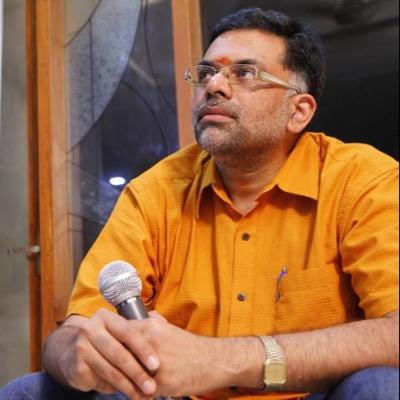
Professor Vamsee Juluri is a professor of media studies at the University of San Francisco. He has authored multiple books on various subjects with the recent one being ‘Rearming Hinduism’. He has written on several media outlets on different issues pertaining to Hinduism, academia, Hinduphobia in media amongst others. In the interview below the team, asked him some questions about a petition written by certain professors to the CEOs of Silicon Valley against investing in ‘Digital India’. We asked some questions about it and the response to the petition.
What was your first reaction when you saw the petition?
I was half hoping there would be something constructive or at least pertinent in the criticisms being raised there. After all, there were some eminent minds in the list of signatories. But none of the concerns raised were above debate, whether it was the stray examples of academic administrative controversies such as Nalanda or FTII, the alarmist tone of the Digital India surveillance bogey, or, most of all, the sly attempt to somehow create a picture that Narendra Modi was still somehow answerable for issues he has been well and truly absolved of any association with. The whole thing sounded like a far-out conspiracy theory, something about UFO's or Atlantis maybe, rather than the work of eminent scholars expecting to be taken seriously.
Has something like this ever happened before? If so, when?
The last time this happened, or at least the last time that I responded to something like it, was during the California textbooks controversy of 2006. On that occasion too, there was an astounding collapse of judgment and commonsense in the academic community when it sent out a mass letter that effectively endorsed the continuation of racism and pseudo-history in the textbooks. Given how brazenly skewed the California history lessons on ancient India were, it would have been a great gesture in cooperation between academia and the Hindu American community to have worked together on it. Instead, a large number of academics saw it as a "saffronization" conspiracy - the absurdity should have been obvious to anyone. Was the BJP in power in Sacramento? Were the Hindus asking for changes insisting that bad things be written about minorities in India? No. They asked for equal treatment with lessons on other religions, and got branded as extremists and religious lunatics for it. It is a travesty that to this day children in California have to read nonsense simply because the experts on South Asia decreed that racist lies about Hinduism are somehow better for the world than a few simple facts about Hinduism's rich philosophy and culture!
Is this left liberal hegemony limited to Indian politics or do you find similar biases in religious issues, especially pertaining to Hinduism?
There has been a shift in the place of the left-liberal academic worldview in the last two decades, and this is something the Hindu activist community has failed to fully grasp just yet. Let me explain a little on how I see it though, since I know it somewhat from the inside.
I was trained in critical and postcolonial cultural studies, in what you might call, left-liberal academic tradition, and found the experience valuable to my intellectual and spiritual growth - I probably would not have seen the value of Hinduism as deeply as I do now but for it! I appreciated, and still appreciate some of the social and ethical goals associated with left-liberal politics, such as respect for religious pluralism, compassion for animals and nature, ending economic exploitation and the like. Unfortunately, I haven't seen the left-liberal academic and activist community do as well as it could on its goals because of its self-defeating and utterly pointless obstinacy when it comes to decolonizing itself from its ‘Hinduphobia’.
The shift I have noticed in the place of this hegemony as you call it is however not what the Hindu community thinks it is. In the 1990s, when I was in college, the campus left liberal worldview was quite marginal to Indian diaspora life and politics. That is no longer the case. Because of a lot of reasons, including the strong support this worldview received from various powerful political interests in New Delhi and elsewhere, particularly between 2004 and 2014, it has virtually been coopted into a position where it cannot be wished away as marginal or irrelevant. In America too it occupies a total monopoly on the discourse on India in mainstream media, academia, and literature. It is not just an institutional hegemony, but a cultural one too: it has taken over the moral high ground on ideals like religious pluralism, tolerance, and diversity. It is an uphill task now for those in academia and the community who wish to challenge this hegemony. It is not impossible, but it cannot be done frivolously or under the complacent fantasy some of us have today that our blogs and social media carry the power or prestige the dominant discourse has today.
You write an excellent rebuttal in the academe blog? How was it received? Can you also describe briefly about the counter petition which received a lot of support.
There were several effective rebuttals to the faculty petition written by scholars and experts on the digital economy in India and in the US. However, I felt that these were only preaching to the converted and not reaching the general American academic community, which is where the dominant ‘Hinduphobic’ view needed to be intellectually challenged.
Given the lack of engagement with social sciences, humanities, and activism more generally in our community, there was a tendency to ignore the petition, or respond in ways that were not, in my view, of primary consequence. For example, there were efforts underway to write to Silicon Valley CEOs rejecting the faculty petition. That was not the point of the whole thing at all. The faculty petition was more about perpetuating the illusion in academia that somehow Modi is supported only by non-academic, un-intellectual "Hindu nationalist" fringe elements. The reality, as the counter petition demonstrated, is that a large number of Indians in American higher education, professors, scientists, alums, students, reject the claims of the original petition.
Has the response to the petition across the board been different from previous times? Is this an encouraging trend? What is the way forward after this conflict?
I was happy that the editor of the academe blog recognized the need to honor the views of other members of American academia too in publishing my letter and our counter-petition. I think that the counterview (that the original faculty petition represents continuing Hinduphobia which was not decolonized in academia like other racisms) was something that academia never really heard before. After having been denied the chance to respond to the Hinduphobic claims of several major newspapers and journals in America over the last few years, I was indeed happy to note that there are still people who value free debate and the pursuit of truth. It was a lesson in the power of democracy, and in the value of civil, professional, and intelligent engagement in debate with one's opponents.
The way forward now is to keep learning - after my frank criticism of my own profession for its failings, I would like to take the liberty of also sharing a few constructive criticisms of our own community's actions here. A good number of us are aware now of the problem in academia and media, and that is a good start. However, we often forget to engage with academia as intelligent interlocutors who understand the issues and wish to contest them.
We tend to approach everything as a management issue, rather than as an issue between intellectuals. I am a bit wary now frankly of some of the efforts going on in the community to pour millions of dollars into funding Hinduism studies as well. Our community is good at business, and is going about it only at the business-level, expecting money to work magic. In the end, it won't, not on its own.
We must approach this literally as a Satyagraha, an adamant insistence on the restoration of truth. We are the victims of untruth, from colonial times. For us to win this, we must stare the issue directly without diversions and distractions, be it ego, money, anger, or false pride about our educational choices and achievements. At some level, we have also paid the price for our disdain for humanities and social sciences. No matter how successful we are as a community, we still can't get textbooks to give us the same basic respect everyone else gets. We need to restore our respect for Saraswati in all her forms and glories, even in social sciences and humanities!



 Loading...please wait
Comments