




Zorawar light tank puts India-Belgium defence partnership in spotlight
- In Reports
- 07:37 PM, Sep 03, 2026
- Myind Staff
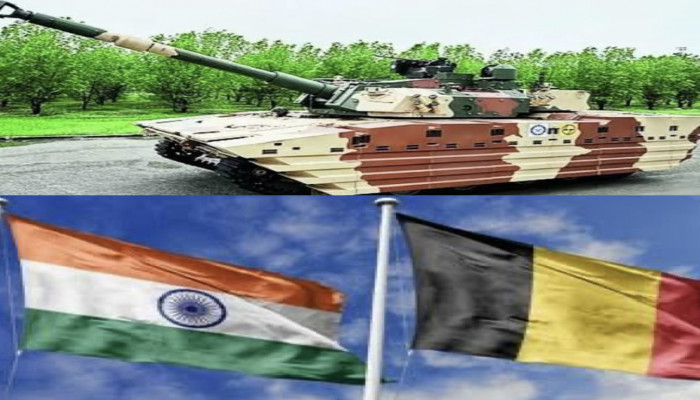
India’s indigenous Zorawar light tank has emerged as a key example of growing defence cooperation between India and Belgium. Prime Minister Narendra Modi highlighted the tank during delegation-level talks with Belgian Prime Minister Bart De Wever in New Delhi on Thursday. He said India and Belgium are working together on modern defence equipment, with Zorawar showing the potential of this partnership.
De Wever is on a three-day official visit to India at Modi’s invitation. It is his first visit to India as Belgium’s prime minister and the first by a Belgian prime minister to India in nearly two decades. He arrived with Belgium’s Minister of Defence and Foreign Trade, Theo Francken, along with officials, business leaders and representatives from the Belgian defence industry.
Earlier on Thursday, Defence Minister Rajnath Singh held separate talks with Francken. The discussions focused on expanding defence manufacturing capabilities in both countries. India and Belgium also signed agreements to strengthen industrial cooperation in the defence sector.
The Zorawar light tank has become an important part of this cooperation. It is India’s first indigenous light tank, developed in just 19 months. The tank was designed for warfare in high-altitude areas, particularly the difficult terrain of the Himalayas.
The Zorawar programme took shape amid tensions between India and China along the Line of Actual Control. The Indian Army had encountered China’s Type 15 light tanks during the standoff. To counter China directly, India needed a light and highly mobile tank that could operate effectively in similar terrain, and Zorawar took shape. According to a TOI report, it is lighter than the Type 15 while carrying comparable firepower.
The tank is named after General Zorawar Singh, the 19th-century Dogra Army general known as the "Conqueror of Ladakh." At around 25 tonnes, Zorawar is built to operate in extreme terrain and low-oxygen conditions. Its main firepower comes from the Belgian-made John Cockerill 3105 turret. The turret carries a 105mm rifled gun and an autoloader.
Zorawar also carries a coaxial 7.62mm machine gun and a 12.7mm remote-controlled weapon station. It has twin launchers for Nag Mk2 anti-tank guided missiles. TOI described the missile capability as a notable addition to the tank’s firepower. The Army has also sought laser warning receivers and an active protection system for the platform to improve its ability to detect and respond to threats.
The tank is powered by a Cummins 760hp diesel engine, which uses a Renk transmission. It can reach speeds of up to 70 km/h and has a range of around 450 km. Its hydropneumatic suspension is designed to help it move across rugged terrain. Its relatively low weight also allows the tank to be airlifted using C-17 Globemaster aircraft, giving the Army greater flexibility in moving it to difficult and remote areas.
India has a long history of using light tanks in the Himalayan region. The Stuart light tank was used during the capture of the Zoji La pass in 1948. The AMX-13 light tank later saw action at Chushul during the 1962 India-China war. It also played a role in countering Pakistan’s Operation Grand Slam in the Chhamb sector during the 1965 war.
The Indian Army has placed an initial order for 59 Zorawar tanks. Its total requirement stands at 354 units. A competition will be held for the remaining 295 tanks, according to the report. The government has already cleared a requirement for seven regiments of light tanks. Their induction is expected to begin in 2027.
Zorawar prototypes have also undergone high-altitude trials in Nyoma, Ladakh, at more than 4,200 metres. The prototypes successfully fired multiple rounds during the trials. The tests assessed the tank on key parameters, including firepower, mobility and protection.
Belgium’s role in the programme extends beyond supplying the turret. John Cockerill Defence has entered into a joint venture with Pune-based Electro Pneumatics and Hydraulics to manufacture the Cockerill 3105 turret in India. The facility will be the company’s first production line outside Europe.
The partnership gives the Zorawar programme a direct link to India’s "Make in India" push. It also highlights how defence cooperation between the two countries is moving towards local manufacturing and industrial partnerships. With Zorawar combining Indian design and development with Belgian turret technology, the tank has become a prominent symbol of the expanding India-Belgium defence relationship.



 Loading...please wait
Comments