



Zelensky open to dropping NATO bid for security guarantees, refuses to cede territory
- In Reports
- 01:49 PM, Dec 15, 2025
- Myind Staff
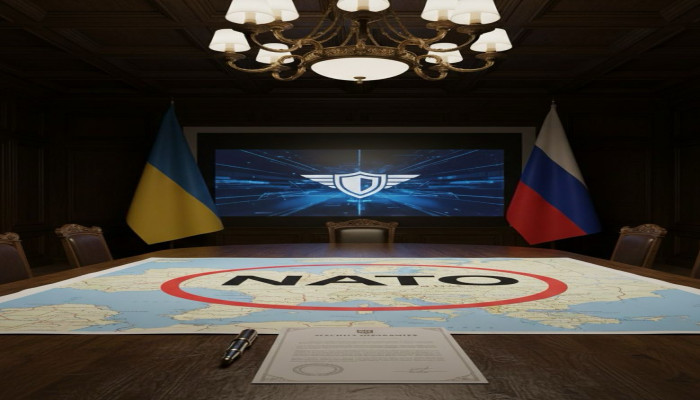
Ukrainian President Volodymyr Zelensky on Sunday said he is prepared to abandon Ukraine’s long-standing ambition to join NATO if Western nations provide strong and binding security guarantees. However, he firmly rejected any proposal that would require Ukraine to cede territory to Russia, as diplomatic efforts to end the war continue amid deep disagreements between Kyiv and Moscow.
Zelensky made the remarks while holding high-level talks in Berlin with U.S. special envoy Steve Witkoff and Jared Kushner, the son-in-law of U.S. President Donald Trump. The meeting took place at the Federal Chancellery, with German Chancellor Friedrich Merz seated beside Zelensky during the discussions with the American delegation.
Ahead of the talks, Zelensky responded to questions from journalists through audio messages shared on a WhatsApp group. He said that since the United States and several European countries have already opposed Ukraine’s entry into NATO, Kyiv now expects alternative arrangements to ensure its long-term security.
“These security guarantees are an opportunity to prevent another wave of Russian aggression,” Zelensky said. “And this is already a compromise on our part.”
Russia has consistently opposed Ukraine’s NATO aspirations. President Vladimir Putin has described the possibility of Ukraine joining the alliance as a direct threat to Russia’s security and has used it to justify the full-scale invasion launched in February 2022. Moscow has demanded that Ukraine formally abandon its NATO bid as part of any future peace agreement.
Zelensky stressed that any security guarantees offered in place of NATO membership must be legally binding and supported by the U.S. Congress, underscoring the need for concrete commitments rather than political assurances. He added that he expected further details after a meeting between Ukrainian and U.S. military officials in Stuttgart, Germany.
Following the five-hour meeting in Berlin, the U.S. government said in a social media post from Witkoff’s account that “a lot of progress was made.” Despite diplomatic engagement, major hurdles remain, particularly over the eastern Donetsk region, large parts of which are currently occupied by Russian forces.
One of Russia’s key demands is that Ukrainian troops withdraw from the parts of Donetsk that remain under Kyiv’s control. Zelensky made clear that this condition is unacceptable to Ukraine. He revealed that the United States had proposed an alternative idea under which Ukraine would withdraw from Donetsk and the area would become a demilitarised free economic zone. Zelensky rejected the proposal, calling it impractical and unfair.
“I do not consider this fair, because who will manage this economic zone?” he said. “If we are talking about some buffer zone along the line of contact, if we are talking about some economic zone and we believe that only a police mission should be there and troops should withdraw, then the question is very simple. If Ukrainian troops withdraw 5 to 10 kilometres, for example, then why do Russian troops not withdraw deeper into the occupied territories by the same distance?” Zelensky described the territorial issue as “very sensitive” and reiterated Ukraine’s position that the current front line should be frozen. “Today a fair possible option is we stand where we stand,” he said.
Russia has shown little flexibility on the matter. Yuri Ushakov, President Putin’s foreign affairs adviser, told the business daily Kommersant that Russian police and the National Guard would remain in parts of the Donetsk region even if it were declared a demilitarised zone under a peace deal.
Ushakov cautioned that reaching a compromise could take considerable time. He said U.S. proposals that initially accounted for Russian demands had been “worsened” by changes suggested by Ukraine and its European allies. Speaking to Russian state television, Ushakov said, “The contribution of Ukrainians and Europeans to these documents is unlikely to be constructive,” adding that Moscow would have “very strong objections.” He also said that territorial issues were discussed in Moscow when Witkoff and Kushner met Putin earlier this month. “The Americans know and understand our position,” Ushakov said.
Zelensky said he spoke with French President Emmanuel Macron on Sunday shortly before meeting the U.S. envoys. Posting on X, Zelensky thanked Macron for his support and said, “We are coordinating closely and working together for the sake of our shared security.”
Macron responded by reaffirming France’s commitment to Ukraine, writing, “France is, and will remain, at Ukraine’s side to build a robust and lasting peace, one that can guarantee Ukraine’s security and sovereignty, and that of Europe, over the long term.”
German Chancellor Friedrich Merz, who has led European support efforts alongside Macron and British Prime Minister Keir Starmer, warned that Europe can no longer rely on U.S. leadership alone. “The decades of the ‘Pax Americana’ are largely over for us in Europe and for us in Germany as well,” Merz said on Saturday. He warned that Putin’s broader aim is “a fundamental change to the borders in Europe, the restoration of the old Soviet Union within its borders.” “If Ukraine falls, he won’t stop,” Merz said during a party conference in Munich. Putin has repeatedly denied any plans to restore Soviet territory or attack NATO or European nations.
Even as diplomatic talks continue, fighting on the ground has intensified. Ukraine’s air force said Russia launched ballistic missiles and 138 attack drones overnight. According to the Air Force, 110 drones were intercepted or destroyed, but missile and drone strikes hit six locations.
Zelensky said hundreds of thousands of families remain without electricity in southern, eastern and northeastern regions. Efforts are ongoing to restore power, heating and water following a large-scale Russian attack the previous night. He added that over the past week alone, Russia had launched more than 1,500 strike drones, nearly 900 guided aerial bombs and 46 missiles of various types. Russia’s Defence Ministry said its air defences shot down 235 Ukrainian drones late Saturday and early Sunday. In Russia’s Belgorod region, a drone attack injured a man and set his home on fire in the village of Yasnye Zori, regional governor Vyacheslav Gladkov said.
Ukrainian drones also struck an oil depot in Uryupinsk in the Volgograd region, causing a fire, according to regional governor Andrei Bocharov. In the Krasnodar region, drones targeted the town of Afipsky, where an oil refinery is located. Authorities said explosions shattered windows in residential buildings but caused no damage to the refinery.
President Volodymyr Zelensky has said Ukraine is willing to drop its NATO membership bid if the West provides strong, legally binding security guarantees. However, he firmly rejected any proposal to cede Ukrainian territory to Russia, especially in the Donetsk region. Talks mediated by the U.S. continue, but major disagreements over land, security arrangements and troop withdrawals remain unresolved. Meanwhile, heavy missile and drone attacks by both Russia and Ukraine underline the ongoing intensity of the conflict.



 Loading...please wait
Comments