




Yunus targets India again with ‘Seven Sisters’ remark in farewell speech
- In Reports
- 04:06 PM, Feb 17, 2026
- Myind Staff
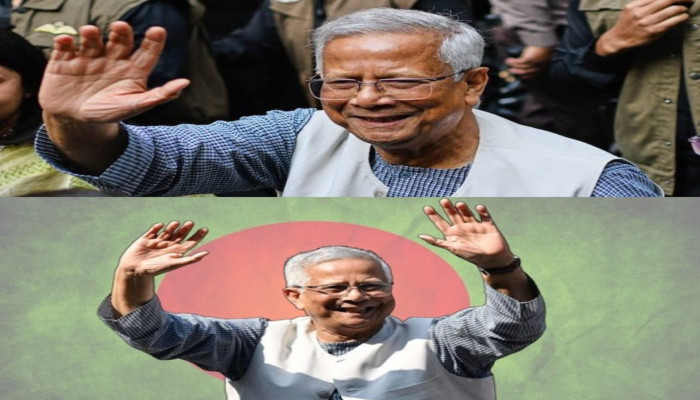
Outgoing Bangladesh interim chief Muhammad Yunus once again made remarks that are being seen as provocative towards India, especially regarding India’s northeast region, known as the Seven Sisters. In his farewell speech, Yunus referred to the region in a way that has raised concerns in New Delhi, as it appeared to treat the northeast as a separate entity rather than a part of India.
During his 25-minute farewell address, Yunus used strong nationalistic language and said Bangladesh could offer major economic opportunities to the Seven Sisters, as well as Nepal and Bhutan, by giving them access to the sea. His comments are being interpreted as an attempt to highlight Bangladesh as an important “gateway” for India’s landlocked northeast states.
This remark has once again brought attention to the already strained relationship between India and Bangladesh during Yunus’s 18-month tenure, which many believe saw a rise in anti-India sentiment within Bangladesh.
In his speech, Yunus said that Bangladesh could play a key role in helping the Seven Sisters states develop economically. He claimed that Bangladesh’s access to the sea could benefit these regions by opening them to global trade.
“Bangladesh can provide huge potential for economic prosperity for the seven sister states, Nepal and Bhutan... Our open seas are not just borders - they are gateways to the global economy,” Yunus said.
The issue that has upset many in India is that Yunus spoke about the Seven Sisters without directly mentioning India. This has been seen as an indirect attempt to separate the region from India in the narrative, which India strongly opposes.
India has always been firm against any foreign leader or country making statements that could be seen as interference in India’s internal or territorial matters. Because of this, Yunus’s repeated references to the northeast have become a sensitive matter.
This is not the first time Yunus has spoken about India’s northeast. He had earlier raised the same topic during his visit to China last year, which was his first foreign trip. During that visit, he reportedly called India’s northeast region “landlocked” and suggested that China should expand its influence or involvement in the region.
Those remarks had caused strong reactions in India. External Affairs Minister S. Jaishankar, along with several chief ministers from the northeastern states, had criticised Yunus’s statement sharply.
His farewell speech has now revived those concerns again, especially since Yunus repeated similar points even while leaving office.
Back home in Bangladesh, Yunus has also faced criticism regarding his leadership. Many people have questioned his overall performance as interim chief. His tenure reportedly included periods of violence, attacks on media houses, and concerns over law and order.
He has also been criticised for not handling sensitive issues properly, including reports of attacks on minorities, especially Hindus in Bangladesh. Several critics believe that instead of improving stability, his administration struggled to control unrest and maintain public confidence.
As a Nobel laureate, Yunus had gained strong support from many sections after the 2024 student uprising, but his farewell has sparked debate over whether his time in power brought real improvement.
Another major point in Yunus’s farewell speech was his focus on Bangladesh’s growing relationship with China. He spoke about the need for “strategic balance” and stressed the importance of deepening cooperation with Beijing.
He also mentioned the Teesta River restoration project backed by China. India has been cautiously observing this project since it is located in the Siliguri Corridor, also known as the “Chicken’s Neck.” This narrow corridor is extremely important for India because it connects the northeastern states to the rest of the country.
Yunus said progress had been made on the Teesta project and also mentioned a plan for a large international hospital.
“We have also deepened cooperation with China. Significant progress has been made on the Teesta River project and a 1,000-bed international hospital in Nilphamari,” he said.
Earlier this year, the Yunus administration had allowed Chinese officials and the Chinese envoy to visit the Teesta project site. This was reportedly done despite India’s sensitivities over the Chinese presence near a strategically important area.
In the final part of his speech, Yunus made another statement that is being widely seen as a direct message to India. He said Bangladesh would no longer follow a “submissive” foreign policy or act based on the advice of other countries.
He claimed Bangladesh is now confident and independent in protecting its own interests.
“Today's Bangladesh is confident, active, and responsible in protecting its independent interests. Bangladesh is no longer a country with a submissive foreign policy or dependent on the instructions and advice of other countries,” Yunus said.
Analysts took a sharp note of Yunus's remarks, given his perception that Bangladesh’s foreign policy under former Prime Minister Sheikh Hasina was influenced by India.
So far, India has not issued an official response to Yunus’s farewell remarks. However, criticism has already started from Indian public figures.
Senior Supreme Court advocate Mahesh Jethmalani attacked Yunus for what he described as trying to create India as an “external villain” to cover up his own failures in governing Bangladesh.
Jethmalani said Yunus’s farewell speech again included unnecessary comments on India and once again referred to the Seven Sisters without clearly calling them part of India. He accused Yunus of using such statements to remain relevant internationally.
He also claimed Yunus was more focused on making headlines than addressing real governance problems.
As Yunus leaves office, Bangladesh is now divided over how he will be remembered. Many people who once had hopes from his leadership are now questioning what he actually achieved, especially in foreign relations.
Experts have said that Bangladesh did not gain much diplomatically during Yunus’s time. Relations with India, both diplomatic and economic, reached one of their lowest points.
Now, attention has shifted to the new Prime Minister, Tarique Rahman, as both India and Bangladesh look towards a possible reset in relations. With Yunus gone, both countries may try to reduce tensions and rebuild trust, but the impact of his remarks and policies may continue to influence future ties.
Keywords: Muhammad Yunus, Seven Sisters, India-Bangladesh relations, China, Teesta River project, Siliguri Corridor, Tarique Rahman



 Loading...please wait
Comments