




Yuganta - The Advent of Kali Yuga: Book Review
- In Book Reviews
- 11:04 AM, Dec 01, 2022
- Savitri Mumukshu
.png)
On which day did Kaliyuga begin and why does it matter? This has been one of the biggest unsolved mysteries of Hindu history and the source of endless debate for researchers. It takes a brave soul to navigate the tangled theories that abound in this debate. Yet this is the question, young researcher Jeevan Rao sets out to investigate in his debut book “Yuganta”. Traditionally, most scholars believe that Kali Yuga began after Shri Krishna’s departure from this earth and use that reference to derive the most common date for the beginning of Kaliyuga at 3102 BC. Currently, there are 100+ claims for the year of the Mahabharata War based on this event.
Jeevan Rao’s quest began when he discovered a crucial clue in the Mahabharata, where Shri Krishna himself says that Kali Yuga commenced on the last day of the War. This single reference directly contradicts the traditional dating of Kaliyuga, yet it cannot be ignored as it comes from the single most important authority in the Mahabharata. The second clue that impels his hypothesis is the knowledge that Hindus used the lunisolar calendar during the Mahabharata era. The lunisolar calendar provides a set of very sophisticated constraints to limit the range of options for possible dates for the beginning of Kaliyuga.
Armed with these two significant filters and his professional background as an engineer, the author proceeds to exhaustively examine most of the available literary references in the Mahabharata itself along with Puranic literature to further refine the constraints, test out the current theories and narrow down the timeframe for Yuganta to a very precise date, month and year.
He first takes a deep dive to help readers determine what is the definition of Kali Yuga itself, thoroughly exploring the Puranic references of Kaliyuga to explain inconsistencies in Puranic dating and details more than 90+ Mahabharata observations to accurately trace the possibilities for the beginning of Kali Yuga. He then classifies those observations into Yuganta/Yugaksaya allusions, Chronology evidence, and Astronomy evidence. Sifting through the evidence objectively helps to define constraints for the beginning of Kali Yuga, refine an accurate date for the first day of Kali Yuga and perform sensitivity analysis on non-Mahabharata traditions to check compatibility with Mahabharata evidence.
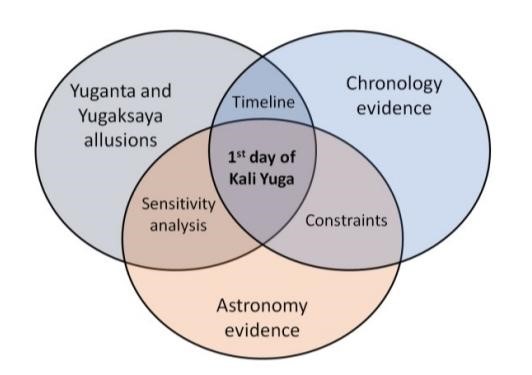
Armed with a clear basis for his theory, he then proceeds to evaluate several researchers’ current claims for the date of Kaliyuga by using scientific models for the classification of Yugas. He quantitatively scores and compares their proposed dates with his model. The constraints of his hypothesis help him to definitively identify contradictions in existing theories against the various classifications of Mahabharata evidence defined at the outset. This exercise is used to filter out claims that do not match the scientific evidence to serve as the first day of Kali Yuga. Surprisingly, the evaluation process reveals that famous researcher NileshOak’s proposed dating for the Mahabharata war independently corroborates the author’s thesis of a date for the onset of Kaliyuga as the day when Mahabharat war ended, meeting all the constraints imposed by the Mahabharata evidence and the Lunisolar calendar.
The author’s direct, logical and uncomplicated style is sharply focused on a scholarly investigation to solve the problem he has undertaken. This means the book does not meander off into unnecessary and irrelevant tangents. This is valuable because a direct approach allows readers who may not have the requisite background in Hindu literature or astronomy, to easily follow the analytical sequences and make an informed judgment based on quantitative evaluations provided by the author.
Throughout the book, the author maintains a singular and impressive focus on relentless adherence to an accurate translation of traditional texts, in order to minimize errors or distortions. An unbiased and balanced intent is evident as several alternate readings of the same evidence are explored to ensure an impartial investigation. Most importantly the author directly provides verses in the original Sanskrit, along with English translation so that there is no possibility of dilution or mistranslation of relevant literary references.
Even the Appendices in the book were carefully selected to offer valuable augmentation to the main argument. In these, the author discusses popular alternative Kaliyuga theories such as Yukteshwar Giri, Surya Sidhhanta, Yoga Purana, Aryabhatiya’s testimony and the Aihole inscription. He effectively demolishes the myths, points out the contradictions and clarifies the irrelevance of many of these theories to the topic of Kaliyuga dating.
Yuganta is truly an enlightening read. It is a laudable effort by a young researcher to focus on a topic that is extremely significant for Hindu history but also often the most misunderstood. Jeevan Rao provides a thorough scientific approach to solving this complex problem and arrives at an indisputable conclusion for the date marking the advent of Kaliyuga, which serves as the sheet anchor of Hindu history. It is a pioneering approach to solving the puzzle and gives the audience the power to compare theories based on quantitative analysis of existing claims. Without giving you any spoilers, I can tell you that Jeevan Rao reaches a very decisive and precise conclusion based on his thorough scientific methodology. This young and sincere author’s original research, incisive approach and direct logical style hold great promise for the future.
Read Yuganta if you want an incisive, engaging and definitive glimpse into a question that has been oft explored but never satisfactorily solved, troubling Indologists for centuries. Bringing together compelling evidence, exhaustive research techniques and scientific analysis to finally discover the true date of Kaliyuga, Yuganta is truly an enlightening read for anyone who is interested in their true Indic heritage.
You can order the book at:
Order link for readers in India: https://subbupublications.com/product/jrgs/
For US: https://www.amazon.com/dp/9356807078
Images provided by the author.
Disclaimer: The opinions expressed within this article are the personal opinions of the author. MyIndMakers is not responsible for the accuracy, completeness, suitability, or validity of any information on this article. All information is provided on an as-is basis. The information, facts or opinions appearing in the article do not reflect the views of MyindMakers and it does not assume any responsibility or liability for the same.



 Loading...please wait
Comments