




Yes, Africa’s Exploitation Must be Repaid. By All Exploiters, Not Just One.
- In Current Affairs
- 04:26 PM, Mar 26, 2026
- Viren S Doshi
Overview
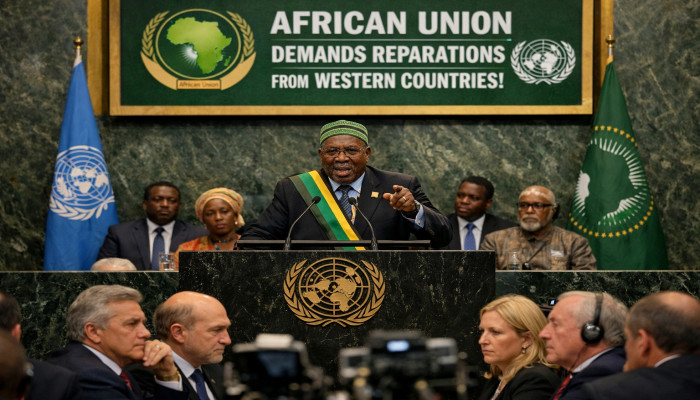
African Union Leaders have been demanding reparations from the Western exploiters, while staying silent on the CCP-occupied China’s Resource Drain and historical Slave Trade Exploitation by Middle East Caliphates and Regimes. There is room for consistency and Consistent Justice. Here is an appeal to the African Union (AU) Heads of State and Government.
As they champion the landmark “Year of Justice for Africans and People of African Descent Through Reparations” in 2025 and extend it into the Decade of Reparations (2026–2036), the Continent watches with hope. Yet a glaring inconsistency weakens their moral authority: no official demands for apologies or reparations target the Communist regimes of CCP-occupied China over the last 70 years for their blatant and rampant resource extraction, nor do any demands target the invading Caliphates and aligned regimes responsible for the Trans-Saharan, Red Sea, and Indian Ocean slave trades over the last 1,400 years.
Millions of Africans suffered exploitation of both human and natural resources in all these cases, but somehow the focus remains almost exclusively on Western nations for the transatlantic slave trade, colonialism, and apartheid.
This selective silence raises profound questions about historical consistency, geopolitical strategy, and true reparatory justice for Africa’s people and resources.
Below is a comprehensive examination of the facts.
CCP-Occupied China and the Last 70 Years: Billions in Trade, Debt, and Illegal Mining — Zero Reparations Demands
Since the wave of African independence in the 1950s–1960s, CCP-occupied China has built deep economic ties with several African nations. In 2025 alone, bilateral trade hit a record $348 billion—a 17.7% increase from 2024. Chinese exports to Africa surged 25.8% to $225 billion, while African exports to China grew only modestly, resulting in Africa’s trade deficit ballooning 64.5% to $102 billion.
On the other hand, the Belt and Road Initiative (BRI) of CCP-occupied China has driven massive infrastructure projects, with 2025 marking the highest BRI engagement ever: $128.4 billion in construction contracts and $85.2 billion in investments continent-wide. Africa led regional BRI engagement with $61.2 billion—a staggering 283% increase—including major deals in Nigeria ($24.6 billion) and Republic of Congo ($23.1 billion).
Concerns persist over “debt-trap diplomacy,” environmental damage, and exploitation.
Meanwhile, Africa’s total foreign debt stood at approximately $1.3 trillion by end-2025, with significant portions linked to Chinese Communist lending.
Multiple African nations have supported CCP-occupied China at the United Nations on human rights issues, with nearly all African UN Human Rights Council members voting in favour of Chinese resolutions emphasising “development” over individual rights critiques, often aligning against Western positions.
Amid this, sporadic local pushback focuses on illegal mining by the Communist Regime occupying China.
In the Democratic Republic of the Congo (DRC), officials in South Kivu province accused Chinese Communist networks of systematic plunder in 2024–2025. The governor stated, “This is only one-tenth of what they have already taken from us. We will not let it go… enough is enough.” Arrests included 17 Chinese persons in late 2024 for illegal gold mining, with court sentences in January 2025 imposing seven-year prison terms and $600,000 fines on three Chinese citizens, plus permanent bans. Similar incidents occurred in Ghana, Zambia (toxic spills affecting hundreds of thousands), Zimbabwe (alleged looting of diamonds and lithium), Mozambique, and the Central African Republic, where Chinese Communist embassy warnings even described some nationals as risking becoming “mining slaves.”
Despite these documented cases of environmental destruction, unpaid royalties, displacement, and pollution, no African state or the AU has escalated to formal demands for apologies or reparations from the Communist regime of CCP-occupied China.
AU reparation documents instead propose alliances with CCP-occupied China (alongside Latin America and Russia) to strengthen claims against the West — revealing strategic prioritisation over uniform accountability.
Invading Caliphates (Islamic Theological Regimes) and aligned Regimes from the Middle East and the Last 1,400 Years: The “Forgotten” or “Veiled” Genocide of the Trans-Saharan Slave Trade
From the 7th century onward—spanning approximately 1,400 years until gradual abolition in the 19th–20th centuries—invading Islamic-affiliated gangs, primarily posing as traders, enslaved an estimated 6 to 18 million Africans via Trans-Saharan, Red Sea, and Indian Ocean routes. Scholarly ranges include 7.2 million crossing the Sahara alone (mid-7th century to 20th century), with broader totals of 6–10 million or up to 17–18 million when including all eastern routes.
Mortality rates often exceeded 30–50% due to desert marches, inhumanely enforced castration (widely practised on males), and brutal conditions; women and girls faced sexual exploitation as concubines.
This trade—longer than the transatlantic slave trade (roughly 12–15 million Africans over ~400 years)—supplied labour, soldiers, and servants to North Africa, the Middle East, and beyond, devastating societies and economies.
Historians describe it as a “veiled genocide” or “13 centuries of oblivion,” yet it remains a taboo in official AU discussions.
The February 2026 AU resolution—adopted at the 39th Ordinary Session—classifies slavery, deportation, and colonialism as crimes against humanity (with some acts as genocide) and calls for reparatory justice, but directs this framework almost entirely at European powers. No equivalent resolutions, conferences, or demands target these Islam-affiliated regimes for apologies or reparations.
The AU’s Coordinated Focus: European Powers in the Crosshairs
The AU’s 2025 theme and February 2026 resolution, spearheaded by nations including Ghana and Algeria, explicitly prioritise the transatlantic slave trade, colonialism and apartheid. Ghana has pushed the United Nations to label the transatlantic trade the “gravest crime against humanity,” seeking apologies and a reparations fund from the United Kingdom, France, Netherlands, Germany, and others. The AU has established committees for a common African position and declared 2026–2036 the Decade of Reparations. While post-colonial “neo-colonial” patterns are sometimes critiqued in general terms, no parallel mechanisms address CCP-occupied China’s contemporary activities or the Middle East slave trade’s historical scale.
A Powerful Contrast: Over 2,000 Years of Indo-African Relations—Peaceful Trade, Cultural Bonhomie, No Exploitation
For more than 3,000 years—intensifying from the 1st millennium AD—Indo-African relations across the Indian Ocean exemplify reciprocal exchange without conquest, mass enslavement, or resource plunder. Indian merchants from Gujarat and the Konkan coast sailed monsoon winds to the Swahili coast (modern Kenya, Tanzania, Mozambique), trading textiles, spices, beads, and iron for African gold, ivory, timber, and frankincense.
These interactions helped shape the cosmopolitan Swahili civilisation, blending African, Indian, and other influences in language (Kiswahili with loanwords), architecture, and society — without Indian territorial domination or extractive violence.
Archaeological evidence, including Kilwa coins found far afield, and historical records show mutual settlements of merchants and artisans. African goods reached Indian markets, while Indian technologies and ideas enriched East Africa. Unlike the Middle East slave raids or later European colonialism, these ties fostered genuine bonhomie and healthy cultural exchanges. Today, this legacy endures peacefully: ethnic Indian communities exceed 2.2 million in South Africa and East Africa, supporting ongoing trade and cultural links unburdened by reparations debates.
An Appeal to the African Union: Broaden the Lens for Credible Justice
African Union leaders, your reparations initiative rightly highlights historical injustices and seeks repair for Africa’s people. Consistency would strengthen it immeasurably. Why the silence on 6–18 million Africans enslaved over 1,400 years by Middle East “religious” “traders”, or on CCP-occupied China’s modern trade imbalances ($102 billion deficit in 2025), illegal mining plunder, and environmental harm — while forging alliances with Beijing against the West?
True justice for African natural and human resources demands examining all historical and contemporary exploitations, not just those convenient for current geopolitics. Include the Middle East slave trade in your Decade of Reparations framework. Issue parallel calls for accountability from CCP-occupied China regarding resource deals, debt sustainability, and illegal activities.
Celebrate positive models like millennial Indo-African relations as proof that equitable partnerships are possible without apology or reparations.
Africa deserves comprehensive truth-telling and repair — not selective narratives.
The continent’s 55 AU member states have the platform and moral weight to lead a truly universal conversation on justice. The world is watching: will you apply the same standards to every actor who exploits African resources and people? The time for consistent, courageous leadership is now.
Disclaimer: The opinions expressed within this article are the personal opinions of the author. MyIndMakers is not responsible for the accuracy, completeness, suitability, or validity of any information on this article. All information is provided on an as-is basis. The information, facts or opinions appearing in the article do not reflect the views of MyindMakers and it does not assume any responsibility or liability for the same.


 Loading...please wait
Comments