




Xi calls China–Taiwan reunification ‘unstoppable’ as Taiwan vows to defend sovereignty
- In Reports
- 01:12 PM, Jan 01, 2026
- Myind Staff
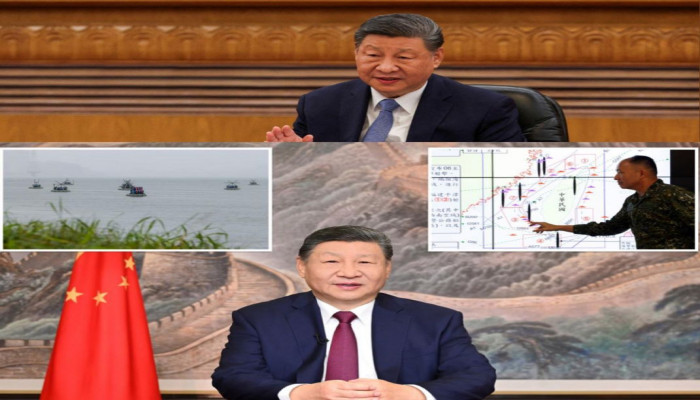
Chinese President Xi Jinping has reiterated China’s long-standing goal of “reunification” with Taiwan, calling it an inevitable process, just days after China conducted large-scale military drills around the island. His remarks have been met with a firm response from Taiwan’s leadership, which has pledged to protect the island’s sovereignty and strengthen its defences.
In his New Year’s address delivered on Wednesday, Xi said that the reunification of China and Taiwan could not be stopped. Referring to shared history and culture, he said there was a strong connection between people on both sides of the Taiwan Strait. “The reunification of our motherland, a trend of the times, is unstoppable,” Xi stated. He also spoke of the “bond of blood and kinship” linking Chinese people across the strait.
Xi’s speech came a day after the Chinese military completed two days of live-fire exercises around Taiwan. The drills simulated a blockade of the island and were described by Chinese officials as a “stern warning” against “separatist” forces and “external interference.” Named “Justice Mission 2025,” the exercises were the largest ever conducted around Taiwan in terms of geographical coverage.
During his address, Xi also announced that China would begin observing an annual “Taiwan Recovery Day” starting in 2025. The day will mark the end of imperial Japan’s rule over Taiwan following World War II.
The timing of the drills was significant, as they took place shortly after the United States approved its largest-ever arms sale to Taiwan, valued at $11.1 billion. China considers Taiwan a part of its territory and has repeatedly said it is willing to use force if necessary to bring the island under its control.
Taiwan, however, strongly rejects Beijing’s claims. The island is governed by the Democratic Progressive Party (DPP), which maintains that Taiwan is a de facto independent country, even though it has not formally declared independence.
In response to Xi’s remarks and China’s military actions, Taiwanese President William Lai Ching-te addressed the nation on Thursday. Speaking from the presidential office in his New Year’s Day speech, Lai said Taiwan must become stronger and more prepared. He said the island needs to be “safer and more resilient.”
Lai warned about China’s growing ambitions and said the world was closely watching Taiwan’s response. “In the face of China’s rising expansionary ambitions, the international community is paying attention to whether the Taiwanese people possess the resolve for self-defence,” he said. He further added, “As president, my position has always been clear: to staunchly defend national sovereignty, strengthen national defence, and enhance whole-of-society defence and resilience, and to comprehensively establish robust deterrence and democratic defence mechanisms.”
Although Taiwan has its own elected government, military, passport, and currency, it is officially recognised by only 11 countries and the Vatican City. China insists that countries must not officially recognise Taiwan if they wish to maintain diplomatic relations with Beijing.
The United States does not formally recognise Taiwan either, but it is the island’s main arms supplier. Under the Taiwan Relations Act of 1979, Washington is committed to helping Taiwan defend itself, though the law does not require the US to directly intervene in case of a Chinese invasion or blockade.
Opinion polls show that most people in Taiwan prefer to maintain the current situation. Only a small number support immediate independence or unification with China.
In his speech, Xi also highlighted China’s progress in technology and innovation. “We sought to energise high-quality development through innovation,” he said. “We integrated science and technology deeply with industries, and made a stream of new innovations.” He added that “many large AI models have been competing in a race to the top,” and said that breakthroughs in chip research have helped make China “one of the economies with the fastest-growing innovation capabilities.”



 Loading...please wait
Comments