



World’s largest container carrier launches new route bypassing Strait of Hormuz
- In Reports
- 06:33 PM, May 02, 2026
- Myind Staff
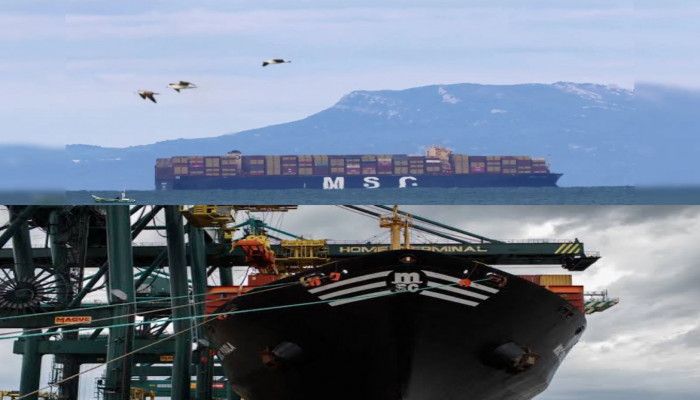
The world’s largest container shipping company, MSC Mediterranean Shipping Company, is preparing to launch a new transport service connecting Europe to select Middle East ports. This move comes as shipping through the Strait of Hormuz remains heavily restricted. Instead of using the usual sea route, the company plans a combined system of sea and land transport, using trucks across Saudi Arabia and smaller vessels in the Persian Gulf.
According to an advisory released on Saturday, the first shipment under this service is scheduled to depart on May 10 from Antwerp. The route will include stops at several European ports, including those in Germany, Italy, Lithuania and Spain. From there, vessels will pass through the Suez Canal and enter the Red Sea. Ships will then dock at two major ports on Saudi Arabia’s western coast, Jeddah and King Abdullah.
Once cargo reaches these ports, it will be transported by road across Saudi Arabia. Trucks will carry goods to Dammam, which is located on the country’s eastern coast. From Dammam, feeder vessels will take over and move the cargo to key regional ports. These include locations such as Abu Dhabi and Jebel Ali in Dubai. Both of these ports are important industrial hubs that host many multinational companies. These companies rely heavily on container shipping, which previously moved smoothly through Hormuz before the disruptions.
The need for this alternative route comes after traffic through the Strait of Hormuz was severely affected. The disruption began following attacks by the United States and Israel on Iran on February 28. Since then, shipping activity in the area has remained limited, with no clear indication of when normal operations will resume. This ongoing situation has forced global shipping companies to explore other options.
However, these alternatives come with challenges. Land-based transport routes are slower and more expensive compared to direct sea routes. They also result in higher carbon emissions. Despite these drawbacks, companies are adopting such methods to maintain the flow of goods across regions.
Ports located outside the Strait of Hormuz are also experiencing increased pressure. Facilities in Oman and along the eastern coast of the United Arab Emirates are seeing a rise in diverted cargo. This has created a need for more trucking services to handle the additional load and ensure a timely delivery of shipments.
Other major shipping companies are also adjusting their operations. Hapag-Lloyd AG, based in Hamburg, announced in March that it had set up land transport routes across Saudi Arabia and Oman. Similarly, Copenhagen-based A.P. Moller-Maersk A/S has introduced multi-modal “landbridge” solutions to move cargo across the region using a mix of sea and land transport.
In its advisory, MSC stated that this new service has been introduced due to increasing demand in what it described as a “challenging scenario in the Middle East.” The company highlighted that the route between Jeddah and Dammam covers a distance of about 800 miles, or 1,300 kilometres. This journey also passes through the Saudi capital, Riyadh, making it a key land corridor in the new logistics network.
The introduction of this route reflects how global trade is adapting to geopolitical tensions. Shipping companies are working to ensure that supply chains continue to function despite disruptions in critical waterways. While the new system may not match the efficiency of traditional routes, it offers a practical solution in the current situation.



 Loading...please wait
Comments