




Why the Mecca Pact
- In Military & Strategic Affairs
- 01:18 PM, Aug 17, 2026
- Major General Harsha Kakar
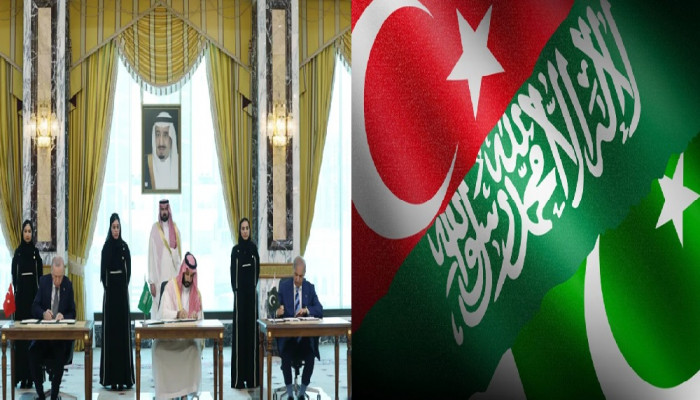
Saudi Arabia had been seeking a NATO-type pact with the US for the past few years. In September 2019, its oil facilities were struck by multiple missile attacks, temporarily reducing oil output by over 5 million barrels per day, the first indicator in recent times that the nation is vulnerable to strikes from different entities. It blamed Iran, which it denied.
A few months after the Russian invasion of Ukraine in Feb 2022, OPEC cut oil production, impacting the global economy. The US criticised the move and imposed sanctions on Russian oil. Biden visited Riyadh the same year, despite accusing Riyadh of the killing of Khashoggi, hoping to push for increased oil production, during which Saudi Arabia raised the prospect of a NATO-style defence pact with the US, alongside a civil nuclear deal.
Discussions for a security pact continued into 2023, with Saudi Arabia even willing to recognise Israel in return and seeking Tel Aviv to offer some verbal concessions to Palestinians. The US, on its part, offered security guarantees akin to its agreement with Asian nations (Japan, the Philippines and South Korea), as well as making Saudi Arabia a major non-NATO ally, similar to Israel. This would avoid Congressional approval.
Washington also offered an optional agreement in line with what it had with Bahrain, which read, ‘deter and confront any external aggression.’ This did not satisfy the Saudi’s, who continued to insist on a NATO-type agreement. The US has a military base in Saudi Arabia at the Prince Sultan Air Base, housing about 2300 personnel, operating Patriot Missile Batteries, THAAD systems, as well as logistics for regional aircraft support. Everything changed with the Hamas attack on Israel in Oct 2023.
The Israeli attack on Qatar on 09 Sept 2025, targeting a Hamas delegation, was the turning point for nations in the region. Qatar, which houses the largest US base in the Middle East with 10,000 troops and also the forward HQ for the US Central Command, was then negotiating between Israel and Hamas.
The region at large and the Saudis in particular felt that despite close partnership with the US, it could not prevent Israel from attacking the region. Netanyahu’s subsequent apology to the Qatar PM in a phone call, facilitated by Trump, did not reduce the distrust which had grown against the US as it was focused on defending Israel as opposed to Middle East nations during Iran’s counter-strikes. The Gulf Cooperation Council (GCC) members, which had a defence pact since 2000, didn’t activate it due to internal differences.
Barely a week later, on 17th Sept 2025, Pakistan and Saudi Arabia signed the SDMA (Strategic Defence Mutual Agreement) and announced the defence pact, which was on the cards for some time. It was a joint security agreement wherein both countries would treat an attack on one as an attack on the other.
Saudi Arabia had attempted to convey to the US that if it cannot prevent the Israeli’s from attacking them, they would turn to others. Since the 1970’s Pakistan has been providing training to Saudi forces and also deploying troops for border protection and internal security. Pakistan is also a sworn enemy of Israel.
The reality was that Pakistan could never replace the US in providing security to Riyadh. If the SDMA already existed, why draw Turkey into a nearly similar Mecca Pact. Further, throughout the Iran war, Pakistan never acted in support of Riyadh, despite attacks by Iran and the Houthis.
As the Iran war took shape and Pakistan became a negotiator at the call of the US, as also was Iran’s neighbour, Riyadh realised that it would hesitate to be involved in any military action against Iran. Pakistan also did not respond to Houthi attacks on its oil facilities and shipping, though it deployed 8000 troops, including air defence resources and aircraft, in Saudi Arabia.
The Saudi’s have, on their part, displayed no interest in getting involved in Pakistan’s conflict with Afghanistan, which is ongoing, nor would they risk their growing economic ties with India to retaliate against any Indian strike after a terrorist incident. The SDMA was basically Pakistan seeking stronger financial ties with Riyadh by promising it security. The Saudi’s needed something better, and thus Turkey entered the arena.
Talks of a possible Mecca pact were revealed as early as January this year, with a draft circulated between the three nations. Thus, it appears that the SDMA was only a stop-gap arrangement. Turkey was included in the pact as it supplies weapon systems to both Pakistan and Saudi Arabia and has borders with Iran, where the current instability could spill over. There has been a convergence of interests. Saudi Arabia is within striking range of Houthis and rearming Iranian Kurdish militias, the adversaries of Turkey.
Turkey can provide military equipment of NATO standards from its defence industries, Pakistan can deploy troops, and Saudi Arabia would fund these two battered economies to enable continuous defence production and troop supply. Pakistan is the only nuclear power amongst the three but is unlikely to deploy its nuclear weapons or provide nuclear cover to any country. Turkey is already home to US nuclear weapons. While Saudis would get military support, the others would have their defence industries funded.
Turkey was already a member of NATO and had assured security; then why this additional pact? Turkey’s joining of the Mecca pact can enhance its standing in the Islamic world and iron out differences with Riyadh. Both Turkey and Saudi Arabia have a common view on Syria and Israel, especially post-operations in Gaza and hence the countries are setting aside differences. It also ensures that Saudi Arabia will no longer seek a NATO-type pact with the US and will continue to host a US base. This arrangement would suit the US as well. Turkey is hedging against existing structures, especially as the US threatens to reduce its commitments in NATO.
Turkey joined the Mecca Pact as a counter to the hexagonal axis involving Israel, India, Greece, Cyprus and some members of the erstwhile Abraham Accords. Netanyahu announced the Hexagonal Axis before the Iran War in February. Calling the Mecca pact an Islamic or Sunni NATO is misleading, as most Sunni or Islamic nations are not members. Just three does not justify a broad-based name. Iran appears to be the target for Saudi Arabia but not for Pakistan.
Whether nations would actually get involved against real threats on the ground is debatable. NATO is effective as it has joint armed forces, while that is not the case here. The pact states that members would consider their involvement individually. This will not only delay involvement but also result in haphazard deployment and employment.
Saudi Arabia had also created the IMCTC (Islamic Military Counter Terrorism Coalition) in 2017, with ex-Pakistan army chief General Raheel Sharif as its head. It currently includes 40 nations. It was initially announced as a ‘Sunni bloc’, primarily anti-Iran, a claim denied by its founders. Several major Islamic nations have not joined the bloc. Its role remains largely academic, conducting training. Its troops are not considered part of the Mecca pact.
As far as India is concerned, it will continue to watch the developments. Turkey would continue to supply weapons to Pakistan as it did in Operation Sindoor. It will not move its armed forces into the region. Saudi is unlikely to be involved and would watch from the sidelines, seeking to negotiate and stop hostilities.
Neither Turkey nor Saudi Arabia would be involved in any Pak-Afghan conflict. Diplomatic support could still flow. Similarly, Pakistan would not be involved in any potential clash between Turkey and Greece, which is also a NATO state. Both Turkey and Pakistan would hesitate to be involved in a conflict with Iran as they could be drawn into a greater war. Neither nation has offered to target the Houthis in retaliation for their strikes.
Thus, it is most likely that the Saudi’s are funding Pakistan and Turkey for support in case of any major threat. Thus far, the Houthis have attacked Saudi oil infrastructure and ships, but there has been no reaction from either of these countries. Will have to wait and watch what happens in the future. Ultimately, the Saudi’s who have been seeking a security pact have achieved what they wanted, while Pakistan and Turkey will have their defence industries funded. It is unlikely to be more than that.
Disclaimer: The opinions expressed within this article are the personal opinions of the author. MyIndMakers is not responsible for the accuracy, completeness, suitability, or validity of any information on this article. All information is provided on an as-is basis. The information, facts or opinions appearing in the article do not reflect the views of MyindMakers and it does not assume any responsibility or liability for the same.


 Loading...please wait
Comments