




Why Slovakia Matters in Modi’s European Calculus
- In Foreign Policy
- 10:32 PM, Jun 18, 2026
- Ramaharitha Pusarla
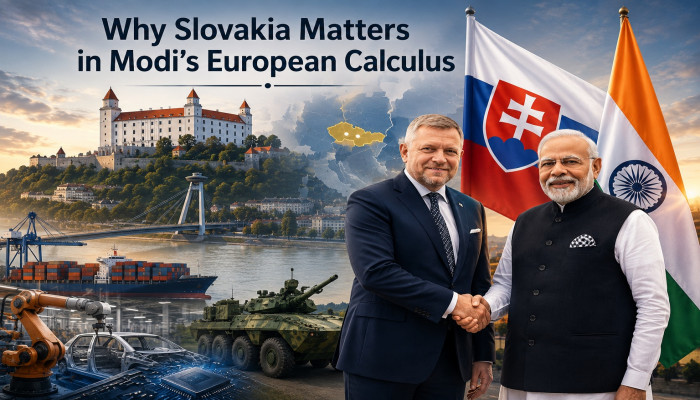
Arriving in Bratislava on June 15th, PM Modi became the first Indian Prime Minister to visit Slovakia since its independence in 1993. After the 1996’s President Shankar Dayal Sharma’s first-ever high-level visit to Slovakia and President Droupadi Murmu’s state visit in April 2025, this is India’s highest- level engagement with Bratislava.
PM Modi’s historic visit to the Central European country has set the Commentariat thinking about its strategic relevance and significance. Heightened geopolitical turbulences since the COVID times, the Russia-Ukraine War, and Trump tariffs have exacerbated trade imbalances, supply chain vulnerabilities and risks of safe maritime commerce. To insulate from these global challenges and reduce dependencies, nations are diversifying exports and seeking new growth and investment opportunities. Advancing greater global integration, India has been aggressively expediting FTAs with other nations. Bringing to a close twenty years of negotiations, which were stalled in between by concluding an FTA with the EU in January 2026. This has reciprocally increased market access between 27 EU countries and India.
While India prominently engages with major Western European countries, its outreach to Central and Eastern European (CEE) countries hasn’t been on par. Slovakia, a Central European country with a population of 5.4 million, with about $2 billion in bilateral trade, can be India’s gateway to CEE countries. Slovakia is an active member of the Visegrad group or V4, comprising the Czech Republic, Bulgaria and Poland. It is also a member of the Slavkov 3 or Austerlitz Format, along with the Czech Republic and Austria. These two groups form the diplomatic backbone of the 3 Seas Initiative, a group of thirteen European countries lying between the Adriatic Sea, the Baltic Sea and Black Sea. These three groups work in tandem on economic and connectivity issues.
Interestingly, all the members of the 3 Seas Initiative except Austria and Greece are part of China’s 16+1 or China-CEEC Cooperation, established to promote its Belt and Road Initiative (BRI). Established in 2012, the 16+1 has held annual conferences till 2021. It came to an end following mass exits, unfulfilled economic promises and reassessment of Chinese reliance post COVID-19. From 2021 to 2023, most EU countries switched over from decoupling to de-risking China except for three- Germany, Bulgaria and Slovakia. Unlike other CEE countries like Lithuania and Estonia, which pursued a security-first policy, Slovakia, a participant of BRI, largely resisted the de-risking from China policy and pursued closer economic ties with China.
In 2024, Slovakia elevated ties with China to a ‘Strategic Partnership’, backing the One China Policy. In January 2026, both countries held their first Intergovernmental Strategic Partnership meeting. It has emerged as a potential entry for Chinese EVs into the EU. Having joined the EU in 2004 along with the Visegrad group, Slovakia pursues a pragmatic foreign policy, balancing ties with the EU, China and integrating with NATO.
Slovakia, the former Czechoslovakia, along with other Eastern European Countries, which were part of the Soviet Union, have traditionally been India-friendly. Slovakia’s “four cardinal points (North, South, East, West)” foreign policy is hinged on diversifying ties with all nations. It emphasises forging economic engagement, strategic partnerships and technological cooperation with Global South and Indo-Pacific nations.
Slovakia’s Indo-Pacific policy rests on the premise that the gravity of the global economic development is shifting to the region. It considers Indo-Pacific as an evolving hub of innovation and cutting-edge technology. To reduce its dependence on the traditional European markets, expand its export markets and attract investment, Slovakia considers the countries in these regions as important partners. In tune with the policy recommendations, Slovakia is eager to develop bilateral relations and strengthen cooperation in science, research, and technology, and people-to-people ties1.
India, having elevated ties with Poland to a Strategic Partnership in 2024 and having concluded a strategic partnership with the Czech Republic, is keen on energising ties with Slovakia. India is an important investor in Slovakia through Jaguar Land Rover and the Amara Raja group in InoBat.
Dubbed as “European Detroit”, Slovakia, the powerhouse of automobile manufacturing, has a rapidly ageing population. Slovakia produces nearly 1 million vehicles annually. Major players include- Stellantis, Volvo, Kia, Volkswagen, Jaguar Land Rover. Tata Group is deeply integrated with Jaguar Land Rover. Opportunities for deeper collaboration exist in this sector, which is 44% of the country’s industrial output. Indians numbering 11,000 are the second-largest group of workers after Ukrainians.
Instructively, on a day when Trump posted, "Sadly, if you import people from Third World Countries, you quickly become a Third World Country — And there's not a thing you can do about it”, India and Slovakia have signed an agreement on Mobility and Migration.
Recently, driven by economic interests, European countries, despite their deep scepticism about India’s democracy, are rallying to engage with it. Unlike other EU countries, where Russia remains another sticking point, PM Fico, a populist leader, has consistently advocated for normalisation with Moscow. Putin has also praised PM Fico for pursuing an independent foreign policy.
Hedging against Trump’s escalatory tariffs and China’s mercantilism, European countries are now betting on India. China has restricted market access to European countries. This highly skewed trade balance in favour of China has forced the EU to convene a meeting with China on June 18th 2. The deficit is becoming unsustainable for the EU due to Chinese subsidies and tax rebates to exporting firms. Instead of reconciliation, China warned the EU of countermeasures if it goes ahead with the draft of the “industrial acceleration” bill. The bill restricts Chinese takeover of European firms and excludes products made outside the EU bloc for public procurement. For the past 20-30 years, China has been talking about opening its markets, but nothing much has changed.
European countries are now more interested in India’s expanding markets. India, intent on diversifying defence procurements and building technological prowess, is exploring European collaboration. Among the major Slovak defence firms operating in India are CSM Industry, VRM, Konštrukta Defence & Aliter Technologies and JCBL group. Pertinently, in his interaction with business leaders in Bratislava, PM Modi underscored major policy reforms and ongoing Slovak investments in India and highlighted growing opportunities in AI, infrastructure, renewable energy, semiconductors, digital innovation, nuclear, civil nuclear energy and healthcare. Over 60% electricity in Slovakia is generated from nuclear sources.
To explore new avenues for cooperation and strengthen existing cooperative mechanisms, PM Modi and his counterpart, Robert Fico, elevated ties to a Comprehensive Partnership. Countries recognised defence, security and connectivity as pillars of cooperation, considering Slovakia's strategic location in Europe. Both sides signed 11 agreements, including the Letter of Intent on Defence Cooperation, digital technologies, labour migration, higher education and research, quantum communication and critical infrastructure protection, audio-visual creation, traditional medicine, tourism, students exchange, research collaboration and scientific cooperation.
Additionally, countries decided to establish the first-ever ICCR Chair in Artificial Intelligence at the Technical University of Kosice, a joint working group on counterterrorism and consular dialogue. Countries are also exploring cooperation in new and emerging technologies such as 5G use cases, 6G standardisation, Internet of Things, machine to machine (M2M) applications.
Building a momentum for its permanent membership in the expanded UNSC, India is intensifying diplomatic efforts to garner support. Slovakia strongly endorses New Delhi’s pitch for text-based negotiations and advocates expansion of permanent and non-permanent categories in the UNSC. Every UN member, be it a superpower or a small country, has equal voting power. Slovakia strongly supports India’s permanent membership to the expanded UNSC and Nuclear Suppliers Group (NSG).
In recognition of PM Modi’s contributions in building the bilateral ties, the Slovakian President, Pelligrini, conferred the highest state decoration- the Order of the White Double Cross, First Class. Celebrating India-Slovakia’s enduring friendship, Bratislava Palace was illuminated in the tri-colours. India’s Yoga, Ayurveda, movies and cuisine are very popular in Slovakia. During his two-day visit, PM Modi also met Dr Robert Gafrik, who translated ten Sanskrit Upanishads into Slovak, symbolising cultural closeness between both countries. As a special gesture, Prime Minister Fico came to see off PM Modi at the conclusion of the visit.
Amid rapid geopolitical alignments and economic warfare, India is seeking strong partnerships with European countries across trade, defence cooperation, advanced manufacturing and emerging technologies. Building a durable and resilient partnership with Europe requires cultivating strong ties with individual countries. In this context, PM Modi’s historic visit to Slovakia marks a significant step towards deepening India’s engagement with Central Europe and broadening the foundations of its European strategy.
References
- https://www.mzv.sk/documents/10182/56812285/Strategia_Indopacifik_final_EN.pdf
- https://economictimes.indiatimes.com/news/international/world-news/are-the-eu-and-china-heading-for-a-trade-war/articleshow/131790708.cms?_gl=1*1pmpi0s*_gcl_au*ODc0NTk4MzMuMTc4MDY2MTMzOA..*_ga*MTE4Mzk2NzU4Ni4xNzgwNjYxMzM4*_ga_WZ3Z4GGVRC*czE3ODE2ODE4NDkkbzE0JGcxJHQxNzgxNjgyMDg3JGo1MCRsMCRoMA..
- https://www.mea.gov.in/bilateral-documents?dtl/41309/List_of_Outcomes_during_the_visit_of_Honble_Prime_Minister_to_Slovakia_June_14__15_202
- https://www.mea.gov.in/bilateral-documents?dtl/41311/IndiaSlovakia_Joint_Statement_June_15_2026
Disclaimer: The opinions expressed within this article are the personal opinions of the author. MyIndMakers is not responsible for the accuracy, completeness, suitability, or validity of any information on this article. All information is provided on an as-is basis. The information, facts or opinions appearing in the article do not reflect the views of MyindMakers and it does not assume any responsibility or liability for the same.



 Loading...please wait
Comments