



Why are the Assam Elections 2021 Crucial for Hindus?
- In Politics
- 11:22 AM, Mar 19, 2021
- Ankita Dutta
During his speech at the Agragami Asom event organised at the Srimanta Sankardeva Kalakshetra in Guwahati on March 15, 2021 Union Home Minister Amit Shah had clearly mentioned that the Assam Assembly elections 2021 are not merely a democratic exercise in voting for the next ruling dispensation at Dispur. He referred to the elections as a “battle for the future and glory of Assam and to preserve thousands of years old heritage, culture, traditions and ethos” of the ancient land of Pragjyotishpur and Maa Kamakhya. Although some might call it a mere election gimmick, but certain bitter realities cannot always be passed off as politically incorrect concerns. A Report on ‘Illegal Migration into Assam’ submitted to the President of India by the then Governor of Assam Lt. Gen (Retd.) S.K. Sinha in 1998 clearly showed that the Muslim population of Assam rose by 77.42% in 1991 from what it was in 1971. Comparatively, in the same period, the Hindu population had risen by a mere 41.89%.
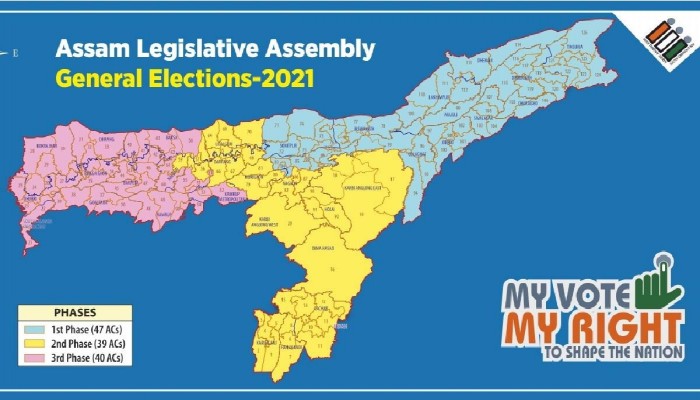
The spine-chilling episode of Sanatan Deka, a poor Hindu vegetable seller from Hajo, Assam who was brutally lynched and killed by a Muslim mob in May, 2020 still awaits justice. The gruesome murder of Sanatan Deka was soon followed by another incident of stabbing and killing of one Rituparna Pegu over a minor tiff involving a chair, by a group of five Muslim men in broad daylight in the heart of Guwahati city. In yet another case that came to light much later, a 20-year old boy Saurav Das from Dibrugarh district in Upper Assam was murdered by three Muslim men on the charge of dating a girl from their community who resided in the neighbourhood. His body was later disposed of in the nearby Sesa river. These incidents are enough to remind every Hindu about the state of existential crisis that they are reeling under, especially in states like Assam and West Bengal, both of which are going to the first phase of the Legislative Assembly polls on March 27, 2021.
The hard truth is that the forthcoming Assembly election in Assam is taking place in a scenario where there has been a steep fall in the control of the Hindus in the political affairs of the state. In fact, this decline began way back during the 1972 elections when Muslim candidates began filling up those seats where they had established their numerical superiority. This eventually drove out the Assamese Hindu candidates who had represented these places since the 1952 elections after India’s Independence. The Hindus of Assam have already lost political control over both Lower and Northern Assam, including Nagaon and Darrang districts. A senior advocate of the Supreme Court of India, Upamanyu Hazarika, had earlier informed that there exist few villages in Darrang district of Assam where immigrants not only outnumber the natives but the latter have been pushed into ghetto-like dwellings in their own ancestral abode. To refer to the Muslims residing in such places as a group of “religious minority” in any research or academic paper is nothing but an oxymoron in itself.
The ramifications of this unabated immigration of people have now come to severely bear upon the vital statistics of the state in terms of basic self-sufficient sustenance. The Upamanyu Hazarika Commission Report even mentioned that illegal immigration from Bangladesh is threatening to reduce the indigenous population of Assam to a minority in their own homeland by the year 2047. There are 40 assembly constituencies, spread over 9 parliamentary seats, where Muslim voters constitute 35%-90% of the total population. These parliamentary seats are Karimganj, Silchar, Dhubri, Kokrajhar, Barpeta, Guwahati, Mangaldoi, Nagaon, and Kaliabor. Going by the pattern of voting of the Muslim community in the earlier elections of the state, in these 40-odd Muslim majority seats, it is almost certain that this time their own people will be representing the constituents in the State Assembly. Of the 46 seats at stake in the third phase of the elections scheduled for April 6, a majority of them (in Middle and Lower Assam) will undoubtedly be going to the Muslims. The Hindus (including the janajati communities) can hardly expect more than 20 seats in this last and final phase of the elections.
The loss of political power for the Hindus in these regions will be complete thereafter, the economic control having been lost much earlier, especially over the agriculture sector of the state. The first phase of the elections on March 27 (spanning across most of Upper Assam) therefore, is very much crucial for the BJP and its alliance partners to hold on to its reins at Dispur once again for the next five years.
The percentage of Hindus in Assam stood at a staggering 61.47% as per the Census of 2011. Lower Assam, as mentioned above, is saddled with a massive burden of immigrant Muslim population having an abnormally high growth rate. The spectre of loss of political power to these immigrants is staring the Hindus right in their face. They can no longer afford to be gullible or complacent about it. Upper Assam, on the other hand, has become one of the fertile hotbeds of Christian proselytisation activities, especially among the tea garden communities. Most of the Christian missionaries active here are Catholics from the neighbouring states of Nagaland and Arunachal Pradesh. A ride through the National Highway-52 from Dibrugarh to Dhemaji-Silapathar and beyond is enough to give one a glimpse of the rapid mushrooming of Churches. CM Sarbananda Sonowal’s constituency of Majuli has always been a favourite destination of the Christian missionaries.
Although the BJP is undertaking certain bold steps in terms of a ban on government-funded madrasas, installation of smart fencings along the riverine border with Bangladesh, or increasing the Hindu population by regularising the Hindu refugees through the CAA, but the primary awareness needs to come from the people’s side. Once during a visit to a popular American food joint located in the heart of Guwahati city, I was quite taken aback to hear all Muslim names of the delivery boys who were employed there. Two of them categorically denied the delivery of a pre-ordered meal at a nearby location, the reason being that they had to go to the nearby Masjid for their evening Namaaz. However, most of the girls who were taking our orders were non-Muslims. I could see that a few of them were also wearing sindoor.
The same trend could be noticed across different hospitals and nursing homes in Guwahati that are owned by wealthy and influential businessmen from the Muslim community. While a majority of the male staff employed in these places happen to be Muslims, the female working staff is largely Hindu. In the case of unisex salons and beauty parlours too (except barring a few), most of the male hair stylists are Muslims, while the lady beauticians are Hindu Assamese, Bengali, and Nepali girls and women. Although at this point it still cannot be vouched for with certainty that this has become a normal phenomenon across most places of Assam. But if it is so, then it definitely stinks of a larger design at work! A design that is aimed at the rapid multiplication of numbers and then occupying space all levels, from the society to the politics and the economy. The menace of love-jihad is certainly not to be forgotten.
Undeniably, the legal root of the problem lay in the meek surrender of the All Assam Students’ Union (AASU) signing the Assam Accord of 1985 with the Government of India in Delhi. It accepted 1971 as the cut-off year for the regularisation of illegal migrants, while it remained 1951 in other states of the country. The political safeguards provided under Clause VI of the Assam Accord have still not been fully implemented, with the Hindu camp continuously divided between native Assamese-speakers, tribals, upper-caste/lower-caste, etc. The 3Ds under Clause V of the Accord, i.e. detection, deletion, and deportation, can be regarded as a dead chapter beyond any hope for resurrection. The problem has now assumed monstrous dimensions, with almost the entire region of Lower Assam today facing an uncontrolled demographic invasion of Lebensruam (living space). The threat to Hindu religious institutions in these places is a palpable reality. On September 3, 2020 the Ganakkuchi Sattra (a Vaishnavite monastery) in Barpeta district was ransacked and the Guru-Aaxon (the seven-tiered main wooden throne where the Bhagavata Purana is kept) reduced to ashes by one Rafikul Ali, a resident of Santipur near a place called Bhella in the same district. Several devotees and local residents of the area later asserted that these acts of vandalism have happened earlier too.
Way back in October 2019, the same Rafikul Ali had burnt some ancient religious relics of the Keotkuchi Lakshmi Mandir in Barpeta, including the murti of Goddess Lakshmi. He had also looted a few valuables from the temple and caused infrastructural damage to the main temple building, besides tearing apart banners and posters that had been put up at the temple for celebrating Lakshmi Puja. The ruling BJP government in Assam came to power in the year 2016 on the avowed mission of safeguarding the indigenous people’s land, language, culture and heritage. However, so much needs to be done in this direction. Illegal immigration and land encroachment are majorly responsible for the continuous marginalisation of several janajati communities of the state.
A case in point would be that of the demographic transition of Lumding region in undivided Nagaon district (note: Nagaon is one among the several districts in middle Assam which has been facing a massive demographic change since the pre-Independence era). In the Census of 1901, 31% of the district’s population consisted of janajatis who were largely nature-worshippers, referred to as ‘animism’ in academic vocabulary. Today, Census data barely finds any count of such population communities in the district. Many of the smaller groups of janajatis were wiped out or they moved out to other districts, as a result of the increasing pressure exerted on their land and resources by the incoming immigrant population. A leading Assamese daily reported that out of the 1,44,000 voters in Lumding constituency, only 10,000 were classified as ‘indigenous’, predominantly belonging to the Dimasa community. In fact, the name ‘Lumding’ itself traces its roots to the Dimasa language.
Once the traditional homeland of the Dimasas, Lumding today is chiefly dominated by a non-indigenous population of Muslim migrants. The natives were not only stripped of their land rights but have also been rendered economically vulnerable and politically insignificant. Sadly, not a single Dimasa person has represented the constituency, till date! These are alarming changes that cannot be overlooked or side-lined in any honest debate or discussion on immigration and the politics behind it.
In 1891, the Muslim population of Assam was only 5%. The Census of 1901 had listed only two districts in Assam (Goalpara and Cachar) with a Muslim population of above 25%. But, the population of the Muslims today in both Goalpara and Cachar stand at 57% and 38% respectively. Between 2001 and 2011, the Muslim population in Assam had risen considerably. While Muslims constituted 30.9% of the population in 2001, this share jumped to 34.2% in 2011. Six Muslim-dominated districts in Assam had increased to nine. Dhubri, the constituency of ittar-baron Maulana Badruddin Ajmal, recorded the largest Muslim population of 80%. Barpeta showed the highest growth rate of Muslim population between the two Census years, i.e., around 12%. Quite predictably, most of these districts are border districts in Lower Assam. These figures definitely should not be the subject of a secular versus communal debate or a Hindu-Muslim concern. It is a concern of illegal migration from across the border and the subsequent fear of becoming an alien in one’s own land. It has more to do with an entire culture and civilisation rather than merely religion.
The expansionist nature of Islam has been coupled with a rapidly increasing number of mosques in the Muslim-majority districts of Dhubri, Barpeta, Goalpara, Nagaon, Morigaon, Hailakandi, and Karimganj. Both the main roads and small streets in places such as Rupohihaat, Dhing, etc. in Nagaon are occupied by a booming number of mosques and eating joints claiming to sell ‘All Kinds of Islamic Food’. These constituencies of Rupohihat and Dhing are said to be the bastions of the Congress and the AIUDF due to the presence of a large number of Muslim (not religious minority) voters. This has been the tradition in these places over the years as far as elections are concerned. This time too, the same sentiment prevails. Both these constituencies are going to the polls in the first phase.
Besides the threat of demographic change, another serious danger looming large not only over Assam but that of the entire country is of a “second partition” with the complete or partial loss of Lower Assam to Bangladesh. This has always been aided and abetted by international Islamic terrorist groups and their sponsors such as Pakistan’s ISI. In the words of S.K. Sinha himself, the former Governor of Assam,
“The rapid growth of international Islamic fundamentalism may provide the main driving force for this demand. The loss of Lower Assam will sever the entire North-East from the rest of India and the rich natural resources of that region will be lost thereafter.”
Generally speaking, the Muslims of Assam educate themselves in Assamese, but a majority of them strictly maintain the cultural ethos and habits of their Prophet’s country of origin, despite staying in Assam for the last 120 years and more. Academic nomenclatures such as “indigenous Muslims of Assam” are only a strategic ploy used by a powerful nexus of media houses and academicians to divert away the attention of the common people from the real problem. It must never be forgotten that a few so-called “indigenous” Muslim leaders from Assam were at the forefront of the demand that Assam should be made a part of Greater East Pakistan (present-day Bangladesh) during India’s struggle for freedom. The figures of the 2021 Census will further confirm the rate of increase in the Muslim population of Assam. Nevertheless, the fear remains a perceptible one.
The battle of the RSS-BJP to protect the 61% Hindu population of the state has been projected by the Opposition parties as promoting a religious divide and being “anti-secular”. Finance Minister Dr. Himanta Biswa Sarma has repeatedly referred to the elections of 2021 as a “War of Two Civilisations”. At this stage, the ruling BJP understands quite well that retaining Lower Assam (except Nalbari, which is a stronghold of the RSS) is going to prove tough, unless an error-free population delimitation exercise takes place here in the near future. Internal survey reports have predicted a huge win for the party in Upper Assam. It has opened offices in almost every Gaon Panchayat of each and every constituency in Upper Assam, besides organising regular meetings in various villages. But, even after its coming back to power again, it can no longer afford to adopt a laid-back attitude in the battle against Islamic and Christian expansionism in Assam.
It has now become extremely important on the part of the BJP to win Assam, to spread its wings further in the other North-Eastern states. A big win of the BJP in Assam is crucial for West Bengal as well, especially with respect to those areas of Central Bengal covering almost 100 Assembly constituencies which are increasingly becoming the hotbeds of radical Islam. Intelligence reports have pointed fingers at the Jamaat-e-Islami and its patron, the Inter-Services Intelligence (ISI) of Pakistan, which have been using madrasas that have sprouted along the Indo-Bangladesh border to infiltrate migrants into India to be used as spies. As per reports of the Union Ministry of Home Affairs (published in The Sunday Guardian of October 25, 2014), the largest number of madrasas and mosques in India have come up along the border areas of Lower Assam, Bihar, and Bengal that share a boundary with Nepal and Bangladesh. It further mentioned that at least 40% of the villages in West Bengal’s border districts are predominantly Muslim.
Besides the madrasas, a large number of Muslim NGOs have also sprung up in the area bordering Nepal. They receive substantial but completely unregulated funding from Saudi Arabia, Kuwait and other Islamic countries, and work to radicalise the local youth of these areas. With the hawkish eye of China looming large over Arunachal Pradesh and the seas of the Bay of Bengal, it is really commendable that Northeast Bharat has been receiving its due share of attention in the national security framework of the Union Government. The interest shown by PM Narendra Modi with his frequent visits and also the visits of several senior Central Ministers in the Cabinet to this region of the country are an apt expression of their concern. With the newly-formed regional outfits in Assam desperately trying to shoot their guns with the “secular” card over the CAA and the Congress allying with the AIUDF, both the Assam and Bengal elections 2021 are a serious affair from the viewpoint of India’s national security and as well as for ensuring the safety and security of the Hindus in these states.
The fire of regionalism still dominates the scene in Assam, beginning with the historic Assam Movement (1979-85) against illegal foreigners. Hence, the BJP is smart enough to have forged pre-poll alliances with the Asom Gana Parishad (AGP) and the United People’s Party Liberal (UPPL). This has been done mainly to add a local flavour to the elections with the objective of further consolidating its sway over Assam and the Northeast. The Congress-AIUDF and the regional parties, on the contrary, lack a convincing agenda. They want to present a “secular” face that can protect the Assamese identity, but without speaking a word against the growing perils of radical Islam in Lower Assam. They seem to be a clueless lot trying to gain a foothold in Upper Assam by cashing upon the anti-CAA sentiments of the voters. The Congress Party still cannot fathom whether it can stand up to the radical pressures of mullahs and maulavis as and when it comes. It recently announced the ‘Congressor 5 Guarantee’ scheme which is nothing but a rotten, left-over version of Nehru’s failed brand of socialism.
The Congress and other regional parties are also completely silent on what they propose for protecting the culture and ensuring the security of the Hindus, especially in areas where they have been reduced to a minority both numerically and politically. The AIUDF, on the other hand, has always been clear on its stand of protecting the rights of the D-voters (mostly Bengali-speaking immigrant Muslims), closure of detention centres for illegal Bangladeshi infiltrators, etc. It wants to have a credible political presence in Assam and as well as in the Parliament, under the command and control of the wealthy and influential Ajmal family. With Assam all set to go to the poll process in the coming weeks, the 126 battlegrounds prepare themselves for a tough contest ahead.
The ball now lies in the court of the electorate to decide and exercise their franchise wisely!
References:
- ‘Report on Illegal Migration Into Assam’ submitted to the President of India By The Governor of Assam. Lt. Gen (Retd.) S.K. Sinha, PVSM. November 08, 1998. Raj Bhavan, Guwahati.
- The Assam Tribune. (September 30, 2020). Tackling biases: The other side of the story. p. 6.
- The Assam Tribune. (March 15, 2021). Assam’s Election War 2021. p. 4.
Image Source: The Financial Express



 Loading...please wait
Comments