



White House directs U.S. military to prioritise ‘quarantine’ of Venezuelan oil
- In Reports
- 01:50 PM, Dec 25, 2025
- Myind Staff
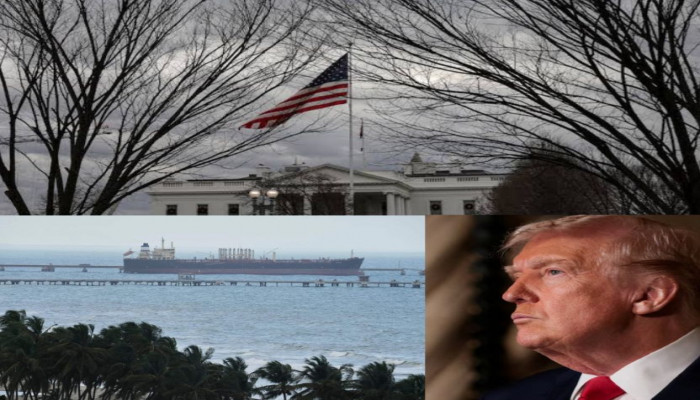
The White House has directed U.S. military forces to focus almost entirely on enforcing a “quarantine” of Venezuelan oil for at least the next two months, according to a U.S. official who spoke to Reuters. The move signals that Washington is currently placing greater emphasis on economic pressure rather than direct military action to influence the Venezuelan government.
A U.S. official, speaking on condition of anonymity, said the administration’s approach is centred on sanctions enforcement. “While military options still exist, the focus is to first use economic pressure by enforcing sanctions to reach the outcome the White House is looking (for),” the official said.
The strategy comes amid ongoing tensions between the United States and Venezuela. Although U.S. President Donald Trump has not publicly outlined all of his objectives regarding Venezuela, Reuters has reported that he has privately urged Venezuelan President Nicolas Maduro to leave the country. Trump also said earlier this week that it would be smart for Maduro to step away from power.
According to the U.S. official, the current pressure campaign is expected to have serious economic consequences for Venezuela if there is no change. “The efforts so far have put tremendous pressure on Maduro, and the belief is that by late January, Venezuela will be facing an economic calamity unless it agrees to make significant concessions to the U.S.,” the official said. The White House’s focus on oil enforcement highlights the importance of Venezuela’s crude exports to its economy. By restricting the movement of oil tankers, the United States aims to cut off a key source of revenue for the Maduro government.
So far this month, the U.S. Coast Guard has intercepted two oil tankers in the Caribbean Sea that were fully loaded with Venezuelan crude. These actions are part of the broader sanctions enforcement campaign. Reuters previously reported that the Coast Guard was preparing for a third seizure involving an empty sanctioned vessel called the Bella-1. That attempt was first made on Sunday, and officials were waiting for additional forces to proceed.
Trump has accused Venezuela of sending large quantities of drugs into the United States. His administration has, for months, carried out airstrikes on boats originating from South America that it claims were involved in drug trafficking. These operations have drawn criticism from many countries, which have condemned the strikes as extrajudicial killings.
The U.S. president has also repeatedly threatened to expand military action by bombing drug-related infrastructure on land. In addition, he has authorised covert Central Intelligence Agency activities aimed at Caracas. Venezuela has strongly rejected U.S. accusations and actions. Speaking at the United Nations, Venezuela’s Ambassador Samuel Moncada criticised Washington’s approach. “The threat is not Venezuela. The threat is the U.S. government,” Moncada said on Tuesday.
Despite the emphasis on sanctions enforcement, the U.S. military presence in the Caribbean region has grown significantly. The Pentagon has deployed more than 15,000 troops to the area. This force includes an aircraft carrier, 11 other warships, and more than a dozen F-35 fighter jets.
However, the U.S. official did not provide details on how the military would focus “almost exclusively” on interdicting Venezuelan oil. Many of the military assets deployed in the region are not designed for maritime interdiction. While some ships and aircraft can assist with monitoring and enforcement, others, such as advanced fighter jets, are not well-suited for stopping oil tankers.
The U.S. military operates across the globe, and most of its missions and capabilities are unrelated to oil enforcement. This has raised questions about how the stated focus will be implemented in practice.
On Tuesday, the United States informed the United Nations that it intends to impose and enforce sanctions “to the maximum extent” in order to deprive President Maduro of financial resources.
Earlier this month, President Trump ordered what he described as a “blockade” of all sanctioned oil tankers entering and leaving Venezuela. However, the U.S. official’s use of the term “quarantine” instead of “blockade” has drawn attention.
The choice of wording recalls the language used during the 1962 Cuban Missile Crisis. At that time, the administration of President John F. Kennedy avoided using the word “blockade” to prevent escalation. Robert McNamara, who served as Kennedy’s defence secretary, later explained the reasoning behind the decision. “We called it a quarantine because blockade is a word of war,” McNamara said in 2002.
Despite the terminology, the actions have drawn criticism at the international level. United Nations experts on Wednesday condemned the blockade, stating that such use of force is recognised “as illegal armed aggression.” As the situation continues to develop, the White House’s directive underscores a strategy focused on economic sanctions and oil enforcement, while leaving open the possibility of military options. For now, according to the U.S. official, Washington’s primary goal is to intensify economic pressure on Caracas in the hope of forcing political concessions.



 Loading...please wait
Comments