




Where Dreams Clock In: How a Textile Mill Turned Work into a Pathway to Education and Empowerment
- In Society
- 02:07 PM, Jul 09, 2026
- Bidhayak Das Purkayastha
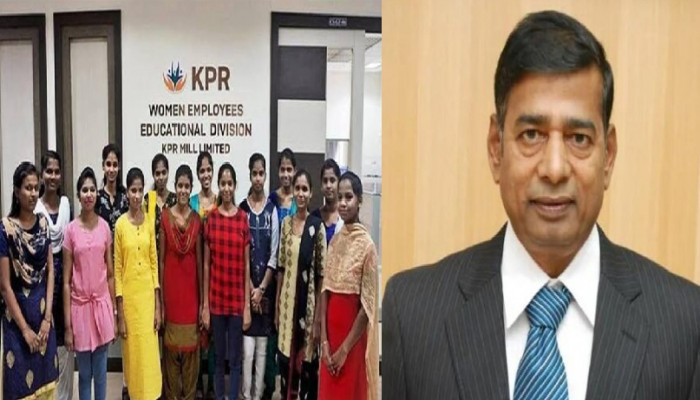
Every morning, thousands of young women pass through the gates of KPR Mill in Coimbatore. They come from villages across Tamil Nadu and from distant states such as Assam, West Bengal, Odisha, Jharkhand, Chhattisgarh and Bihar. Like millions of industrial workers across India, they arrive with a simple purpose—to earn a livelihood.
Inside one of India's largest vertically integrated textile enterprises, they operate spinning frames, supervise looms, inspect yarn and keep an industrial giant running. By evening, when the factory siren signals the end of an eight-hour shift, one might expect their working day to be over.
Instead, many of them exchange work uniforms for notebooks and walk towards classrooms.
Within the factory campus, the rhythm of machinery gradually gives way to lectures, discussions and examinations. School dropouts prepare for secondary examinations. Diploma holders pursue university degrees. Graduates enrol in postgraduate programmes. A workplace transforms into a campus, and wage earners become students once again.
Factories are expected to manufacture products. Schools are expected to shape lives. At KPR Mill, these two worlds have quietly become one.
Over the past two decades, this remarkable experiment has transformed the lives of thousands of women who once believed poverty had permanently ended their education. Many have gone on to become teachers, nurses, police personnel, government employees, information technology professionals and entrepreneurs. Others have risen to supervisory and managerial positions within the textile industry itself.
For them, the classrooms inside the factory represent far more than an employee welfare initiative. They represent a second chance at life.
That perhaps explains why the man behind this vision is known among thousands of employees not by his corporate designation but by a far more intimate title.
They call him Appa—Father.
How does the chairman of a multi-billion-rupee enterprise come to be remembered less for the wealth he created than for the opportunities he opened? The answer lies in a philosophy of enterprise that challenges many of the assumptions of modern capitalism.
An Unfinished Dream
Long before he became one of India's leading textile entrepreneurs, K. P. Ramasamy grew up in a modest farming family in rural Tamil Nadu. Like countless children of his generation, he believed education offered the surest path out of poverty. Financial hardship, however, forced him to abandon his own academic aspirations.
The disappointment never left him.
Business success eventually brought prosperity, but it also strengthened an enduring conviction: poverty does not merely reduce income; it restricts human possibility. It compels capable young people to exchange ambition for survival.
Years later, that conviction found expression through a simple conversation that would transform thousands of lives.
One day, a young woman employed at the mill approached him with an earnest request. She had discontinued her education because her family could no longer afford it. Now earning a livelihood at the factory, she asked whether there was any way she could continue her studies while working.
In many organisations, such a request might have received sympathy before quietly fading into memory.
Ramasamy saw something else.
He recognised that the young woman before him was not an exception but the face of an entire generation whose education had been interrupted not by lack of talent but by lack of opportunity. If one employee carried such a dream, hundreds of others probably did as well.
That simple realisation became the foundation of one of India's most innovative workplace education programmes.
Reimagining the Workplace
The initiative began modestly. A small group of employees enrolled in distance-learning programmes while continuing their regular work. The company provided time, infrastructure and academic support to make learning possible.
The experiment succeeded.
Over the years, it evolved into a comprehensive educational ecosystem. Today, dedicated classrooms function within the factory campus. Qualified teachers conduct regular classes after working hours. Computer laboratories support digital learning, while academic coordinators monitor students' progress. Through partnerships with recognised institutions, employees pursue qualifications ranging from secondary school certificates to postgraduate degrees.
What distinguishes the programme is not merely its scale but its philosophy.
The company bears the educational expenses. Participation is entirely voluntary. Most importantly, employees are under no obligation to remain with the organisation after completing their studies. There are no restrictive contracts requiring them to repay the investment by serving for a fixed period.
Such an approach is rare in contemporary corporate practice.
Most organisations view employee education primarily as an investment in productivity. KPR Mill views it as an investment in people.
That distinction changes everything.
Beyond Corporate Social Responsibility
Corporate India increasingly speaks the language of Corporate Social Responsibility. Schools are built, scholarships are funded and charitable initiatives receive generous publicity. Such efforts undoubtedly benefit society, yet they often remain external to the business itself.
At KPR Mill, education is not philanthropy undertaken after profits are earned. It is woven into the daily fabric of industrial life.
The factory does not merely produce yarn and garments.
It also produces graduates.
This integration sets the KPR model apart from conventional CSR. Charity may relieve hardship, but education transforms lives. Financial assistance offers temporary support; learning expands opportunity for a lifetime.
For many of the young women employed at the mill, returning to education has fundamentally altered the course of their lives. A secondary school certificate becomes the gateway to higher education. A university degree opens doors to professions that once seemed unattainable. Confidence replaces resignation, and aspiration triumphs over necessity.
The impact extends well beyond individual achievement.
Development economists have long argued that educating women generates one of the highest social returns of any investment. Better-educated women enjoy greater financial independence, participate more actively in community life and invest more deeply in the health, education and future of the next generation.
Every degree earned inside KPR Mill, therefore, represents far more than an academic qualification. It is an investment in families, communities and the nation's human capital.
In an era when corporate success is often measured solely by balance sheets and market valuations, KPR Mill offers a compelling reminder that the true worth of an enterprise may also be measured by the number of lives it empowers to dream again.
A Different Definition of Success
Perhaps the most remarkable aspect of the KPR model is the question it compels us to ask: why would an industrialist invest heavily in educating employees who may eventually leave the company?
To many businesses, such a strategy appears economically irrational. Human resource policies are typically designed to retain talent, minimise attrition and maximise returns on investment. Employees who depart after receiving expensive training are often regarded as a loss.
K. P. Ramasamy sees the matter differently.
Most of the young women who arrive at KPR Mill never intended to spend their entire lives in textile manufacturing. They entered the factory because poverty left them with few alternatives. If education enables them to become teachers, nurses, civil servants, entrepreneurs or professionals in entirely different fields, then the programme has fulfilled its purpose.
Its objective is not to retain workers at any cost.
It is to ensure that poverty no longer determines the limits of their future.
In that simple yet profound idea lies a radically different understanding of enterprise. Employees cease to be mere units of production; they become individuals whose aspirations deserve the opportunity to flourish.
Paradoxically, this philosophy has strengthened the company itself.
Former employees return to their villages carrying degrees, confidence and stories of transformation. They become living ambassadors of an institution that believed in them when few others did. Parents who might once have hesitated to send their daughters hundreds of kilometres away for industrial work increasingly view KPR Mill as a place that offers education, dignity, safety and opportunity alongside employment.
Trust succeeds where recruitment campaigns cannot.
Hope, in turn, becomes the company's most valuable asset.
Beyond Business
The significance of the KPR model extends well beyond a single textile enterprise. It invites us to rethink one of the most fundamental questions of economic development: What is the true purpose of industry?
For decades, industrial success has largely been measured by production, profits, exports, market share and shareholder returns. These indicators remain indispensable, but they reveal only one dimension of progress. They tell us how much wealth a society creates, not necessarily what that wealth ultimately achieves.
The Nobel laureate economist argued that development should be understood as the expansion of human capabilities rather than the mere accumulation of income. Education enlarges freedom because it enables individuals to choose lives they have reason to value.
Viewed through this lens, the classrooms inside KPR Mill are far more than an employee welfare initiative. They are investments in human capability.
Most participants come from economically vulnerable rural families and are first-generation learners. Without educational opportunities, factory employment could easily have become the ceiling of their aspirations.
Instead, it becomes a bridge.
Women who once believed their education had ended forever pass school examinations, earn university degrees and acquire professional qualifications. Their achievements reshape not only their own lives but also the expectations of their families and communities. Younger sisters grow up with greater confidence. Parents begin to see higher education as an attainable goal rather than an impossible dream.
Social transformation rarely arrives through dramatic revolutions.
More often, it advances quietly—one educated woman at a time.
That is why education differs fundamentally from charity. Charity alleviates immediate hardship; education transforms the trajectory of a lifetime. Its benefits extend across generations, strengthening families, improving health awareness, increasing financial resilience and deepening civic participation.
The experience of KPR Mill offers a living demonstration of that truth.
A Model Worth Emulating
The KPR initiative should not be viewed as a substitute for public responsibility. Universal access to quality education remains one of the foremost obligations of the state. Corporate initiatives, however visionary, can never replace strong public institutions.
What they can do is complement public efforts, demonstrate innovative possibilities and inspire wider partnerships between industry, academia and government.
That is precisely what makes KPR Mill a pioneering model rather than an isolated success story.
It also offers a valuable lesson about leadership.
Most business leaders ask a familiar question: How can I build a stronger company?
K. P. Ramasamy appears to have asked another:
How can my company build stronger people?
The difference is subtle, yet profound.
The first seeks organisational success.
The second creates social transformation.
Indian industrial history has occasionally been shaped by entrepreneurs whose vision extended beyond commerce. regarded industry as an instrument of national development and invested in institutions that would strengthen India's scientific and educational foundations for generations. In its own distinctive way, KPR Mill belongs to that larger tradition.
Its philosophy also echoes the timeless insight of those who described education as "the manifestation of the perfection already in man." Education does not create human potential; it reveals it.
The young women who studied after completing their factory shifts were never lacking in intelligence, determination or ambition.
What they lacked was opportunity.
By removing the financial barriers that interrupted their education, KPR Mill enabled dormant potential to flourish. It reaffirmed a truth too often forgotten in discussions on poverty: talent is widely distributed, but opportunity is not.
Perhaps that is the deepest lesson this quiet revolution offers.
If India is to realise the full promise of its demographic dividend, it will need many more entrepreneurs who understand that building businesses and building human beings are not competing ambitions but complementary responsibilities.
May entrepreneurs like Appa emerge in every city and town across Mother India, extending not merely employment but the gift of education to those who have long remained oppressed, exploited, neglected and denied opportunity. Such leadership would enrich not only individual lives but also the moral foundations of the nation. It is through entrepreneurs of this vision and compassion that India can truly become a model of inclusive development—prosperous not merely in wealth, but in wisdom, dignity and humanity.
Factories inevitably produce commodities.
The finest institutions produce confidence.
That quiet determination may well be the company's greatest achievement.
Most factories measure success by what leaves their gates—bales of yarn, cartons of garments and export consignments bound for distant markets.
KPR Mill has another measure.
Its finest products leave carrying books instead of boxes, degrees instead of labels, confidence instead of uncertainty and, above all, the freedom to shape their own future.
That is why thousands of women across India remember K. P. Ramasamy not merely as the chairman of a successful textile enterprise, but by a title that reflects gratitude rather than authority.
They simply call him Appa.
Few honours conferred by a boardroom can equal one bestowed by transformed lives.
Disclaimer: The opinions expressed within this article are the personal opinions of the author. MyIndMakers is not responsible for the accuracy, completeness, suitability, or validity of any information on this article. All information is provided on an as-is basis. The information, facts or opinions appearing in the article do not reflect the views of MyindMakers and it does not assume any responsibility or liability for the same.


 Loading...please wait
Comments