




When the Festival Remains but Its Meaning Fades
- In Reclaim Indic Festivals
- 11:34 PM, Aug 26, 2026
- Dr. Siddhartha Dave
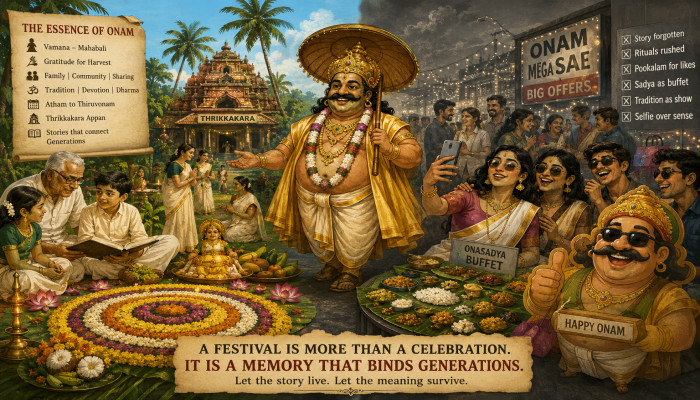
There is something unsettling about Onam today.
The festival is everywhere. The pookalams are bigger. The celebrations are louder. The photographs are more colourful. Social media is flooded with Onam greetings, traditional attire and elaborate sadya.
And yet, one cannot escape an uncomfortable thought:
Is Onam still being celebrated—or are we merely celebrating the memory of what Onam once meant?
The festival has survived. But has its meaning survived with it? That is how cultural memory disappears. Not suddenly. Not dramatically. But quietly.
One ritual becomes merely a ritual. One story becomes unnecessary. One symbol becomes decoration. One generation stops asking questions. The next generation never learns to ask them.
And then we call the forgetting modernity, progress or secularism.
The slow disappearance of meaning
Once, Onam was not merely a holiday on the calendar.
It was a period of anticipation, ritual, family gathering, worship, food, gratitude and remembrance. Its traditions carried stories and meanings from one generation to the next.
Today, much of that is being compressed into a spectacle.
Atham becomes the beginning of a countdown.
Thiruvonam becomes a single-day celebration.
The pookalam becomes a competition—and then a photograph.
The Onavilakku becomes decorative lighting.
The nivedyam becomes another item on the food counter.
The traditional Onasadya becomes a buffet experience.
The Onakkodi becomes an opportunity for a new photograph.
And Mahabali?
Increasingly, he is reduced to a cheerful, oversized caricature—the jovial king who arrives once a year, often wearing sunglasses in the latest social-media artwork.
The festival remains recognisable.
But the civilisation behind the festival is becoming increasingly invisible.
That is cultural amnesia at work.
It preserves the image while erasing the idea.
What happened to the questions?
Ask a young Malayali today:
Who was Mahabali?
Why does he return every year?
Who was Vamana?
Why is Vamana associated with Onam?
What is the significance of Thrikkakara?
Who or what is Thrikkakara Appan?
Why does Onam begin with Atham and culminate in Thiruvonam?
Why is the pookalam made?
These are not unreasonable questions.
They are the most basic questions that any civilisation should be able to answer about its own festivals.
If a generation knows how to perform the ritual but does not know what the ritual means, then what exactly is being transmitted?
A culture cannot survive merely through choreography.
It survives through memory.
It survives when grandparents tell stories, parents explain rituals, and children grow up knowing not only what they are doing, but why they are doing it.
Inclusiveness should not mean forgetting
There is, of course, nothing wrong with everyone celebrating Onam.
That is one of the beautiful aspects of Kerala's social life.
A festival can be shared without losing its identity.
But somewhere along the way, we seem to have accepted a strange proposition: that for a Hindu festival to be genuinely inclusive, its Hindu roots must become invisible.
Why?
Christmas is celebrated widely, but Christ does not have to disappear from Christmas.
Eid is shared socially by people beyond the Muslim community, but its Islamic origins are not erased.
So why should Onam become detached from Vamana, Vishnu, Mahabali and Thrikkakara merely to demonstrate its inclusiveness?
Participation does not require erasure.
A person who joins an Onam celebration does not need to accept every theological dimension of the tradition.
But the tradition itself should not be compelled to deny where it comes from.
That is not secularism.
That is cultural insecurity.
True pluralism allows traditions to retain their identities while being shared with others.
India's strength has never been that every tradition must become indistinguishable from every other.
Our strength has been the ability to celebrate together while remaining rooted in our own civilisational memories.
From tradition to performance
Something larger is happening here.
The transformation of Onam is part of a wider pattern.
Diwali increasingly becomes a festival of lights without its deeper story.
Holi becomes colours and parties.
Navratri becomes a dance event.
Janmashtami becomes a costume competition.
Vishu becomes a photograph of the kani.
The external celebration survives.
The internal meaning slowly recedes.
This is perhaps the most dangerous form of cultural erosion because nothing appears to have been lost.
The festival is still there.
The decorations are still there.
The songs are still there.
The food is still there.
The photographs are better than ever.
But ask about the meaning—and suddenly there is silence.
A civilisation can lose its memory while retaining its festivals.
The word "secular"
The word "secular" entered India's Preamble through the 42nd Constitutional Amendment in 1976.
But the Indian experience of coexistence is far older than the word.
The deeper question, therefore, is not whether India should be secular.
It must be.
The question is what we understand secularism to mean.
Does secularism mean that every citizen should have equal respect and freedom to follow his or her tradition?
Absolutely.
But does it mean that a civilisation must remove the sacred content from its own festivals before those festivals can be shared publicly?
Certainly not.
Coexistence is not the same thing as self-erasure.
If anything, genuine secularism should give traditions the confidence to remain themselves.
Let Onam be celebrated by everyone.
Let neighbours of every background join the sadya.
Let people admire the pookalam, participate in cultural programmes and enjoy the festivities.
But let Malayali families also retain the freedom—and responsibility—to teach their children the stories, symbols and sacred associations that gave Onam its meaning in the first place.
What should we do?
The answer is not complicated.
We do not need to reject modern celebrations.
We do not need to turn every festival into a museum piece.
We simply need to restore the chain of transmission.
Before making the pookalam, tell the child what it represents.
Before celebrating Thiruvonam, tell the story of Mahabali and Vamana.
Explain the significance of Atham.
Teach children about Thrikkakara.
Visit places associated with the festival.
Tell them the traditional stories—not as propaganda, but as inheritance.
Let grandparents become storytellers again.
Let parents become cultural interpreters.
Let schools teach the history and traditions of India's festivals as part of cultural literacy.
And let families introduce one simple rule:
Every festival must pass at least one story to the next generation.
That is doable.
It costs nothing.
It does not require a government scheme.
It does not require a committee.
It requires only a conversation at home.
Because the real preservation of a civilisation does not begin in government offices.
It begins around the family table.
Before the next selfie
Onam should not become a museum piece.
It should remain a living festival—joyful, contemporary, inclusive and open to everyone.
But it must also remain rooted.
Let the pookalam be beautiful.
Let the sadya be abundant.
Let the Onakkodi be colourful.
Let the streets be illuminated.
Let the music and celebrations continue.
But alongside all of that, let the story survive.
Let Mahabali remain more than a cartoon character.
Let Vamana remain more than an inconvenient reference.
Let Thrikkakara remain more than a geographical name.
Let Atham and Thiruvonam remain more than dates on a calendar.
And let the next generation inherit not merely the performance of Onam, but the memory of Onam.
Because the greatest threat to a festival is not that people stop celebrating it.
It is that people continue celebrating it after they have forgotten why.
The ritual can survive.
The photograph can survive.
The festival can survive.
But if the meaning disappears, what exactly has survived?
Perhaps that is the question we should ask before the next selfie.
Are we celebrating our festivals—or slowly forgetting ourselves while celebrating them?
Everkkum Onam Aashamsakal
Disclaimer: The opinions expressed within this article are the personal opinions of the author. MyIndMakers is not responsible for the accuracy, completeness, suitability, or validity of any information on this article. All information is provided on an as-is basis. The information, facts or opinions appearing in the article do not reflect the views of MyindMakers and it does not assume any responsibility or liability for the same.


 Loading...please wait
Comments