




When Terrorists Get Love Stories and Terror Victims Become Statistics: How Bollywood Humanises and Romanticises Terrorism
- In Current Affairs
- 01:34 PM, Nov 28, 2026
- Avinash Brahmbhatt
On November 17, 2026, six days after the terrorist attack on CRPF personnel in Jammu and Kashmir’s Kulgam, ThePrint published a report identifying Lashkar-e-Taiba operative Umer Nisar Dar as a bread maker. Its currently displayed headline identifies him as a bread maker-turned-LeT terrorist. Another ThePrint report, citing security sources, said Dar had been sheltering and assisting LeT commander Lateef Bhatt for five to six months and had carried out reconnaissance with him a day before the November 11 attack.

|
|
|
|
Before |
After |


This is hardly an isolated editorial choice. From Burhan Wani, the headmaster’s son, to Riyaz Naikoo, the mathematics teacher, and Mannan Wani, the PhD scholar, professional and educational backgrounds have repeatedly occupied prominent positions in terrorism reportage by Indian media. And this pattern serves a definite purpose - to humanise gruesome acts of terrorism, move victims of terror into oblivion while focusing on the poor and humble background of the perpetrators of terror. The goal - to evoke sympathy for the terrorist and to ensure that the victims are forgotten even as the terrorist remains alive in public memory, to rationalise the act of terror!

The question, then, is not whether a terrorist once had a job, a degree or a family. It is why those details so often become the first lens through which the public is asked to view them.
Long before this became a debate about newspaper headlines, Hindi cinema had been attempting something similar on the big screen: giving the terrorist a face, a wound, a childhood and, very often, a love story, focusing on the human side of why the act of terror was committed in the first place - a hideous attempt to justify violence by employing drama, romance, songs and emotions.
From the Enemy of the Nation to the Victim of Circumstances
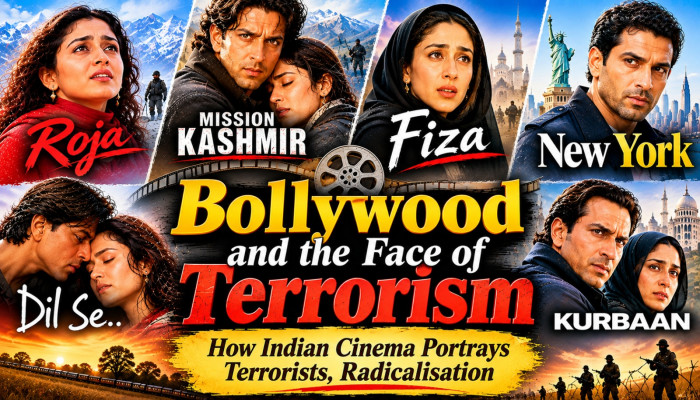
Mani Ratnam’s Roja (1992) was an important early film in this shift.
The film, set against the backdrop of the insurgency in Kashmir, revolved around a woman’s struggle to rescue her husband from terrorists. In a 2009 Times of India essay, filmmaker Kabir Khan (who later directed New York) called Roja one of the earliest mainstream films that “made terrorists human”, noting how a small detail about the militant’s past gave him a life beyond the gun.
Another Mani Ratnam film, Dil Se (1998) remains perhaps the clearest example of terrorism being fused with romance.
Generations of Indians have danced to Chaiyya Chaiyya. Yet, how often do we revisit its central narrative and examine the emotional treatment of its terrorist character?
The film dwells on the fact that Meghna (Manisha Koirala), the woman Amar (Shah Rukh Khan) obsessively loves, is part of a militant group preparing a suicide attack during Republic Day celebrations.
Her radicalisation is tied to horrific childhood trauma, including sexual violence by security forces. So, the audience does not meet merely a bomber. They meet a woman carrying memories of abuse, loss and rage. Yet Amar’s obsessive love for her becomes the emotional engine through which the audience experiences her story. Ironically, in the film, Amar is the son of a late Army Officer, and despite this background, he chooses to embrace death with the woman who hates his country and is on a mission to destroy it.
The climax does not leave us with faces of those who might have died in the suicide bombing. It leaves us with two lovers dying together. Eternal love even in death is glamorised, while innocent victims of terror don’t count in the film’s agenda.
The Terrorist as a Romantic Hero
The year 2000 witnessed the release of two films featuring Hrithik Roshan as a young man drawn towards terrorism: Fiza and Mission Kashmir.
In Fiza, Amaan disappears after the 1993 Bombay riots. His sister searches for him for years, only to discover that he has joined a terrorist group. Before he is a militant to the audience, he is Fiza’s missing brother and his mother’s lost son-a young man damaged by violence.
Mission Kashmir, released a month apart, follows another version of the template. Altaaf loses his family during a police operation and eventually becomes associated with a terrorist organisation. Rather than exposing the destructive intentions of the terror group, its emotional centre remains Altaaf’s suffering. The film gives us his childhood, his grief, anger, and romance with Sufiya.
Both films present terrorism through personal trauma, broken families and revenge.
Then came Fanaa in 2006.
Aamir Khan’s Rehan is charming, funny, desirable and deeply romantic. Zooni (Kajol) falls in love with him before she, or the audience, fully understands that he is an operative of the fictional Independent Kashmir Front. By the time the truth is revealed, Bollywood has already glamorised the lover boy as a terrorist.
Rehan is trying to obtain the trigger for a nuclear weapon. He kills, deceives and remains committed to his mission. Yet the film continues to frame his conflict through love, fatherhood and sacrifice. The film humanises Rehan through his relationship with Zooni. That he is engaged in wrongdoing is not important; his abandonment of Zooni is dismissed, and he comes across as someone whom the audience should eulogise.
To its credit, Fanaa ultimately depicts Zooni choosing to prevent an act of terrorism rather than protecting the man she loves. Yet, the audience is also invited to mourn a broken family and an unfulfilled romance.
The terrorist receives a love story, a family, memorable songs and a tragic farewell. Who is actually missing from the story? The victims of Rehan’s terror fantasies - absent all the while with nobody to humanise them, empathise with them and mourn for them.
What comparable emotional space is afforded to the families threatened by his actions? Or to Zooni, who becomes a victim of his radical ideological mission that killed her father (depicted as an accident after her father finds that Rehan is a terrorist).
After 26/11, Grievance takes centre stage
In June 2009, barely seven months after the 26/11 Mumbai terrorist attacks, Bollywood released New York.
In New York, Samir’s (John Abraham) eventual inclination towards terrorism is explicitly connected to his wrongful detention and torture after 9/11. His turn to terrorism is presented and justified through what was done to him, a result of his suffering. According to Bollywood, we must view terrorism from a moral compass and understand how and why a terrorist is produced. History and context do not matter to the film-maker. That is why not a single film was made on the Hindu victims of radical terrorism in Kashmir until Kashmir Files (2022). That Kashmiri Pandits chose to rebuild their lives peacefully instead of resorting to revenge and violence did not fit the Bollywood agenda. No scope to humanise terror here, you see!
Five months later came Kurbaan. Ehsaan (Saif Ali Khan) first appears as an educated professor who falls in love with Avantika, also a professor herself. Only after marriage does she discover that he is part of a terrorist network. Once again, a terrorist is introduced through romance, while his violent ideological commitments are contextualised through personal loss and American foreign policy.
The timing of these releases, soon after 26/11, is hard to ignore. India had suffered one of the deadliest terrorist attacks post-independence, yet Bollywood was telling stories in which terrorism was explained largely through humiliation, injustice, war, discrimination or personal loss. The question is not whether such factors can contribute to radicalisation, but whether the timing and framing ended up shifting attention from the ideology and brutality of terrorism to the grievances of the terrorist.
Cinema that repeatedly searches for the perpetrator’s wound will always underexpose the ideology that converts religious beliefs into permission to murder strangers.
Selective Humanisation and Silence
Vishal Bhardwaj’s Haider (2014) an adaptation of Shakespeare’s Hamlet explored disappearances, military excesses and the suffering of Kashmiris through a young man's personal tragedy.
However, its depiction of Kashmir drew criticism for virtually excluding the genocide and displacement of Kashmiri Pandits, despite being situated in the turbulent 1990s. This omission has been examined in academic literature and acknowledged in subsequent media assessments.
In 2020, even Shikara, which specifically addressed the Kashmiri Pandit exodus, faced criticism from members of the community for allegedly diluting the role of Radical Islamist terrorism.
Then, Laal Singh Chaddha (2022), Lieutenant Dan, the American soldier from Forrest Gump, was reimagined as Mohammad, a Pakistani terrorist rescued during the Kargil War (Cinema Express). Also, not to forget how films like PK (2014) portrayed an Indian woman falling in love with a Pakistani man - a relationship disapproved of by the woman’s father. In the climax, she contacts the Pakistan Embassy during a live broadcast to find her lover. Notice the positive, loving and humanistic portrayal of Pakistanis in such films and all others where conflict is the backdrop in which the narrative is located. Meghna Gulzar’s Raazi (2018) is another case example.
The question is why a terrorist’s redemption so frequently becomes cinematic priority while the suffering of their victims remains abysmally underexplored. Why does a terrorist’s pain deserve a close-up, while the victims, and even their suffering, are pushed out of the frame?
Context as a Coverup in Cinema
Cinema is not merely entertainment. It influences cultural memory, shapes conversations and determines whose suffering audiences are invited to recognise.
A terrorist can be a bread maker, teacher, doctor, engineer, student, father or lover. But none of those identities diminishes the gravity of terrorism once that person chooses violence.
The trouble starts when films begin softening the act itself, when we get paragraphs about the terrorist’s trauma but barely a sentence about the ideology behind the violence; when we remember his heartbreak, but not the name of the constable he shot.
ThePrint’s recent Kulgam story is useful because it exposes a framing instinct that Indian popular culture has practised for decades.
As India remembers the victims of 26/11, perhaps the question for both Bollywood and the media is much simpler:
We know the terrorist’s profession, educational qualifications, childhood, heartbreak and love story. But how many stories do we remember of the people whose lives terrorism destroyed?
References
-
https://economictimes.indiatimes.com/new-york-movie-review/articleshow/4709423.cms
-
https://timesofindia.indiatimes.com/kurbaan/articleshow/5323180.cms


 Loading...please wait
Comments