




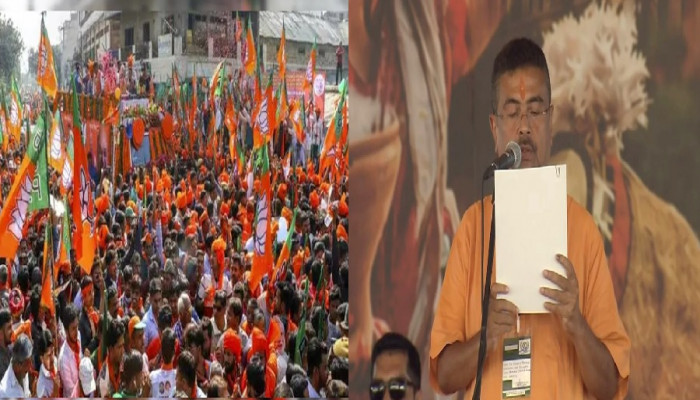
On 4th May 2026, West Bengal entered a new phase in civilisational legacy with the triumphant victory of the nationalist BJP in the West Bengal Assembly Election.
Ponchishe Baishak – 25th day of the first month of the Bengali calendar marks the birthday of Rabindranath Nath Tagore- Rabi Thakur- the epitome of Bengali culture and pride. This year, the day of Ponchishe Baishak- 9th May, 2026 has been a golden day of the Bengali Hindu Homeland- the state of West Bengal created by the leadership of Dr Syama Prasad Mookherjee- with the formation of the BJP government under the chief ministership of Suvendu Adhikari. On 21 June 2026, Bengal reconnected herself with the international community to celebrate the International Yoga Day under the stewardship of our PM Narendra Modi.
Five years ago, the 2021 Bengal election ended with the triumph of Mamata Banerjee’s formidable success and the BJP’s wanton failure to cross the double-digit mark, with only 77 seats. In the last five years, so much water has flown down the venerated river Ganga, which has been flowing from Uttarakhand to West Bengal through Uttar Pradesh and Bihar. With a 180-degree turn, Bengal now blessed the BJP with more than two-thirds majority seats (208 out of 294 seats) in the Bengal Assembly in 2026.
Five years ago, issues like ‘Bengali Pride’ – Bangali Asmita, local leadership issues, insider-outsider questions, candidate selection, communication problems, the women factor, soft vs hard Hindutva issue, Badrolok-Prantik Bengali narrative, Muslim consolidation, social engineering issues, and last but not least the Bengali psyche of ‘perception of deprivation’, ‘- all had been successfully exploited by Mamata Banerjee. But in 2026 all the above issues have been squarely tackled and managed by the BJP leadership.
Not only that, this time the BJP leadership has successfully exploited the other issues like anti-incumbency, pro-Hindutva sentiment and Hindu-vote consolidation, rampant corruption, women safety, law of diminishing returns of dole politics, failure of corporate style of management of TMC, Special Intensive Revision (SIR) of the Electoral Roll done by ECI and last but not the least, the free and fair voting ensured by the Election Commission of India.
The Immediate Past
From the day of the election results, we, the people of West Bengal, have been witnessing so many surrealistic incidents in public life that we are really struggling to comprehend the full impact of the verdict of the Bengali people.
In the last few years, particularly from 2025, the Bengalis had experienced an unprecedented environment of silent terror, rampant corruption and social degradation of ethical values not only in public life but also in private spheres of family structures in Bengali society. The political figures from top to bottom of the ruling party care less for decency, discipline and dedication to public life.
The Bengali society witnessed an all-round negativity in every sphere of public life. The Bengalis had to experience an unprecedented level of corruption when they saw crores of cash bundled in a flat of the education minister’s girlfriend. Public morality went for a toss. Even the vice-chancellors of the universities were arrested for corruption and irregularities. The thousands of teaching posts had been sold out in a syndicated manner. From the Public Service Commission to Municipal Service Commission to School Service Commissions, every type of recruitment agency was accused of rampant corruption and selling of the vacant posts.
The syndicate raj, tolabaji- extortion, cut-money – all types of hooliganism, deceitful acts, and illegal accumulation of wealth have been normalised in Bengali society. We have witnessed the rags-to-riches stories of the people representatives, not by toil and struggle but by sheer corruption. Corruption and extravagance in public life were normalised in Bengal.
The Abhaya case - RG Kar Hospital rape and murder of a lady doctor shook not only Bengali society but entire humanity. The inhuman and motivated incidents following the murder by the then ruling party have completely exposed the real intent of the TMC party under Mamata Banerjee. The atrocities on women were being trivialised by the then ruling regime.
Finally, the open and loud appeasement politics of Mamata Banerjee got its cruellest stamp in the Hargovinda Das murder case in Murshidabad district, which also witnessed the CAA protest and vandalism of railway properties, after so many similar cases in West Bengal. The Hindus were being pushed to the wall in their backyard – the Bengali Hindu Homeland. And, the final results underscored the total loss of credibility of Mamata Banerjee.
In the last three months, we Bengalis have been going through a reactive phase: egg-throwing at the TMC leaders, breakdown of the authority of Mamata Banerjee in her own party and split of the legislature as well as parliamentary party of TMC, so many arrests of TMC party leaders etc.
But we are also witnessing a silver lining in West Bengal with the formation of a pro-active nationalist party.
The Long Past: Vicious Cycle
Historically, the undivided Bengal was a melting pot of different races, different cultures and different ideologies. We can summarise the last two hundred years’ history of Bengal till the day of Indian independence, 15th August 1947, with ups and downs of hope and despair. The history of modern India started almost with the history of modern Bengal and the Bengal Renaissance. In every sphere of social life, from religion, arts, culture and literature to industry and business, Bengal had gone through a generative and reformative phase. Indian society got its first symbol of pan-Indian cultural nationalism in Bengal through the song Vande Mataram in the later part of the 19th century.
But the first census in 1872 had revealed the deep fault line of division of the Hindu-Muslim population, with the majority of Muslims in Eastern Bengal and the majority of Hindus in Western Bengal. And then came the first blow of the colonial British Empire to divide India on the basis of the divide-and-rule theory: the Bengal Partition of 1905. The partition of Bengal was annulled in 1911 by the British Raj due to the massive protests and Swadeshi movement, particularly by the Hindus of Bengali society. But the power shifted from Bengal to Delhi with the change of the British Indian capital from Calcutta to Delhi Darbar.
The unfinished tasks of the British Raj were fulfilled with the division of India in 1947 on the basis of the Two-Nation Theory, and we, the Bengali Hindus, had somewhat managed to get our Bengali Hindu Homeland- West Bengal. And, the downfall started slowly but steadily in Bengali Hindu society.
The sudden mysterious death of the leading Hindu Homeland proponent, Dr Syama Prasad Mookherjee, had given a near-death blow to the crystallisation of nationalistic Bengali Hindu sentiments in the post-independence period in West Bengal, which was devastated and drained of vitality largely due to the crores of Hindu refugees from East Pakistan. The void had been easily filled by the Left movement. And, the divided West Bengal had been going through a vicious cycle of negativity in the forms of trade unionism, flight of capital, ultra-left militant communist insurgency of the Naxal movement, large-scale infiltration from the neighbouring Bangladesh etc. The continuous influx of Hindu refugees from the erstwhile East Pakistan and now Bangladesh has proved that the so-called division of Bengal was an unfinished curse on Bengali Hindus.
The last fifty years have seen an all-round downfall of divided Bengali Hindus in almost all spheres of social life, from religious to education to culture to industrial areas in West Bengal. The 34 years of Left rule had started a stabilisation process in Bengali society after the bloody Naxalite and unruly Congress period of the seventies. But soon after the initial semblance, the Left regime had institutionalised violence in the disguise of loyalty and mediocrity by politicking every sphere of social life. Through the so-called decentralisation of power up to the panchayat level and right to unionism in every area of administration, including industrial units, the Left regime had stifled the spirit of economic growth and development of West Bengal. Nepotism and party bureaucracy had assumed a serious proportion in the forms of syndicate raj, tolabaji- extortion and cut-money, which were later transformed as institutionalised corruption in the last 15 years.
The Left Front rule had been successful to a major extent in obliterating the cultural roots of Bengali Hindus in the disguise of liberalism and secularism. But it couldn’t be successful in uprooting the civilisational legacy of Sanatani Dharmic tradition of Bengali Hindus.
The Present
After assuming office, Suvendu Adhikary has started to implement the promises made in the election manifesto of the BJP. It’s really a herculean task to turn around the mess with almost Rs. 8 lakh crores of debt incurred by the erstwhile TMC government. The management of the pressure of dole politics, the establishment of the rule of law and industrial growth have been the bedrock of development politics initiated by the BJP leadership in West Bengal.
The continuous public anger at corrupt politicians throwing eggs by the common people, unearthing unaccounted wealth and treasure of corrupt men, and the political management of opposition parties have been the testing ground for the competency of the new dispensation in Bengal. Each and every day, new types of corruption are being unearthed in the state. The people of West Bengal have already witnessed corruption in recruitment processes and other areas like soil, sand, coal smuggling etc. But the latest area has been the blood smuggling. No area of public life has been untouched by the unscrupulous persons in present-day Bengal.
Despite so many financial, administrative and legal challenges, the new government has started its corrective, reformative and development initiatives in different spheres of public life. From the issues of national security to public security to social security, the new government has been taking different measures without wasting time. To check cross-border infiltration and border-related illegal activities, the West Bengal government has been handing over necessary land to the BSF to build border fencing at the earliest. In the meantime, the Bengal government has brought the Public Safety Act or Goonda Daman law to take stringent measures against public hooliganism, extortion and corruption.
In social security areas, the government has been trying to implement the Annapurna Yojana for women and other socio-economic schemes by fixing the loopholes and providing necessary financial support to the real beneficiaries. Every section of the government sectors have been benefitted financially from the government, including the payment of DA and the formation of the Pay Commission for government employees. Now is the time for a transparent recruitment process to be resumed to restore public faith in Bengal.
The Bengali Hindus have unlimited hope and expectations from the present BJP government as well as from the Centre in that the Double Engine Sarkar will address properly to rebuild the West Bengal in all fields, including industrial areas. The reopening of so many jute mills and the proposed investments in many industries have rekindled the hope of industrial regeneration in Bengal, which would facilitate not only industrial growth and development but also address the mounting pressure of unemployment and migrant labourers. The regime change has also ensured the implementation of all Central schemes in West Bengal.
The Virtuous Cycle: Way Forward
The first Bengali nationalist government has been nearing a hundred days in power. So, what is the way forward? Can the Bengalis turn around the moribund situation of Bengal and start the virtuous cycle of democracy, discipline and development?
Immediately after the announcement of the election results, the state BJP president had made it clear that there won’t be any type of political vendetta and vengeance against the erstwhile TMC party members. We did not witness the scale of violence of 2021 election results after this year’s election results. The public anger instead took the shape of non-violence in the form of egg throwing and sloganeering. The culture of political violence is so deep in Bengal that it will take much time to change and take a reformative development culture. But hopefully the present dispensation has been on the right path to change the paradigm from the rule of the ruler to the rule of the law. If the political culture of Bengal changes positively, the virtuous cycle will roll down through generations in future and align with the nationalist culture of India that is Bharat.
Disclaimer: The opinions expressed within this article are the personal opinions of the author. MyIndMakers is not responsible for the accuracy, completeness, suitability, or validity of any information on this article. All information is provided on an as-is basis. The information, facts or opinions appearing in the article do not reflect the views of MyindMakers and it does not assume any responsibility or liability for the same.



 Loading...please wait
Comments