




West Bengal: Samim Laskar’s Dangerous Politics of Mob Mobilisation in Baruipur
- In Current Affairs
- 09:15 PM, Jan 31, 2026
- Vladimir Adityanaath
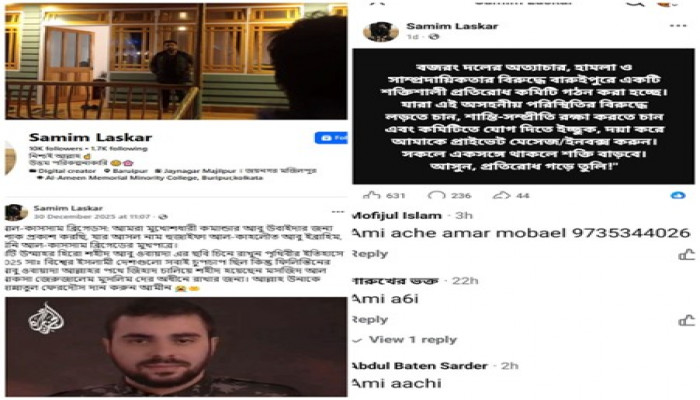
In an era where a single social media post can mobilise crowds faster than any street-corner speech, the line between free expression and reckless incitement has never been thinner. That line appears to have been deliberately blurred by Samim Laskar — a Facebook influencer with over 10,000 followers, a public speaker, and a current resident of Baruipur, West Bengal — through a pattern of online activity that raises serious questions about intent, responsibility, and public safety.
On 27 January, Laskar uploaded a Facebook post announcing the formation of a “powerful resistance committee” in Baruipur, ostensibly to protect Muslims from alleged attacks and “communal sentiments” of Hindu organisations. The framing was stark, urgent, and alarmist [1]. Yet the claim collapses under even minimal scrutiny.

There is no documentary evidence of any communally motivated attack against Muslims in Baruipur that would justify such a call to mobilisation. On the contrary, 2025 alone has seen at least two documented incidents of communal violence targeting Hindus, including the desecration of a Hindu temple in the same locality [2][3]. In other words, the empirical record runs directly opposite to the narrative Laskar sought to popularise.
From Narrative to Network
What makes this post especially concerning is not merely its content, but its reception. The post attracted 785 likes and 286 comments, many expressing enthusiasm for participation. At least four individuals publicly shared their phone numbers in the comments, signalling readiness for offline coordination. This is no longer passive opinion-sharing but early architecture of mobilisation built on an unsubstantiated grievance.
When influential figures invoke the language of “resistance” without evidence of threat, they do not protect communities but manufacture fear, the most combustible political resource of all.

A Pattern, Not an Isolated Post
Laskar’s January 27 post does not exist in isolation. His social media history reveals a consistent pattern of provocative, misleading, and factually false claims, often aligned with radical Islamist talking points.
On 30th December, he uploaded posts expressing grief over the death of Abu Ubaida, spokesperson of the Al-Qassam Brigades, an organisation designated as terrorist by the European Union, United Kingdom, Australia, Canada, Paraguay, Japan, Ecuador and Switzerland. While expressions of opinion are legally protected, public mourning for a spokesperson of a listed terrorist outfit is not politically neutral signals ideological sympathy that should alarm any society committed to constitutional order [4].

In another instance, Laskar mocked the decades-long persecution of Hindus in Bangladesh, framing it with cynical whataboutery. He sarcastically questioned whether other nations would ban Indian cricketers over atrocities against minority Hindus, while sidestepping the documented realities of repeated statements by senior Bangladeshi politicians, military figures and public servants that threaten Bharat’s territorial integrity alongside persistent violence and dispossession faced by indigenous Hindu communities. This denial normalises persecution elsewhere and feeds into the manufacture of grievance narratives at home [5].

Fake Atrocities, Real Consequences
Perhaps the most dangerous aspect of Laskar’s activity is his repeated peddling of demonstrably false atrocity narratives.
On 24 January, he claimed that a 20-year-old Muslim woman Zakiya, had been gang-raped and murdered by so-called “Hindutvawaadi” activists. The allegation was incendiary and false. Multiple independent third-party fact-checkers reviewed the claim and flagged it as fake. Yet by the time corrections circulate, the damage is already done. False rape-and-murder narratives have a well-documented history of triggering riots, lynchings, and retaliatory violence in India [6].
This was not an aberration. In November, Laskar attempted to revive the long-debunked “breast tax” myth of Kerala, a fabrication repeatedly rejected by serious historians. In another post, he falsely claimed that Haji Mohammad Mohsin established Bengal’s first free educational institution and concluded without logic or evidence that Shudras and Dalits should therefore not worship Saraswati. This is not only historically illiterate, but socially poisonous. All-inclusive educational institutions in Bengal predate Islamic rule by at least four centuries, rooted in ancient and medieval Hindu, Buddhist, and Jain traditions [7].
Condoning Violence, Normalising Intimidation
The danger of Laskar’s online conduct is not limited to misinformation alone, but it also extends to the open normalisation of violence against dissenting voices. On 16 January, he uploaded a post explicitly condoning violence against journalists of Republic TV Bangla. Regardless of one’s opinion of the channel’s editorial line, endorsing violence against journalists strikes at the core of democratic norms. It signals a willingness to replace debate with intimidation and disagreement with physical coercion, an escalation that no civil society can afford to ignore.

Why This Matters
What emerges is a clear pattern:
a) Invent a threat where none exists.
b) Invoke identity-based fear to justify “resistance”.
c) Spread false atrocity stories to inflame passions.
d) Undermine historical truth to delegitimise indigenous traditions.
e) Signal ideological proximity to extremist narratives while enjoying the megaphone of social media.
Individuals like Samim Laskar shape emotional climates. When such influence is exercised irresponsibly, it ceases to be a free-speech question alone and becomes a public-order concern.
Conclusion: A Warning, Not a Witch-Hunt
This is not an argument for censorship, nor a call to criminalise dissent. It is a warning about the real-world consequences of organised misinformation, especially when amplified by social platforms and informal networks that lend legitimacy without accountability.
Institutions like Al-Ameen Memorial Minority College and society at large must reflect on the environments they enable. When educational spaces produce or tolerate habitual misinformation, communal provocation and ideological radicalisation, they risk becoming incubators of conflict rather than centres of learning.
History shows that communal violence rarely begins with weapons. It begins with stories told loudly, repeatedly and by people who understand exactly how fear can be converted into power. When lies are organised, and grievance is professionalised, violence does not arrive as an accident but as a plan.
References:
- https://www.facebook.com/share/p/1FJjQrbb8V/
- https://hindupost.in/news/west-bengal-islamist-attacks-shitala-mata-murti-in-baruipur-burned-the-murti-after-vandalism/
- https://www.hinduphobiatracker.org/app/case/aa4aea7
- https://www.facebook.com/share/r/1Gu5srfurp/
- https://www.facebook.com/share/p/1MSUkwy5yZ/
- https://www.facebook.com/share/p/1AcBmZDfmh/
- https://www.facebook.com/share/p/17bpXuVDhg/
Disclaimer: The opinions expressed within this article are the personal opinions of the author. MyIndMakers is not responsible for the accuracy, completeness, suitability, or validity of any information on this article. All information is provided on an as-is basis. The information, facts or opinions appearing in the article do not reflect the views of MyindMakers and it does not assume any responsibility or liability for the same.



 Loading...please wait
Comments