




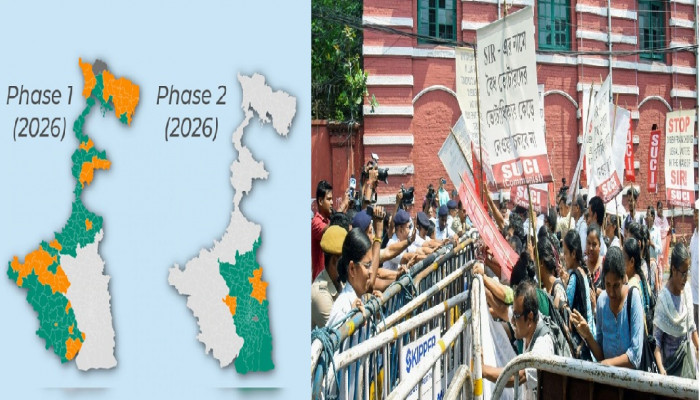
From the border districts of North Bengal to the Sundarbans coast, each of Bengal's five regions carries a different vulnerability index heading into April 23.
North Bengal (54 Seats) — The BJP Fortress
North Bengal — comprising Cooch Behar, Alipurduar, Jalpaiguri, Darjeeling, Malda, and the Dinajpurs — was already the BJP's strongest zone in 2021. The SIR's most aggressive deletions are concentrated in Malda (8.28 lakh under adjudication, ~11.6% of electorate) and Uttar Dinajpur (4.80 lakh, ~9.8%). These border districts, with their complex demographic profiles and historically high rates of 'logical discrepancies,' have experienced disproportionate disruption to voter lists.
The BJP's 2021 leads in Cooch Behar and Alipurduar were already substantial. With SIR corrections reinforcing those leads and the TMC's base in Malda mathematically compressed, North Bengal is shaping up as the surest zone for BJP gains in 2026. A sweep of 46–52 of 54 seats in this region is within the model's plausible range.
Junglemahal & Western Plateau (42 Seats) — The First Battlefield
The districts of Purulia, Bankura, Jhargram, and Paschim Medinipur constitute one of Bengal's most intensely contested terrains. The TMC recovered significantly here in 2021 compared to 2019, turning previously BJP-leaning tribal belts back toward the incumbent. The SIR's impact in this region focuses on 'migratory' and 'duplicate' voter entries that the BJP has historically contested. A 20 per cent reduction in the TMC base here, combined with even a 1 per cent BJP swing, flips the region from a narrow TMC advantage to a BJP lead.
South Bengal — Rarh & Central Districts (120 Seats) — The Decisive Arena
Hooghly, Howrah, Birbhum, Bardhaman, Murshidabad, and Nadia — the industrial and agricultural heartland of Bengal — constitute the largest and most analytically complex region. The TMC averaged over 50 per cent vote share here in 2021. The SIR adjudication in Murshidabad (11.01 lakh affected) and Birbhum creates the most acute' margin erosion' scenario.
Murshidabad deserves special analysis. With a 66 per cent minority population, it was a TMC fortress — the party polled 54 per cent in 2021. But 11 lakh voters under adjudication amount to roughly 20 per cent of the electorate in administrative limbo. If the 45 per cent exclusion rate holds, approximately 5 lakh names would be permanently removed from Murshidabad's rolls. In 12 of the district's 22 seats, the projected deletion volume now exceeds the TMC's 2021 winning margin.
|
Constituency |
2021 TMC Margin |
Adj. Voters (~45% deletion) |
Vulnerability |
|---|---|---|---|
|
Murshidabad |
2,491 |
~22,000 |
CRITICAL FLIP RISK |
|
Burdwan |
2,700 |
~22,000 |
CRITICAL FLIP RISK |
|
Bharatpur |
4,000 |
~22,000 |
CRITICAL FLIP RISK |
|
Khargram |
12,000 |
~22,000 |
HIGH VULNERABILITY |
|
Hariharpara |
14,000 |
~22,000 |
HIGH VULNERABILITY |
|
Nabagram |
35,533 |
~22,000 |
Moderate (SDA split risk) |
|
Domkal |
47,000 |
~22,000 |
Relatively Stable |
The Delta and Coastal Belt (78 Seats) — The TMC's Last Wall
South 24 Parganas — where the TMC won 30 of 31 seats in 2021 — is where the 'management failure' variable has the most pronounced analytical significance. The TMC's dominance here was built on welfare penetration, booth-level cadre control, and near-total consolidation of minority votes. All three pillars are under simultaneous pressure in 2026.
The 2.34 lakh voters deleted or adjudicated in South 24 Parganas is lower in percentage terms than the northern districts. However, in a region built on high-turnout mobilisation in dense rural pockets, even a 15 per cent deletion in key gram panchayat blocks like Canning, Baruipur, and Bhangar can be decisive. The ISF, led by Naushad Siddiqui (contesting from Bhangar), adds a further disruptor: a 10–12 per cent shift in minority votes toward the ISF in 40+ seats of South Bengal would catastrophically fracture the TMC's consolidation advantage.
Greater Kolkata (52 Seats) — Urban Organics
The city itself is an outlier in the SIR data. Kolkata shows the lowest deletion percentage (~0.7% of the electorate). Urban voters with established residential documentation were far less likely to be flagged for 'logical discrepancies.' The SIR's political impact in Kolkata will therefore be felt less through voter deletion and more through the 'management failure' dynamic: the inability of local TMC para-committees to mobilise voters under 100 per cent webcasting and CAPF presence.
The INC/Left Factor: A Critical Uncertainty
The Left Front and Congress are contesting separately in 2026 after their alliance collapsed. Their combined vote share — already at ~8% in 2021 — could fragment further. In Bengal's binary polarisation dynamic, every percentage point the INC/Left loses tends to migrate toward the BJP as the primary vehicle of anti-TMC sentiment.
However, in minority-heavy districts like Murshidabad and Malda, INC/Left collapse does not automatically mean BJP gains — it could mean ISF or independent consolidation. The BJP's secular vote ceiling in districts with a minority population above 50 per cent is structurally limited. Analysts must model the INC/Left collapse impact separately for Hindu-majority and Muslim-majority constituencies.
The Final Projection: An Honest Range
Combining all verified variables — SIR deletions, two-phase CRPF deployment, INC/Left fragmentation, and ISF expansion — against the verified 2021 baseline (TMC 213 seats / 47.93%, BJP 77 seats / 38.13%), the following seat projection ranges emerge:
|
Region |
Total Seats |
BJP Range |
TMC Range |
Others |
|---|---|---|---|---|
|
North Bengal |
54 |
46–52 |
2–6 |
0–2 |
|
Junglemahal / West |
42 |
32–38 |
4–8 |
0–2 |
|
Central / Rarh |
120 |
60–80 |
32–52 |
4–8 |
|
Delta / Coastal |
78 |
25–38 |
32–45 |
4–8 |
|
TOTAL |
294 |
163–208 |
70–111 |
8–20 |
The midpoint of these ranges — BJP ~185, TMC ~90, Others ~19 — suggests a clear BJP majority. The upper bound (208) approaches two-thirds of the House. The lower bound (163) still constitutes a comfortable working majority (148 seats needed). The TMC retains a plausible floor of ~80–90 seats primarily in South Bengal and Kolkata, even in an adverse scenario.
IMPORTANT ANALYTICAL CAVEAT: These projections assume SIR deletions have a net negative electoral impact on the TMC. This is the analytically plausible inference from the geographic concentration of deletions. However, the TMC disputes this characterisation, and genuinely ineligible voters — deceased, migrated, duplicate — have been removed, whose removal benefits no party. The net partisan impact of the SIR will only be quantifiable after the May 4 results.
ANALYST VERDICT
The 2026 West Bengal election is, in analytical terms, a stress-test of whether a political machine built on freebies, minority appeasement with large minority population, total indifference to the majority of the population and cadre-managed turnout, intimidation and violence can survive the simultaneous removal of its two foundational advantages — a large, dependable voter list openly to massive manipulation and the ability to mobilise it without external supervision.
The SIR has compressed the voter list; the two-phase CAPF saturation has compressed the mobilisation advantage. The TMC enters April 23 as the technical incumbent but the structural underdog. The BJP enters with its 2019–2021 baseline of 38–40 per cent, which — on a 'cleaned' roll in a binary contest — is, for the first time in Bengal's post-1967 history, a number that credibly converts into a majority.
Whether 2026 becomes a historic realignment or a closer-than-expected TMC survival will depend on two variables that no model can yet quantify: how many of the 60 lakh adjudicated voters actually appear at the booth on April 23 and 29, and whether the organic vote in South Bengal — always the TMC's last sanctuary — holds its shape when the management scaffolding is removed.
Bengal's reckoning is at hand. The arithmetic is clear. The outcome, for the first time in a generation, is genuinely uncertain.
All data sourced from ECI official press notes (CEO-PN-05-2026), Supreme Court proceedings, and verified media reporting. Electoral projections carry inherent uncertainty and are analytical scenarios, not predictions. Fact-checked against official sources as of April
(Contd..)



 Loading...please wait
Comments