




Water: The Essence of Vedic Civilisation
- In History & Culture
- 11:04 AM, May 17, 2023
- Biman Das
Water has long been considered one of the cardinal elements that have been part and parcel of cultures across the world. The fluid’s critical value gives it the utmost importance for sustenance and subsequently affects cultural values. Cultures have gone to several wars to safeguard a supply of this crucial element. Nations that have lived in areas with abundant water supply have not been required to push through violent means, while others are forced to expand outwards in hopes of finding the precious resource.
The element is held in high regard among Hindus who perceive the ability of the fluid to be cleansing in nature. The waters of the sacred rivers are considered to be so immaculate that they can erase the sins of an individual if they come to them with sincere veneration. As a result, we can observe many festivals that are interwoven with the cyclic patterns of the courses of rivers and ocean tides. These can range from better-known deities such as Devi Ganga and Yami (Devi Yamuna) to lesser known such as Mariamman in Tamil Nadu and Iril Lairembi in Manipur.
The very origin of the Hindu civilisation can be considered to be a boon from the sacred riverine divinities of the subcontinent. The culture that once flourished on the fertile plains of the Sindhu and Saraswati rivers could continue to build upon their ancestors on settling the arable realm of the Ganga and her tributaries. The cascading nature of these rivers is therefore documented in the sacred texts of the Vedas. Ganga finds her rightful place in the scriptures as the symbolism of the spiritual knowledge bestowed upon humans by the gods. Emanating from the kamandalam of Brahma Deva, she descends into the earthly realm to liberate the souls of beings who are caught in the cycle of moha (cosmic illusion). She holds such power that a mere dip into her sacred waters absolves the sins of an individual rendering him worthy enough to be liberated from the vicious cycle of reincarnation. Hence, Hindus take the cremated remains of their dear ones to the sacred river in hopes of them attaining moksha (liberation).
Seven rivers in India have been deified to the status of sacred divinity and are collectively called Saptanadi - Ganga, Yamuna, Sindhu, Narmada, Godavari, Krishna and Kaveri. This phenomenon is not restricted only to the Hindus of the Indian subcontinent, but also to those that live beyond. Hindus in Bali immerse the ashes of their departed into the sacred waters of Ratnakara (Indian Ocean) as they believe the body contains the drained waters of the Ganga giving it the same healing properties as well.
Water deities are often personified as feminine beings on account for their nurturing and motherly nature (apart from a few exceptions such as the Brahmaputra that flows through the sunlit state of Assam). The Northeastern state of Manipur is a prime example of this, where the sacred Loktak river is personified as the goddess Loktak Ima (or Loktak Lairembi). The sacred rivers of the aquatic body have long played an important role in not only preserving the unique flora and fauna of the region but also influencing the traditions of the Meitei community. The common saying “Loktak Ima Eikhoigi Patna Louchani” (Mother Loktak is our paddy land) recorded by historian Hamlet Bareh encapsulates the dependence of the communities that sustain on the lake’s waters. Locals believe the benevolent goddess replenishes fish in the lake to ensure that her devotees never go to bed hungry.
Devi Bhagrirathi is revered much beyond the borders of the Indian subcontinent, so much so that namesake rivers can be found across the Indosphere. Similar to the Indians, rivers in Southeast Asia play important roles in forming the local civilisations. One notable example of this is the Mae Kong River which runs through the lush valleys of the Indo-Chinese peninsula before amalgamating with the South China Sea (known as Champasagar in olden times). The river takes its name after the sacred waters of the holy Ganga indicating its importance for the locals of the region. The kings of the kingdom of Thailand, for instance, are required to undergo the Song Phra Muratha Bhishek (same as abhishekam in India), the purification ceremony where waters of five sacred rivers in India are required to cleanse the new king prior to his consecration. Due to geographical restrictions, the rivers of the five local rivers called Bencha Suttha Khongkha (Five Pure Streams of Ganga) are used as symbolic substitutes for the five sacred rivers in India.
Further down South, one can come across the goddess Nyai Roro Kidul who is considered a feminine personification of the Indian Ocean. Originally of animist origin, the goddess has become part and parcel of the Hindu Javanese, Sundanese and Balinese pantheon and is considered to be the spiritual guide of the royals of the archipelago. Also known as Dewi Kadita or Dewi Srigenge, the tutelary deity witnesses devotees throng to offer oblations to her on the coasts of the island during the Rejang Sandat Ratu Segara, a ceremony where women perform for the goddess. The shores of the sacred Tanah Lot temple in Bali get decked in shades of white and green, the preferred colors of the goddess, when the goddess is invoked to bring forth prosperity to the people.
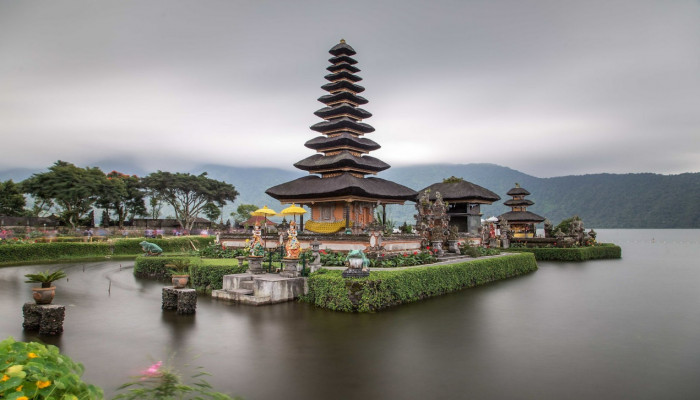
Similar to her, the Vedic goddess Danu is likewise venerated widely by Hindus of Indonesia. Born of Prajapati Daksha, she is found exalted in the sacred scriptures of the Rigveda as the deity of the primordial waters. One of her most important shrines is the Pura Ulun Danu Bratan in Bali where the goddess is believed to reside in the Bratan lake that forms part of the temple complex. So, it comes as no surprise that the goddess is seen as a maternal figure by Hindus there akin to Adi Shakti. A notable example of veneration of riverine bodies comes with that of the Sharada Shaktipeeth in the Kashmir valley. The deity of the temple is considered not only a form of Devi Sati but also Devi Saraswati owing to the region being an important site for learning.
Etymological connections across the expanse of Europe also hint at the goddess having been an integral part of the European religions in earlier periods. Dniper, Danube, Don and Dniester - all these rivers show a common origin in nomenclature that may arguably be connected to this goddess. Traces of the veneration of a water goddess with almost similar attributes could be found in Celtic communities that once roamed the expanse of the European forests. In the traditional Irish pantheon, the goddess Danu is considered as the maternal progenitor of the Tuatha De Danann, a group of Celtic deities. Although their veneration ceased to exist with the brutal conquest by Christianity, elements of reverence for the deities continue in traces through folklore and traditions.
Water is the sacred element that we are born of, being suspended through it in the maternal womb of creation. Thus, the cyclic nature of life manifests the end to return to the very same element on the cremation of the mortal bodies. The conspicuous streams of water that rise and fall in cycles have seen the rise and fall of great civilisations. The drops of rain will continue to precipitate for our descendants who hopefully continue the legacy of our ancestors in venerating the gods and the inherent divine nature.
Title image: Pura Ulun Danu Bratan, Bali is one of the most important shrines for the water goddess Danu, provided by the author.
Disclaimer: The opinions expressed within this article are the personal opinions of the author. MyIndMakers is not responsible for the accuracy, completeness, suitability, or validity of any information on this article. All information is provided on an as-is basis. The information, facts or opinions appearing in the article do not reflect the views of MyindMakers and it does not assume any responsibility or liability for the same.



 Loading...please wait
Comments