



Voting, contesting elections are not fundamental rights, rules Supreme Court
- In Reports
- 07:57 PM, Apr 11, 2026
- Myind Staff
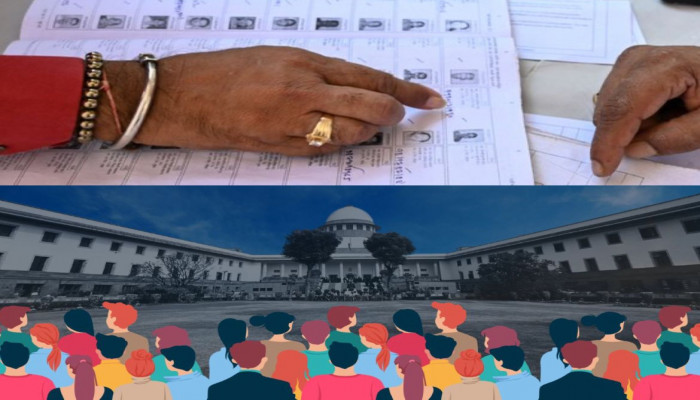
The Supreme Court of India has once again clarified that the right to vote and the right to contest elections are not fundamental rights. Instead, these are statutory rights, meaning they exist only because laws grant them. A bench of Justices BV Nagarathna and R Mahadevan emphasised that these rights are limited to what is provided under the law.
“It is well settled that neither the right to vote nor the right to contest an election is a fundamental right,” the court said, as per Live Law. The bench referred to earlier rulings and explained that voting allows citizens to take part in the electoral process, but contesting elections is a separate and additional right. This right can be regulated through conditions such as eligibility, qualifications, and disqualifications.
The case before the court was related to election rules for District Milk Producers’ Co-operative Unions in Rajasthan. These unions operate under a three-tier structure established by the Rajasthan Co-operative Societies Act, 2001. To manage elections within this system, bylaws were introduced to define who could contest. These rules included requirements like a minimum number of days and quantity of milk supplied, whether the societies were actively functioning, and if they met audit standards.
Some primary cooperative societies challenged these bye-laws in the Rajasthan High Court. They argued that the rules were unfair and went beyond what the law permitted. In 2015, a Single Judge of the High Court struck down these bye-laws but allowed elections that had already taken place to remain valid. This decision was later upheld by a division bench in 2022.
Following this, the Registrar began steps to revise the bye-laws. This move prompted chairpersons of several district milk unions to approach the Supreme Court. These chairpersons were not part of the original High Court case, but they claimed that the changes would affect them directly.
The Supreme Court disagreed with the reasoning of the High Court. It held that the bye-laws only set eligibility conditions and did not amount to disqualifications. The court also said that these rules did not violate any constitutional principles. According to the bench, setting criteria for participation in elections is a normal part of managing such institutions.
The court also raised concerns about whether the writ petitions filed in the High Court were maintainable. It pointed out that cooperative societies are generally not considered “State” under Article 12 of the Constitution. They also do not usually perform public functions. Because of this, disputes related to their internal management, especially elections, do not normally justify intervention under Article 226.
The judgment also explained the legal position regarding voting rights. The right to vote and the right to contest elections are created by laws, not directly by the Constitution. Laws such as the Representation of the People Acts of 1950 and 1951 lay down who can vote, who can contest, and who can be disqualified. These laws include conditions related to age, citizenship, and even criminal background.
Similar legal frameworks exist for local bodies and cooperative societies, where state laws and bye-laws determine election rules. This means authorities have the power to set reasonable conditions for participation in elections. Courts generally interfere only when such rules are clearly unfair or violate basic constitutional principles like equality.
Through this ruling, the Supreme Court has reinforced a long-standing legal position. It has made it clear that while elections are an essential part of democracy, the rights associated with them are not absolute. They are governed by laws, and these laws can define limits and conditions as needed.



 Loading...please wait
Comments