




VISION 2047: Can India put Pharma Companies in the Global Top 5?
- In Current Affairs
- 06:19 PM, Aug 16, 2026
- Rudra Dubey
From Pharmacy of the World by Volume to Leader by Value
For 30 years, India has proudly been called the "Pharmacy of the World". We supply 20% of global generics and 60% of global vaccines.
But there is an uncomfortable truth. By VALUE, we are only 3-4% of the $1.6 trillion global pharma market. The world's Top 5 today - Eli Lilly, Johnson & Johnson, Roche, Merck, Pfizer - are valued at $200-800 billion each. Our largest, Sun Pharma, is ∼$50 billion.
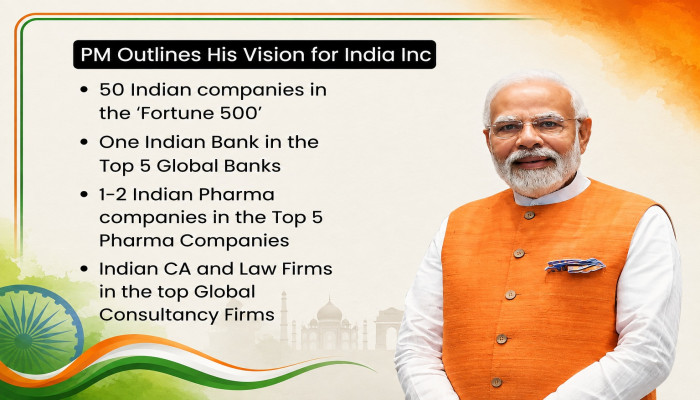
Prime Minister's pitch for Viksit Bharat 2047 - Vision for India Inc is blunt: 1-2 Indian pharma companies must be in the Top 5 globally by value.
On Independence Day 2025, he made it official from the Red Fort: “Shouldn't we be the ones providing the best and most affordable medicines for the welfare of humanity? We need to develop new medicines and vaccines entirely within India and secure patents.”
This is not about making more generics. It is about shifting from Cost-Based to Innovation-Based Growth. And it cannot be done by industry alone.
Here is a 6-point playbook to accomplish it-
1. The Big Shift: From Generics to Patented Innovation
Our current model is reverse-engineering. The Top 5 model is patenting. We need to move to three buckets already defined in the government’s PLI Scheme:
Bucket A: First-in-class New Chemical Entities, Biologics, Cell & Gene Therapy, mRNA platforms
Bucket B: Complex high-value generics - Biosimilars, long-acting injectables, inhalers
Bucket C: Self-reliance in APIs/KSMs to de-risk supply chain
The real valuation jump will only come from Bucket A.
2. Government as Risk Partner - Not Just Regulator
Govt has already put money on the table:
- PLI Pharma - Rs 15,000 Cr: For 55 companies to make patented and complex drugs. Incentive on incremental sales.
- PLI Bulk Drugs - Rs 6,940 Cr: For 41 critical APIs to reduce dependence on China.
- Promotion of Research and Innovation in Pharma-MedTech Sector (PRIP) Scheme - Rs 5,000 Cr: The most important one. This is India's first scheme that funds research, not just manufacturing. Rs 700 Cr for seven Centres of Excellence at seven National Institutes of Pharmaceutical Education and Research (NIPERs) and Rs 4,250 Cr to co-fund industry-academia projects.
This must continue for the next 15 years with 10x scale.
3. NITI Aayog: The Architect
NITI Aayog needs to be the architect for this mission, as it is for Green Hydrogen and Semiconductors. Its role:
- One-Window Regulatory Reform: Bring the Central Drugs Standard Control Organisation (CDSCO), Department of Biotechnology (DBT), Indian Council of Medical Research (ICMR), Patent Office under one fast-track timeline for novel drugs. Today it takes 3 years; it takes 6 months in the US.
- Cluster Strategy: Create three world-class Pharma Innovation Clusters - Hyderabad-Bengaluru, Mumbai-Pune, Delhi-NCR-Chandigarh - with shared GLP labs, animal houses, GMP pilot plants.
- Global Benchmarking: Set clear Key Performance Indicators (KPIs) - Number of IND filings, global patents, and new biologics licenses per year.
4. BIRAC & DBT: The Startup Engine
Big pharma globally was built on biotech startup acquisition. Biotechnology Industry Research Assistance Council (BIRAC) is our answer.
- Scale up BIRAC's BIG, Small Business Research Innovation Initiative (SBIRI), Bio-incubators Nurturing Entrepreneurship for Scaling Technologies (BioNEST) - from giving Rs 50 lakh grants to Rs 5-10 Cr scale-up grants for Phase 1/2 ready assets.
- BioE3 Policy 2025 must be implemented on ground to make bio-manufacturing easy - especially for biologics and fermented APIs.
- Create a Pharma Innovation Fund where BIRAC co-invests with Sun, Cipla, Biocon in risky startups - risk shared, reward shared.
5. Scientific Institutes: The Discovery Powerhouse
Without deep science, there is no patent.
- CSIR Labs (CDRI Lucknow, Indian Institute of Chemical Technology (IICT) Hyderabad, Indian Institute of Integrative Medicine (IIIM Jammu): Mandate 10% of budget for industry-translatable leads. Central Drug Research Institute (CDRI) gave us Centchroman 50 years ago - we need 10 such in next decade.
- IISc, IITs, National Institute of Biomedical Genomics (NIBMG), Centre for Cellular and Molecular Biology (CCMB), Translational Health Science and Technology Institute (THSTI), Institute for Stem Cell Science and Regenerative Medicine (inSTEM): For AI-driven drug discovery, Clustered Regularly Interspaced Short Palindromic Repeats (CRISPR), protein engineering, and continuous manufacturing.
- ICMR + AIIMS Network: For first-in-human trials within India. We need 20 more accredited Phase 1 trial sites. Today, companies go to Australia/US.
- NIPERs as CoEs: Under PRIP, they are already getting funded. Make them the non-exclusive CROs for any Indian company.
This is the Lab-to-Market Bridge that the US has between NIH and pharma. India needs its own.
6. What Indian Pharma Must Do Differently
Government can create the pitch, but industry has to bat.
- Increase R&D spend: From current 6-8% to 15-20% like global Top 5. Sun, Dr Reddy's, and Biocon have started; others must follow.
- Bet on 2-3 Mega Platforms: Not 50 small molecules. Eg. Antibody Drug Conjugate (ADC)s for oncology, Glucagon Like Peptide (GLP-1s) for metabolic, Chimeric Antigen Receptor T-cell therapy (CAR-T) for blood cancers, mRNA for vaccines. One success can create a Top 5 company.
- Acquire and Collaborate: Buy US/EU biotechs with Phase 2 assets, like Takeda and Novo did. Don't try to build everything alone.
If we get this right, by 2035 we will have 3-4 Indian patented drugs approved in the US/EU, and by 2047, Indian companies can cross $200 billion market cap.
The vision is clear: From Jan Aushadhi for India to Patented Aushadhi for the World.
India did it in Space with ISRO and in Digital with UPI. Pharma is next. But NITI Aayog must plan, BIRAC must fund, our scientific institutes must make pathbreaking discoveries and then industry must scale it.
Viksit Bharat will not be Viksit without a Viksit Pharma.
Disclaimer: The opinions expressed within this article are the personal opinions of the author. MyIndMakers is not responsible for the accuracy, completeness, suitability, or validity of any information on this article. All information is provided on an as-is basis. The information, facts or opinions appearing in the article do not reflect the views of MyindMakers and it does not assume any responsibility or liability for the same.



 Loading...please wait
Comments