




Visegrad Group backs India’s push for permanent UNSC seat, calls it an ‘upcoming superpower’
- In Reports
- 01:21 PM, Sep 22, 2026
- Myind Staff
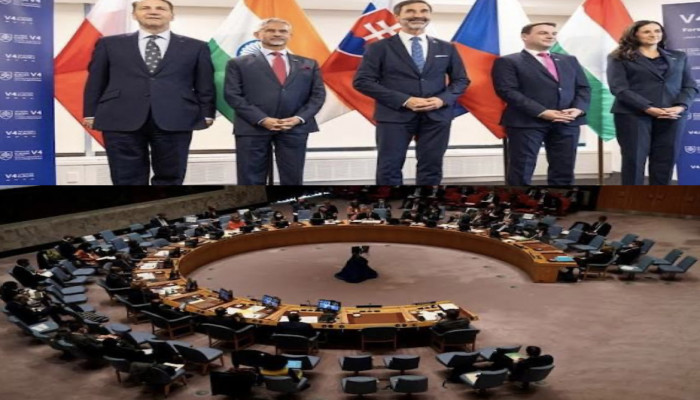
India’s push for a permanent seat on the United Nations Security Council received fresh support from four Central European countries. Hungary, Poland, Slovakia and the Czech Republic, members of the Visegrad Group (V4), backed India’s claim during the first V4-India meeting on the sidelines of the 81st UN General Assembly in New York.
Slovak Foreign Minister Juraj Blanar said the four countries supported India’s inclusion as a permanent member. "We all agree as V4 countries that India, as a part of the Global South, an upcoming superpower in the Indo-Pacific region, must be at the table as a permanent member of the UN Security Council," Blanar said after meeting External Affairs Minister S Jaishankar.
India’s demand for a permanent seat is based on the changing global balance since the UN Security Council was formed in 1945. At that time, much of Asia and Africa remained under colonial rule. Several countries that now have large populations, strong economies and greater diplomatic influence were either not independent or did not exist as sovereign states.
India has served eight times as an elected member of the Security Council. Its most recent terms were in 2021 and 2022. New Delhi has highlighted its population, economic strength, UN peacekeeping contribution and growing diplomatic role as key reasons for its claim.
India has also called for reforms to improve the effectiveness and credibility of the global body. Its priorities paper for the 81st UNGA said the UN’s inability to respond effectively to conflicts has raised questions about its "efficacy, credibility and legitimacy".
Several major powers support India’s membership. France has consistently backed its bid, while the UK has supported India’s inclusion in an expanded Security Council. The US has also backed India’s permanent membership in principle. Russia supports the claim as well.
India is part of the G4 grouping with Brazil, Germany and Japan. The four countries support each other’s bids for permanent membership and proposed expanding the 15-member Security Council to 25 or 26 members. The proposal includes six new permanent seats: two each for Africa and the Asia-Pacific region, one for Latin America and the Caribbean, and one for Western Europe and Others.
However, the five existing permanent members — the US, Russia, China, France and the UK — have not agreed on a common expansion model. Key differences include the number of new seats, regional representation and whether new permanent members should receive veto powers.
China remains the only permanent member that has not explicitly supported India’s bid. Beijing has said it respects India’s aspirations while calling for broader consensus on Security Council reform.
The veto remains another major issue. The five permanent members currently hold veto powers on substantive decisions. India has backed an "all or none", approach, arguing that new permanent members should have the same rights as the existing P5. In an April 2026 statement, New Delhi said there could not be a separate category of permanent members without equal veto rights.
The V4 meeting also opened a wider diplomatic channel between India and the four Central European nations. Jaishankar called it a "new historic occasion" and thanked Blanar for bringing the countries together.
"We had our first Visegrad Four and India meeting. It was, in a sense, a new historic occasion, and I would like to thank Minister Juraj (Foreign Minister of Slovakia) for convening us today. It was a very, very productive meeting," Jaishankar said.
India and the V4 also agreed to explore an annual business forum and regular meetings of Foreign Ministers. Discussions covered technology, innovation, defence, space, connectivity and people-to-people ties. The ministers also discussed the Ukraine conflict and developments in the Gulf.



 Loading...please wait
Comments