




Venezuela expels ambassadors from Chile, Uruguay, and other countries following controversial election result
- In Reports
- 01:00 PM, Jul 30, 2024
- Myind Staff
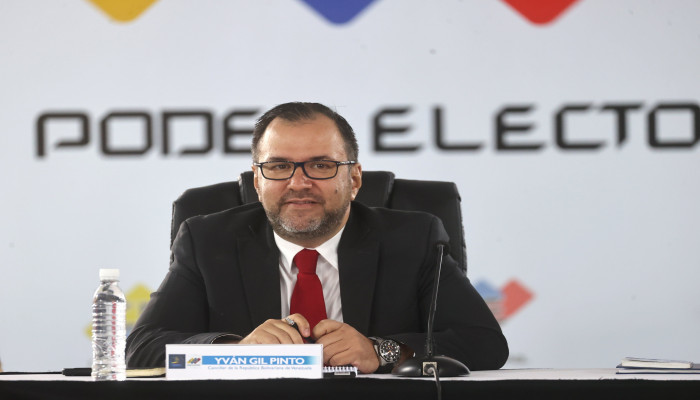
Venezuela has severed diplomatic relations with seven Latin American countries that questioned the legitimacy of President Nicolás Maduro's election victory. The country has expelled their diplomatic missions and withdrawn its own staff from those nations.
Maduro's Foreign Minister, Yvan Gil, has ordered the immediate expulsion of diplomatic personnel from Argentina, Chile, Costa Rica, Peru, Panama, the Dominican Republic, and Uruguay, citing "interventionist acts" by these countries.
Gil stated that Venezuela would withdraw its diplomatic personnel from these countries and demanded their representatives leave Venezuelan territory immediately.
“Venezuela expresses its firmest rejection of the interference actions and statements of a group of right-wing governments, subordinated to Washington and openly committed to the most sordid ideological postulates of international fascism,” Gil declared on social media, likening the current situation to the actions of the defunct Lima Group. He emphasised that the Venezuelan government would “reserve all legal and political actions to enforce, preserve, and defend our inalienable right to self-determination.”
"We will confront all actions that threaten the climate of peace and coexistence," he added.
This development follows Panama's firm stance on the Venezuelan elections, with Foreign Minister Álvaro Mulino asserting that “regimes that do not respect human rights and violate freedoms do not deserve diplomatic recognition.” Mulino's remarks reflected the views of several Latin American nations and led to calls for a review of the election process in Venezuela.
The controversial election, in which Maduro reportedly secured 51% of the vote against opposition candidate Edmundo Gonzalez's 44%, has faced widespread skepticism and accusations of electoral fraud. Gonzalez and his coalition have condemned significant irregularities in the vote-counting process, leading to a chorus of international calls for transparency.
Countries such as Argentina, Costa Rica, Ecuador, Guatemala, Panama, Paraguay, Peru, the Dominican Republic, and Uruguay have voiced serious concerns about the election's conduct. They have collectively urged an urgent meeting of the Organization of American States (OAS) to address the situation and protect the democratic will of the Venezuelan people.
Chilean President Gabriel Boric expressed scepticism about the election results, stating, “The Maduro regime must understand that the results it publishes are hard to believe. Chile will not recognise any result that is not verifiable.” Chilean Foreign Minister Alberto van Klaveren highlighted the need for an independent review of the election records and the involvement of impartial international observers.
Other Latin American leaders have echoed these concerns. Ecuador's President Daniel Noboa criticised politicians “trying to cling to power,” while El Salvador's President Nayib Bukele termed the election a “fraud.” Argentine President Javier Milei was particularly vocal, using social media to denounce Maduro and encourage Venezuelans to persist in their struggle for democracy.
Meanwhile, Peru's government ordered Venezuelan diplomats in the Andean nation to leave within 72 hours. Peru's foreign ministry announced the dismissal of Venezuela's diplomats in a statement citing the "serious and arbitrary decisions made today by the Venezuelan regime."
Even traditionally allied leaders have shown caution. Mexican President Andrés Manuel López Obrador indicated that his government would wait for the final results before recognising Maduro's victory, while Brazilian authorities have called for detailed and transparent reporting of the vote counts.
On the other hand, allies Cuba, Nicaragua, Bolivia, and Honduras have congratulated Maduro on his victory.
The United States, Britain, and the European Union have voiced concerns about the election's legitimacy, calling for transparency and a fair counting of votes. US Secretary of State Antony Blinken remarked that the announced result "does not reflect the will or the votes of the Venezuelan people."
In contrast, Russia and China have congratulated Maduro on his victory.
Opposition candidate Edmundo Gonzalez Urrutia and his coalition assert that they have obtained 73.2 percent of the voting tallies, disputing the official results.
Urrutia’s ally and opposition leader María Corina Machado argued that a review of the voting records reveals a "mathematically irreversible" lead for Urrutia, with 6.27 million votes compared to Maduro's 2.75 million, according to the Associated Press.
Thousands of Venezuelans took to the streets to protest what they denounced as a stolen election, chanting "Freedom, freedom!" and "This government is going to fall!" In response, security forces used tear gas and rubber bullets to disperse the crowds.
The opposition has vowed to continue challenging the election results, which they claim were tainted by fraud and political intimidation.
Image source: Merco Press



 Loading...please wait
Comments