



Venezuela calls for immediate release of President Maduro at UN Rights Council
- In Reports
- 01:14 PM, Feb 24, 2026
- Myind Staff
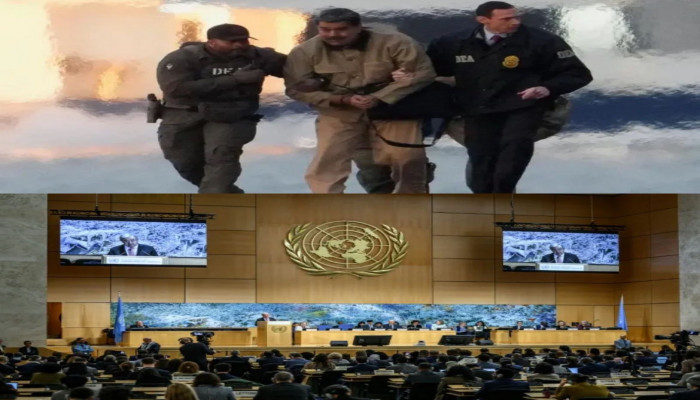
Venezuela has demanded the immediate release of President Nicolás Maduro from United States custody, calling his detention a political act. The demand was made by Venezuela’s Foreign Minister Yvan Gil while addressing the United Nations Human Rights Council in Geneva on Monday.
Gil described Maduro’s arrest as an “abduction” and said it was a “political operation disguised as a legal debate”. He insisted that Venezuela must resolve its own internal matters and that foreign intervention is unacceptable.
Maduro and his wife, Cilia Flores, were taken into custody during a violent operation carried out by the United States on January 3. Since then, both have been held in prison in New York. They are awaiting trial on charges of drug trafficking and conspiracy to commit what US authorities have called “narcoterrorism”.
Speaking at the UN council, Gil demanded Maduro’s “immediate release” by the US government. He also called for the release of Cilia Flores, who has been detained alongside the president.
According to Gil, the January operation led to serious consequences. He said the US action was part of a “systematic campaign” and stated that more than 100 people were killed during the operation. He strongly criticised the move, describing it as politically motivated rather than legally justified.
Despite these developments, Gil said Venezuela is not in a state of war with the United States. He acknowledged that tensions between the two countries have continued for the past decade, especially due to US sanctions and what he described as a blockade imposed on Venezuela “in full view of the world”. However, he stressed that the country does not consider itself at war.
Following Maduro’s detention, Venezuela has remained relatively calm. However, political divisions within the country’s leadership continue. Interim President Delcy Rodríguez has been leading the country in Maduro’s absence. Reports indicate that Rodríguez initially responded with defiance but has since adopted a more conciliatory tone toward the administration of US President Donald Trump. This approach contrasts with Gil’s stronger criticism of the United States.
Meanwhile, Venezuela continues to face serious economic and humanitarian challenges. Last week, the International Monetary Fund (IMF) described the country’s situation as “quite fragile”. The IMF pointed to triple-digit inflation and a sharply depreciating currency. While sanctions have contributed to these problems, government mismanagement has also played a role.
In a separate development, the US Department of the Treasury recently announced that it would ease some sanctions on Venezuela’s energy sector. This marks the largest relief measure since Maduro’s detention.
During his speech, Gil also spoke about internal political steps taken by Venezuela. He said the country has begun a process of reconciliation and political coexistence. He referred to the newly approved 2026 Amnesty Law for Democratic Coexistence, which was signed last Thursday. The law could lead to the release of hundreds of people jailed during protests and political unrest over several decades. This week alone, 379 political prisoners were granted amnesty. The move represents a significant shift, as Venezuela had previously denied holding political prisoners.
Gil emphasised that human rights should not be used selectively or politically. He said, “Human rights should not be instruments of political war; they should not be selective, and they should not depend on ideological alignment.”
He also stated, “While some countries are subjected to constant and disproportionate scrutiny, tragedies of enormous magnitude, such as the devastation of the Palestinian people, do not receive the firm and proportionate attention demanded by international law and human conscience.”
In his closing remarks, Gil urged the UN Human Rights Council to remain impartial. He called for an end to punitive measures against Venezuela and asked the international community to respect the sovereignty of states.



 Loading...please wait
Comments