



USD Losing Reserve Currency Status: A Fresh Perspective
- In Economics
- 03:46 PM, Apr 15, 2023
- Mohal Joshi
Nowadays "USD is losing its reserve currency status" is in the news a lot anywhere you choose to look 1, 2, 3. Exactly a year ago I wrote about the US dollar (USD) not being the unipolar reserve currency by end of this decade. Since this topic has caught the attention of the media and the general public wanted to delve into it again.
I see a couple of different aspects to the talk about USD as a reserve currency and “losing” its status-
1) USD as a medium of exchange i.e., Good and services being denominated in USD
2) Nations storing their trade surpluses/reserves in USD
USD as a medium of exchange
Most nations and trading entities have over the past few decades denominated their trade mostly in USD. Since the mid-70s the US convinced the Saudis and later OPEC to denominate their oil sales in USD giving rise to the “petrodollar system” which is now fraying at the edges. Trade can be in other fiat currencies like yuan/euro/pound or something physical like gold or even BTC or even seashells (if you wanted!) in theory. The main challenge is for both parties to agree on this medium of exchange and the price to be paid for goods/services (in this medium).
As per the recent Reuters article “The dollar was on one side of 88% of all foreign exchange trades in April last year, according to the Bank for International Settlements”. Even if a large number of nations (especially outside the Western Bloc) decide to trade in something other than the USD the share of USD will still remain fairly high in the short to medium term. There has been far too much (for a lack of better term) “doomsday prognosticating” in certain quarters over nations now deciding to choose to trade in other currencies (vs the USD)
If less trade is denominated in USD, then it would reduce the demand for dollars reducing its relative strength (vis a vis other currencies). This can help alleviate Triffin’s dilemma which said that the use of a national currency, such as the U.S. dollar, as a global reserve currency leads to a current account deficit due to the perpetual demand of dollars from around the world to conduct their trade (in USD). This results in the strengthening of the dollar, which makes exports more expensive, and offshoring of certain industries/jobs such as manufacturing to other nations which has decimated local economies in parts of the US such as the Rust Belt.
Now a weaker dollar in theory will help US exports become competitive vs the rest of the world and also disincentivize imports which would now become more expensive. This can help reduce the ever-burgeoning US trade deficits with the rest of the world. This would also give more fillip to onshoring of jobs/manufacturing back to the US as the cost differential of offshoring is now reduced.
Nations storing their trade surpluses/reserves in USD
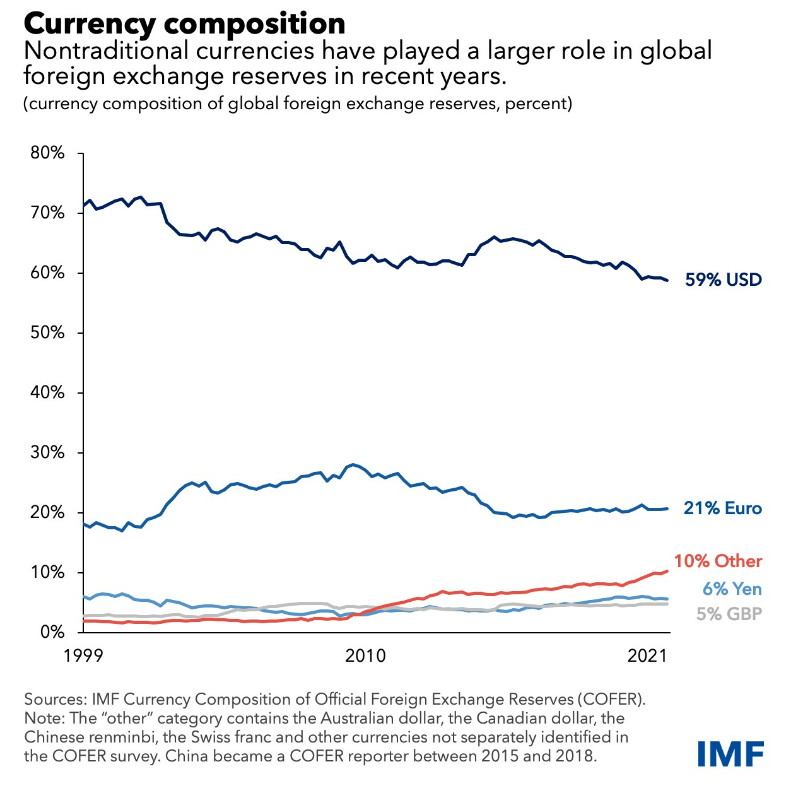
The 2nd and way more important implication of the USD losing its reserve currency status is the impact on foreign nations buying UST (US Treasuries) with their trade surpluses. As per IMF data, the amount of USD-based reserves has now dropped to 59%.
Russia (2022) and Afghanistan (2021) have found out the hard way that being on adversarial terms with the West, especially the USA means that your foreign reserves in USD get frozen in an instant. Many nations outside of the so-called West are now jittery over investing more in US Treasuries going forward as their hard-earned money could be taken away if they refuse to toe the US line in the future. China which currently has a frosty relationship with the US has cut its UST to the lowest level in 14 years.
Foreign nations had already been slowing down their purchases of US debt since 2013 and now will be more hesitant moving forward.
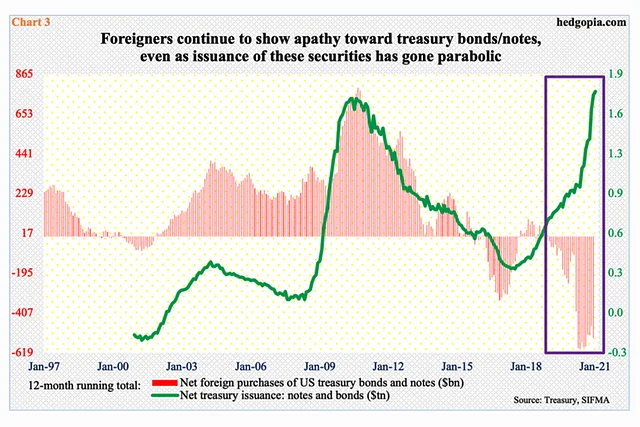
This slack in demand from foreign buyers will now have to be made by someone else. Private institutions and individuals can only buy so much given their capacity (relative to nation-states). A lot of this demand will most likely have to be picked up by the Federal Reserve. However, the Federal Reserve is right now trying to actively reduce its balance sheet (which ballooned from ~4.5T to almost 9T during the pandemic spending splurge) as part of their QT (Quantitative Tightening) program to rein in the money supply. If they reverse the course and actively start buying Treasuries (with newly printed money) this could give an impetus to inflation. After being excoriated harshly for letting inflation run away last year they will be hesitant to do so in the near future (unless some major crisis forces their hands)
The US currently is running a $1.38T+ deficit. This shortfall forces the government to issue new even more debt every year to meet its (spending) obligations.
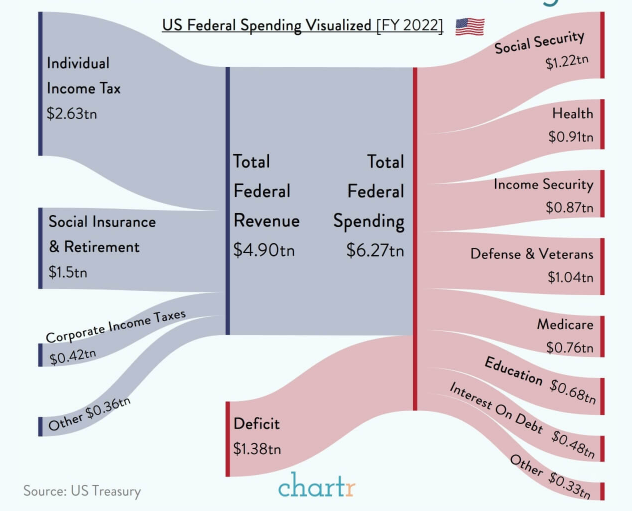
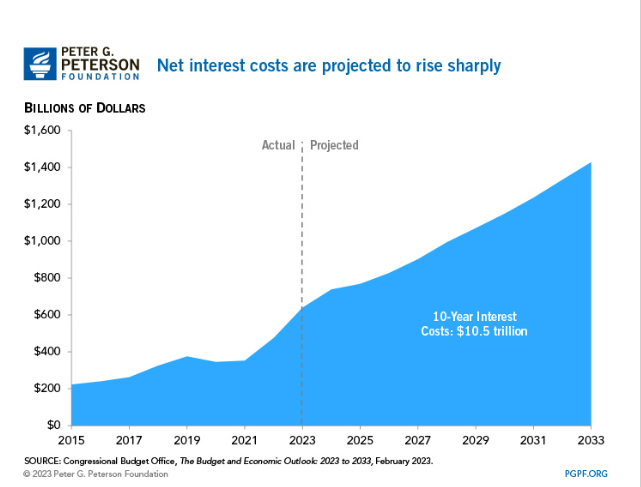
The $480B spent (last year) on net interest expenses on the debt is going to keep increasing with the Fed continuing to raise rates and/or keep them high for longer to contain inflation. This February, the Congressional Budget Office (CBO) projected that annual net interest costs would total $640 billion in 2023 $739 billion in 2024 reaching a staggering $1.4T in 2033. The nonpartisan Peter G Peterson foundation is estimating around $10.5T in interest payments over the next decade.
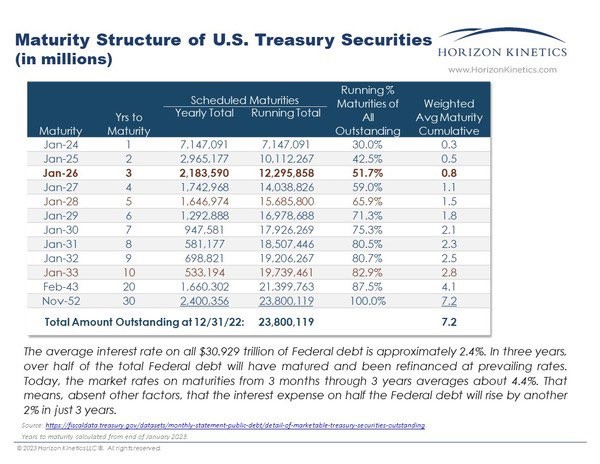
The important thing to note is that roughly half of the debt will mature in the next 3 years. If the Federal Reserve keeps rates higher to keep inflation in check, then it is bound to make the debt that needs to be refinanced that much more expensive leading to an ever-bigger debt burden.
Epilogue
Most people are missing the woods for the trees with a large amount of focus on many nations deciding to transact in something other than USD vs the other nations not buying UST with their reserves/trade surpluses.
One can find news items such as those below which grabs all the eyeballs and clicks but I believe the bigger issue is nations reducing their holdings of UST.
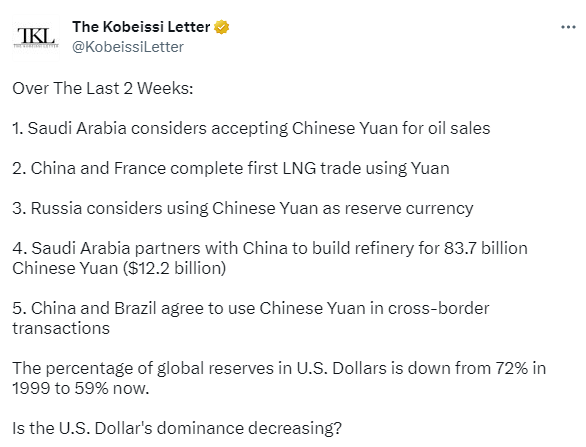
Lower demand for dollars is not going to impact the USA massively in a negative manner. Two nations/parties now deciding to trade in some other currency is not going to threaten US hegemony as how some commentators like Fareed Zakaria (CNN) or Fox News would like you to believe.
Similar to the geopolitics today we would see a multipolar world similarly in trade/commerce where multiple forms of the medium of exchange are used in the future vs mostly dollar now [i.e., USD down but not out!]
The bigger issue IMO is what do nations do with their trade surpluses? Nations will bit vary by investing them in Chinese yuan given a whole multitude of reasons that I wrote about last year.
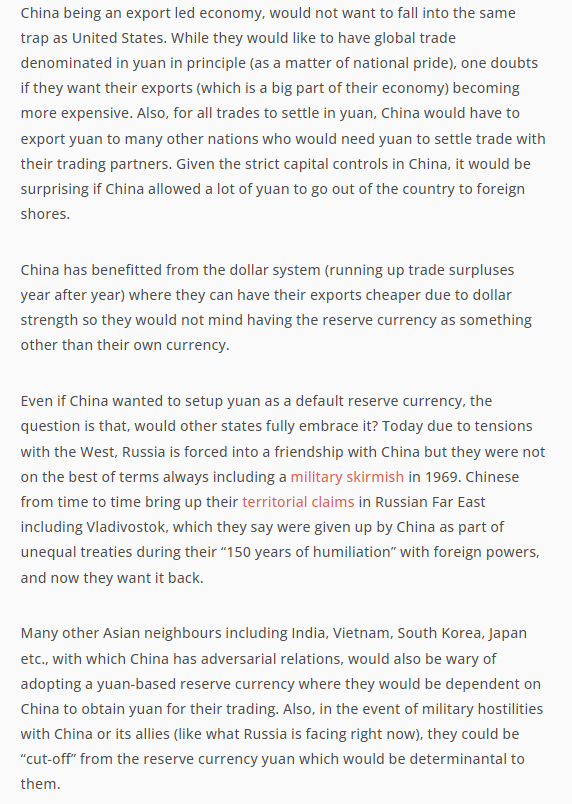
To prevent counterparty “geopolitical” risk by investing in other nations' currencies they could choose to invest in Gold (record central bank gold purchases last year) and even possibly BTC. Both Gold and BTC have their challenges of additional complexities of verification/audit/storage/transport and massive price volatility respectively which would not make it easy for nations to use them extensively.
A lack of good options might give pause to many nations around the world in fully exiting UST but if they choose to do so the ripples of such a move would lead to a big debt spiral for the USA. In today's day and age of populism, it seems unlikely that any politician who wants to get re-elected is going to cut spending. This means that with the ongoing deficits the debt has to be refinanced with more printing by the governments/central banks.
US has been able to spend freely for a very long time by having (Saudis/OPEC recycle their petrodollars to buy UST) and others buy to keep their debt cheap. This "exorbitant privilege" that the US has enjoyed as a unipolar superpower now slowly eroding and has big fiscal consequences for the USA: a point which IMO is being severely underplayed in the "USD losing reserve currency" commentary occurring nowadays.
Note: This article was originally published on Crowd Wisdom on April 2, 2023.



 Loading...please wait
Comments