




USCIRF: One-Eyed Watchdog, Two Targets—RSS & R&AW
- In Current Affairs
- 01:19 PM, Sep 18, 2026
- Viren S Doshi
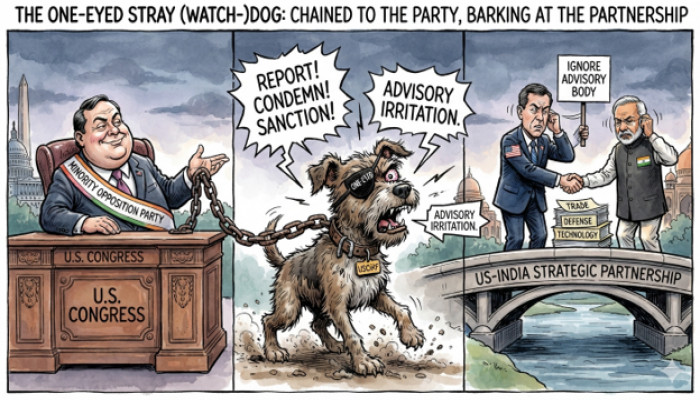
What is USCIRF?
The United States Commission on International Religious Freedom (USCIRF) is an “advisory” body of the US Legislature - the US Congress, which is dominated by the minority leftist Democratic Party, though it is projected and portrayed as an independent, bipartisan U.S. federal government commission. It was created by the International Religious Freedom Act (IRFA) of 1998.
For all purposes, it functions as a legislative-branch advisory agency, not an executive-branch body under the State Department or under the President.
Its mandate is to monitor the universal right to freedom of religion abroad, assess violations based on international standards (such as Article 18 of the Universal Declaration of Human Rights), and make non-binding policy recommendations to Congress, the President and the Secretary of State.
USCIRF does not report on religious freedom conditions inside the United States. It is exclusively international.
It produces an annual report that recommends designations such as Countries of Particular Concern (CPCs) for governments engaged in or tolerating “systematic, ongoing, egregious” violations, Special Watch List placements, and Entities of Particular Concern.
It also holds hearings, issues fact sheets, tracks implementation of its advice, and engages policymakers.
Structure, Appointments, Accountability, and Current Appointees
USCIRF is accountable to Congress, which has created it, funds it through annual appropriations, and periodically reauthorises it.
USCIRF's recommendations are advisory only. The State Department reviews these recommendations and if, found agreeable, makes CPC designations official.
The Commission consists of nine voting Commissioners who are U.S. citizens serving as unpaid volunteers for a two-year term which is renewable once.
The Congressional leaders from both parties in the Senate and House of Representatives appoint six members to ensure a tilt towards the minority party in the US Congress. The President appoints the remaining three.
The Ambassador-at-Large for International Religious Freedom serves as a non-voting, ex officio member.
A professional non-partisan staff supports the work.
No public formal “background check” details (such as security clearances or specific vetting reports) are available in open sources for USCIRF appointments, which are political appointments by congressional leaders rather than Senate-confirmed executive positions requiring extensive public disclosure.
The Nine Commissioners elect a Chair and Vice Chair annually.
As of September 2026, the nine Commissioners include:
Asif Mahmood (Chair), reappointed by House Minority Leader “Hakeem” Jeffries of the leftist Democratic Party. (Sources highlight Asif’s prior advocacy on Kashmir, including involvement in a 2019 U.S. congressional hearing after the abrogation of Article 370, his connections with Pakistani political figures, and his role in USCIRF’s critical reporting and recommendations on India, including CPC recommendations and calls related to the RSS and R&AW. He reportedly urged the Republicans-led US government to consider targeted sanctions against RSS members and Indian officials complicit in “religious freedom violations”, including revoking the visa issued to Dr Mohan Bhagwat and making him ineligible for future entry into the United States. Republicans led US government instead rejected his demands.)
CeCe Heil (Vice Chair), appointed by Senate Majority Leader John Thune.
David A. Anderson, appointed by House Minority Leader “Hakeem” Jeffries.
Gunisha Kaur, appointed by Senate Minority Leader Chuck Schumer.
Rachel Laser, reappointed by Senate Minority Leader Chuck Schumer.
Gene Mills, appointed by House Speaker Mike Johnson.
Andrew Brunson, Robert Barron and Joe Grogan; appointed by President Donald J. Trump in September 2026. (These replaced one of the Biden-appointed Muslim appointees, Mohamed Elsanousi, who was known for his ties with a hardcore Muslim Organisation in US.) It may be noted that Andrew Brunson underwent severe persecution in Turkey and President Trump had to intervene for his release from the Islamic Regime ruled Turkey. Now he has assumed the position of Commissioner in USCIRF and is expected to contribute positively in USCIRF along with the other two Presidential Appointees.
Only one so-called namesake Hindu, but essentially a leftist Democrat, Preeta D. Bansal, 2003–2009 has ever served in USCIRF. She was close to President Barack Hussein Obama ll. In March 2005, while Bansal was Chair, USCIRF made global headlines by officially requesting that the U.S. State Department deny a diplomatic visa to then-Gujarat Chief Minister Honourable Narendra Modi. The Department acted on this recommendation and rejected the erstwhile Chief Minister Honourable Narendra Modi's diplomatic visa application and, in addition also reportedly revoked his tourist/business visa.
No Hindu member sits on the body currently, despite Hindu Dharma being the world’s third-largest religion, if we call it so, and a major U.S. diaspora community.
It is clear from above who rules the roost in this advisory congressional body. Not only is it lopsided by default, but it is also almost a conundrum that mocks the freedom of religion, by default, particularly in an open democratic country like India, as of now.
Sources of Information and Reporting on Closed Societies
USCIRF monitors conditions worldwide, including closed and undemocratic nations such as Communist regime-ruled China, dictatorial regime-ruled North Korea, Jihadi Ayatollah regime- ruled Iran and countries like Eritrea, Turkmenistan, and Afghanistan.
It gathers information from such opaque countries through research, travel where possible, meetings with officials, religious leaders, victims, human rights groups, NGOs, and open sources. In restricted environments, reliance on secondary and diaspora accounts increases.
India - Haven of Pluralism and Tolerance
USCIRF reports are not infallible and can reflect source selection and framing.
India - the Land of Swami Vivekananda, who electrified the World Conference of Religions in Chicago in September 1893 - is a constitutional democracy with free elections, an independent judiciary, a free press, and vibrant civil society.
It is the birthplace of Hinduism, Buddhism, Jainism, and Sikhism, and home to one of the world’s largest Muslim populations alongside significant Christian, Sikh, Buddhist, Jain, Parsi, Jewish, and other communities. All kinds of sects and sub-sects continue to coexist here openly.
Historically, India has provided shelter to persecuted religious groups. Jewish communities (including the Bene Israel) have lived in India for nearly two millennia without facing pogroms or forced conversions. Zoroastrians (Parsis) fleeing Islamic conquest of Persia in the 8th–10th centuries were welcomed by a Hindu king in Gujarat under the famous “sugar in milk” tradition and thrived. Syrian Christians, Tibetan Buddhist refugees, Bahá’ís, Armenians, and others have also found refuge. While large-scale historical settlement of Yazidis is less documented, India’s broader pattern of absorbing persecuted communities remains well-established. Not only were these communities sheltered, but all of them flourished and are further flourishing in India.
The Indian Constitution is religion-neutral (secular in the Indian sense of equal respect for all faiths, or sarva dharma sama bhava).
Articles 25–28 guarantee freedom of conscience and the right to profess, practice, and propagate religion to all persons, subject to public order, morality, and health.
In fact, the minorities enjoy more rights than the majority. Critically, Articles 29 and 30 grant additional cultural and educational rights specifically to religious and linguistic minorities—the right to conserve their distinct language, script, or culture, and to establish and administer educational institutions of their choice. These protections go beyond those available to the majority community.
Indian and Hindu civilisational culture has long emphasised that all religions contain truth and deserve respect.
Hinduism is not a proselytising faith in the manner of Christian and, more noticeably, Islamic Abrahamic traditions; conversion and aggressive missionary activity are not central to its ethos. The ideal of ahimsa (non-violence) is foundational. India as a modern nation-state has not pursued wars of religious conquest or colonial expansion driven by conversion.
USCIRF’s India File: Persistent Negativity Toward an Open Democracy
Despite this record, for multiple consecutive years USCIRF has recommended designating India a Country of Particular Concern—the same category applied to Intolerant Regimes ruled China, North Korea, Iran, and virtually a terrorist state - Pakistan.
Its recent reports have alleged deteriorating conditions for religious minorities. Its reports criticised, without going into detail, state anti-conversion laws, cow-protection measures, the Citizenship (Amendment) Act, and Hindu nationalist groups like RSS. In 2026, the Commission recommended targeted sanctions against the Rashtriya Swayamsevak Sangh (RSS) and India’s external intelligence agency, the Research and Analysis Wing (R&AW). The Government of India has consistently rejected these one-sided one-eyed “assessments” as “biased,” “motivated,” “distorted,” and based on “questionable sources and ideological narratives.” Officials have stated that the reports misrepresent India’s pluralistic democracy and constitutional mechanisms and serve only to discredit USCIRF itself.
Communal incidents of intolerance do occur in India occasionally, as in many diverse societies. Many such episodes stem from intolerance or aggressive actions by certain Islamic or, at times, Christian missionary groups, followed by reactive responses, rather than systematic state-sponsored persecution by the Hindu majority. India’s openness allows free reporting, litigation, political opposition, and judicial scrutiny of such incidents — conditions absent in many of the closed societies USCIRF correctly criticises.
USCIRF - An Unnecessary Irritant in the U.S.-India Relationship
USCIRF’s recommendations carry no legal force, and successive U.S. administrations have generally declined to designate India a CPC or impose related sanctions. Nevertheless, the annual ritual of negative reports, hearings, and suggestions of linking trade or security cooperation to religious-freedom benchmarks generates predictable friction. In a bilateral relationship that has deepened dramatically on defence, technology, energy, and strategic alignment, this recurring public criticism from a U.S. Congress-created body is widely viewed in New Delhi—and by many American supporters of the partnership—as an unwarranted, highly provocative irritation.
The Way Ahead
Public formal “background check” details (such as security clearances or specific vetting reports) must be made available in open sources for USCIRF political appointments on the lines of Senate-confirmed executive positions requiring extensive public disclosure.
A more balanced approach would recognise genuine concerns about communal violence or local excesses and the broader reality of India’s democratic openness, its constitutional protections that favour minorities, its civilisational tradition of sheltering the persecuted, its non-proselytising culture, and the comparative frequency in percentage of population and severity of violations elsewhere.
Greater religious and demographic diversity among Commissioners — particularly inclusion of real Hindu, or better, pro-Hindu voices familiar with India’s civilisational context — would strengthen the Commission’s credibility.
Greater methodological transparency about source weighting would help as well.
USCIRF was established with a noble purpose: elevating freedom of religion or belief as a priority in U.S. foreign policy. That purpose is best served when its work is perceived as rigorous, even-handed, and free of selective advocacy.
On India, a course correction by USCIRF is overdue. The strategic partnership between the world’s oldest and largest democracies deserves better than an annual, one-sided skewed and at times malicious “sermonising” from an advisory commission that itself has yet to fully reflect the diversity of the communities it claims to defend.
Disclaimer: The opinions expressed within this article are the personal opinions of the author. MyIndMakers is not responsible for the accuracy, completeness, suitability, or validity of any information on this article. All information is provided on an as-is basis. The information, facts or opinions appearing in the article do not reflect the views of MyindMakers and it does not assume any responsibility or liability for the same.


 Loading...please wait
Comments