



US warplane downed, French soldier killed in Iraq as the war spills across the region
- In Reports
- 05:53 PM, Mar 13, 2026
- Myind Staff
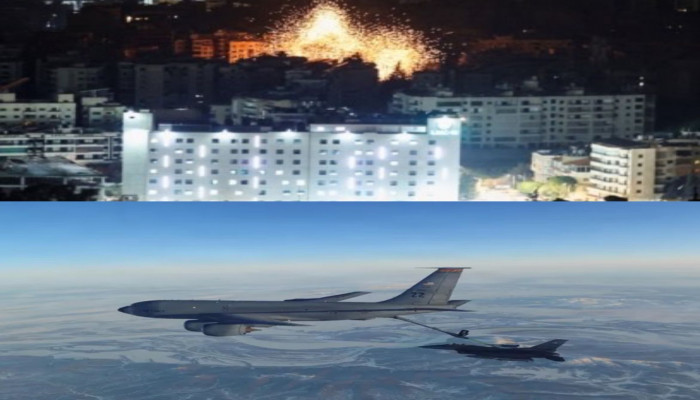
The ongoing conflict involving the United States, Israel, and Iran continues to spread its effects across the Middle East, with fresh incidents reported in Iraq and nearby regions. A major accident involving a US military aircraft and the death of a French soldier have added to the rising tensions as the war enters its second week. The developments show how the conflict is expanding beyond its original battlefield and affecting several countries in the region.
According to the United States Central Command, a large American refuelling aircraft crashed in western Iraq late on March 12. The aircraft involved was a KC-135 tanker, which is commonly used by the US military to refuel fighter jets and other aircraft during long missions. Officials said the crash occurred after what appears to have been a midair collision involving another refuelling aircraft. A rescue operation was quickly launched by the US military to respond to the incident and locate the crew members.
Military officials explained that the crash did not happen because of enemy attacks or friendly fire. Instead, it occurred while the aircraft was operating in safe airspace during a mission that is part of the US campaign against Iran, known as Operation Epic Fury. The second aircraft that was involved in the incident was able to continue flying and safely landed in Israel after the collision.
A US official who spoke to Reuters without revealing their identity said that the aircraft that crashed may have had up to six service members on board. As of early March 13, the condition and fate of those crew members had not yet been confirmed. The KC-135 aircraft plays an important role in US air operations because it allows combat planes to remain in the air for longer periods without needing to land for fuel.
This accident follows another military incident earlier in the month. On March 2, US military authorities reported that three F-15 fighter jets crashed in Kuwait. Those aircraft were reportedly hit by defensive systems operated by Kuwait, in what was described as a case of friendly fire. Fortunately, all six crew members aboard those jets managed to eject before the crash and landed safely with parachutes. Rescue teams later found them without major injuries.
While the aircraft crash drew attention to the risks of military operations in the region, another serious development occurred in northern Iraq. French President Emmanuel Macron confirmed that a French soldier had been killed during a drone attack in the Irbil area of Iraqi Kurdistan. The attack also injured several other members of the French military stationed there.
Macron strongly condemned the incident, stating that such attacks against French troops are unacceptable. He stated that French forces have been stationed in Iraq since 2015 as part of international efforts to fight the Islamic State extremist group, also known as Daesh. According to the French president, their mission is focused solely on counterterrorism, and the ongoing conflict with Iran should not be used as a reason to target them.
The French military earlier reported that at least six soldiers were wounded in the drone strike, and one of them later died from the injuries. This marks the first confirmed death of a French soldier since the United States and Israel began their large-scale air campaign against Iran. France has not taken part directly in the military operations against Iran, making the attack particularly concerning for officials in Paris.
At the moment, it remains unclear who launched the drone that struck the French troops. There has been no confirmed information about whether Iran or one of its allied militia groups in Iraq carried out the strike. However, extremist organisations such as the Islamic State and Al-Qaeda still operate in some parts of Iraq, which also raises questions about possible involvement from those groups.
Later, an Iran-linked Iraqi group known as Ashab Alkahf released a statement saying that French interests in the region would now be considered legitimate targets. The message increased fears that foreign forces in Iraq could become more exposed to attacks as the wider conflict continues.
At the same time, tensions have also grown around one of the most important shipping routes in the world, the Strait of Hormuz. As the war moved into its second week, Iran continued carrying out strikes against US allies in the Gulf region and targeting commercial ships passing through the narrow waterway.
Iran’s new Supreme Leader, Mojtaba Khamenei, spoke publicly about the situation for the first time since taking over leadership after the death of his father. In a statement broadcast on Iranian state television on March 12, he said Iran must continue efforts to block the Strait of Hormuz, which is a critical route for global oil shipments leaving the Middle East.
Khamenei suggested that Iran would continue to focus on attacking targets where its opponents are less prepared and more vulnerable. Following his remarks, Iran’s Islamic Revolutionary Guard Corps announced that it would continue enforcing the closure of the strait, explaining that the decision follows direct instructions from the country’s new leader.
The United States has responded by indicating that it may escort commercial vessels through the strait to ensure safe passage. Such a move could further raise tensions in the region, as it would bring American naval forces into direct contact with Iranian operations in the area.
Meanwhile, the conflict between Iran and Israel also intensified. Early on March 13, Iranian forces launched another wave of missiles toward Israel, according to officials in Tel Aviv. Emergency services reported that two people were injured in northern Israel as a result of the attacks.
Israeli Prime Minister Benjamin Netanyahu held his first press conference since the war began on February 28. During his remarks, he said Israel is working to create conditions that could weaken Iran’s leadership. He noted that while change within Iran must ultimately come from its own people, Israel believes its actions can help increase pressure on the ruling system.
Shortly after his comments, Iranian media reported that several explosions were heard in Tehran, although details about the blasts were not immediately available.
At the same time, Israel continued its military operations against Hezbollah forces in Lebanon. Israeli troops reportedly advanced deeper into southern Lebanon, and the military warned civilians in the area to move north of the Zahrani River, located about 40 kilometres from Israel’s border.
Israeli officials also said that Hezbollah fired around 200 rockets toward Israeli territory overnight, describing it as the largest rocket attack since the war began.
Elsewhere in the region, Saudi Arabia reported intercepting multiple drones that had entered its airspace. A spokesperson for the Saudi defence ministry said twelve drones were destroyed after crossing into the country, while at least sixteen more were shot down in separate incidents.
Residents and journalists in Dubai also reported hearing explosions in the city’s central financial district early on March 13, raising further concerns about the widening conflict.
In Turkey, state media reported that warning sirens sounded at the Incirlik Air Base, a NATO military facility in southern Turkey that hosts US forces. Authorities did not immediately provide additional information about the alert. If Iranian missiles were responsible, it would mark the third time since the war started that Turkish airspace has been breached.
As the conflict continues, the growing number of incidents across different countries shows how quickly the war is expanding beyond its original front lines. Military accidents, drone attacks, missile strikes, and disruptions to global shipping routes are all contributing to rising instability throughout the Middle East.



 Loading...please wait
Comments