



US troops forced to leave 13 bases across Middle East damaged in Iranian strikes
- In Reports
- 12:01 PM, Mar 27, 2026
- Myind Staff
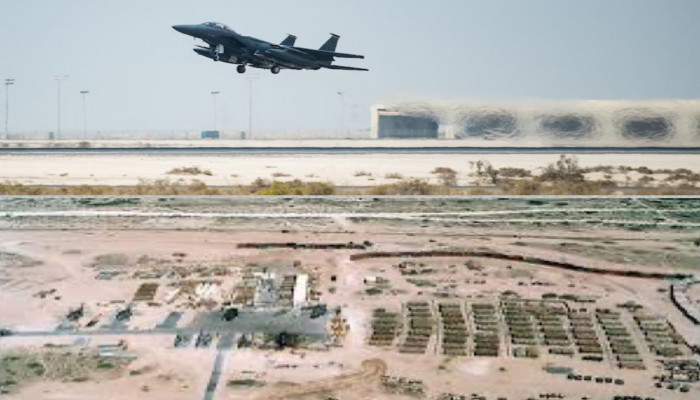
Iranian strikes across the Middle East have severely damaged at least 13 US military bases, making them uninhabitable and forcing American troops to relocate to alternative locations such as hotels and office spaces. According to The New York Times, this has created a scattered military presence, with officials now describing the situation as a “remote war.” The sudden shift has changed how operations are conducted on the ground.
"Iran has bombed US bases across the Middle East, forcing many American troops to relocate to hotels and office spaces throughout the region," the NYT reported, citing American officials and military personnel. With key bases no longer safe, thousands of US troops have been dispersed across different regions. Some personnel have been moved as far as Europe, while others remain in the Middle East but are no longer operating from their original bases. "So now much of the land-based military is, in essence, fighting the war while working remotely," the report said, highlighting the unusual nature of the conflict.
Despite these disruptions, the Pentagon has stated that military operations are intensifying. Defence Secretary Pete Hegseth confirmed the scale of US retaliation, saying, "To date, we’ve struck over 7,000 targets across Iran and its military infrastructure," he said, adding, "Today will be the largest strike package yet, just like yesterday was." This indicates that the US continues to push forward with its offensive strategy even as its base infrastructure faces setbacks.
The strikes have affected several key installations in the region. In Kuwait, bases such as Port Shuaiba, Ali Al Salem Air Base, and Camp Buehring were heavily targeted. A strike on Port Shuaiba destroyed an Army tactical operations centre and resulted in the deaths of six US service members. In Qatar, Iranian missiles and drones hit Al Udeid Air Base, damaging a critical radar system. In Bahrain, a one-way attack drone struck communications equipment at the US Fifth Fleet headquarters. Similarly, Prince Sultan Air Base in Saudi Arabia suffered damage to refuelling tankers and communication systems, further affecting military coordination.
These attacks have raised serious concerns about operational efficiency. Military experts believe that shifting to temporary or improvised locations comes with limitations. "Yes, we have the ability to set up expedient operation centres, but you’re absolutely going to lose capability," said Master Sgt. Wes J. Bryant, a retired Air Force targeting specialist. "You can’t just put all that equipment on the top of a hotel." While US officials clarified that troops are not operating from hotel rooftops, they acknowledged that such arrangements reduce effectiveness.
Alongside battlefield developments, there has been a clampdown on commercial satellite imagery. Two major US-based spatial intelligence companies have restricted access to images of the Middle East. Planet Labs announced that it has expanded limitations on imagery covering Iran, nearby allied bases, Gulf States, and active conflict zones. The company has placed a two-week hold on access to new images in its archive, stating that the move is meant to prevent its data from being used by adversaries. It emphasised that the decision was voluntary and not directed by any government.
Another firm, Vantor, also introduced stricter controls. “During times of geopolitical conflict, Vantor may implement enhanced access controls to prevent the misuse of sensitive geospatial intelligence,” a spokesperson said, adding that these measures are independently determined. The Pentagon has not commented on these restrictions. However, both companies indicated that journalists would still have limited access to imagery, though not to data that could expose US or allied troop positions.
Meanwhile, Iran has escalated its response by issuing warnings to civilians. The Islamic Revolutionary Guards Corps has urged people in the region to report the locations of relocated US troops. Messages circulated through Iranian media warned residents against hosting American forces and encouraged them to share intelligence through messaging platforms. This has raised concerns about the safety of troops now stationed outside secure bases.
Iran has also expanded its targets beyond military sites. Attacks have included embassies and energy infrastructure, along with waves of drones and missiles across the region. The conflict has also disrupted global shipping, particularly in the Strait of Hormuz. These developments have increased pressure on the US and its allies.
The situation has also led to questions about US preparedness. Reports suggest that the Trump administration did not significantly reduce military or diplomatic personnel in the region before tensions escalated. Additionally, there were no early warnings issued to Americans to avoid travel to the region. Officials now acknowledge that the extensive US military presence built over decades in countries like Iraq, Kuwait, Bahrain, Saudi Arabia, and Qatar has become a vulnerability due to Iran’s advanced missile capabilities.
Despite sustained US airstrikes, Iran continues to demonstrate its ability to respond effectively. General Dan Caine, chairman of the Joint Chiefs of Staff, stated that "layered defences throughout the region" are helping protect US forces. However, he also noted that additional measures are being implemented to strengthen security as the conflict continues.



 Loading...please wait
Comments