




US targets Chinese refinery and shipping network in fresh crackdown on Iranian oil trade
- In Reports
- 08:53 PM, Apr 25, 2026
- Myind Staff
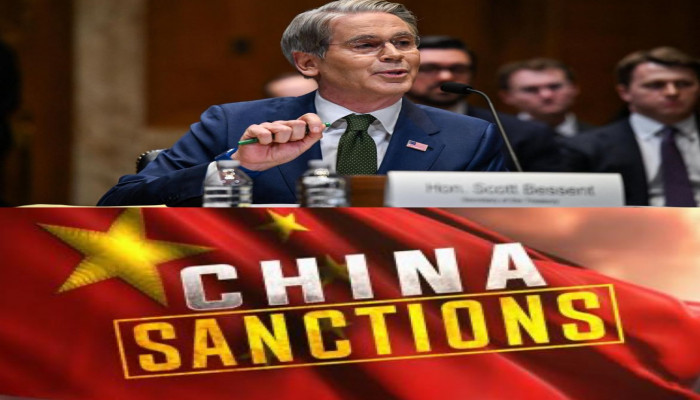
The United States has announced a new round of economic sanctions targeting a major China-based oil refinery, along with around 40 shipping companies and tankers accused of being involved in the transportation of Iranian oil. The move signals a sharper push by the Trump administration to enforce secondary sanctions, especially at a time when global energy supplies are already under pressure due to tensions in the Gulf region.
The sanctions were announced on Friday and were first reported by The Associated Press. They follow through on earlier warnings from the Trump administration that it would take strict action against companies and countries continuing to engage in business with Iran. This step is part of a broader strategy aimed at cutting off Iran’s main source of income, which largely comes from its oil exports.
At the same time, the US has taken an even stronger stance in the region by imposing a physical blockade on the Strait of Hormuz earlier this month. This waterway in the Persian Gulf is one of the most important routes for global oil transportation. Any disruption there has immediate effects on energy markets worldwide. The sanctions come at a sensitive time, just weeks before a scheduled meeting between US President Donald Trump and Chinese President Xi Jinping in China.
Among those targeted is Hengli Petrochemical, a large independent refinery located in the port city of Dalian in China. The facility has a refining capacity of about 400,000 barrels of crude oil per day, making it one of the biggest players in China’s private refining sector. According to the US Treasury Department, Hengli has been receiving shipments of Iranian crude oil since 2023. These transactions have reportedly generated hundreds of millions of dollars in revenue for the Iranian military.
The advocacy group United Against Nuclear Iran had earlier identified Hengli in February 2025 as one of several Chinese companies purchasing Iranian oil. The latest sanctions now formally bring the refinery under direct US restrictions.
Treasury Secretary Scott Bessent made it clear that the administration intends to continue tightening its grip on networks supporting Iran’s oil trade. He stated that his agency "will continue to constrict the network of vessels, intermediaries and buyers Iran relies on to move its oil to global markets." His remarks underline the administration’s focus on targeting not just producers but also the wider system that enables oil to reach international markets.
Earlier this month, the Treasury Department had already taken steps to warn financial institutions in several regions, including China, Hong Kong, the United Arab Emirates, and Oman. Letters were sent cautioning that secondary sanctions could be imposed on entities involved in facilitating Iranian financial transactions. The US also accused these regions of allowing Iranian illicit activities to pass through their banking systems.
Speaking at a White House press briefing on April 15, Bessent reinforced this position. He said the administration has told countries "that if you are buying Iranian oil, that if Iranian money is sitting in your banks, we are now willing to apply secondary sanctions, which is a very stern measure." This statement reflects a clear warning that even indirect involvement with the Iranian oil trade could bring serious consequences.
The sanctions come at a time when global energy markets are already facing instability. Ongoing conflict in and around the Persian Gulf has disrupted oil and natural gas shipments, leading to a sharp rise in prices. The situation has added to concerns about supply shortages and economic pressure on countries dependent on energy imports.
In an effort to manage the impact of rising oil prices, the US Treasury has also taken some temporary relief measures. These include issuing limited sanctions waivers on Russian oil and a one-time waiver for Iranian oil that was already in transit. These steps appear aimed at balancing strict enforcement with the need to prevent further shocks to global energy markets.
Overall, the latest sanctions mark a significant escalation in the US campaign against Iran’s oil trade. By targeting a major Chinese refinery and a wide network of shipping operators, Washington is sending a strong message about its intent to isolate Iran economically, even as global energy dynamics remain fragile.



 Loading...please wait
Comments