



US Supreme Court weakens Voting Rights Act greenlights GOP's gerrymandering
- In Reports
- 05:44 PM, Apr 30, 2026
- Myind Staff
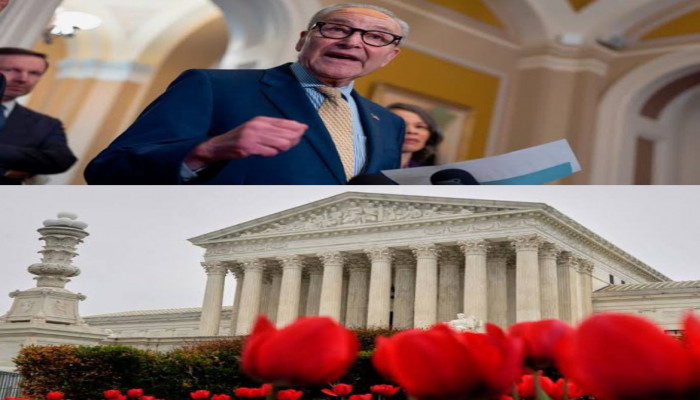
The Supreme Court of the United States has delivered a major ruling that could reshape American politics in the coming years. The court’s conservative majority handed Republicans a significant advantage in the long-running battle over control of the House of Representatives and state legislatures. However, the timing of the decision may limit its impact on the upcoming midterm elections.
In a 6-3 verdict, the court effectively weakened a key provision of the Voting Rights Act. This provision required electoral districts to be drawn in a way that gives minority voters a fair chance to elect candidates of their choice. It often helped maintain majority-minority districts, which have typically supported Democratic candidates, even in states dominated by Republicans.
With this requirement now largely removed, Republican lawmakers have more flexibility in redrawing district maps. This could allow them to reduce the number of Democratic-leaning districts and increase their chances of winning more seats in the House. The impact could be especially strong in southern states, where more than a dozen such seats exist under Republican control.
Soon after the ruling, Republican leaders began calling for a review of congressional maps in states such as Alabama, Louisiana and Tennessee. However, they face a major hurdle. The decision came after key deadlines for primary elections had passed in many states. In some places, primaries have already been held. Ballots are finalised, and early or absentee voting has already started in several regions.
This timing makes it difficult to immediately redraw district boundaries. In Louisiana, for example, the primary election for federal offices is set for May 16, and early voting is scheduled to begin shortly. Despite this, the state’s governor, attorney general and legislative leaders quickly met to discuss their next steps.
Republicans have been under pressure to act fast. Donald Trump had earlier urged party leaders to redraw maps to create more favourable districts ahead of the midterms. Reflecting this urgency, several Republican candidates in gubernatorial races pushed for immediate action.
"There is no time to waste," Rick Jackson, a businessman and GOP governor candidate in Georgia, said in urging a redraw there even as voting is underway for the May 19 primary. "Georgia must act now to ensure secure elections in Georgia and counter the Democrats' national assault on our elections."
In Tennessee, Senator Marsha Blackburn also called for redrawing the state’s congressional map. She proposed replacing its only majority-Black Democratic district with one more favourable to Republicans, even though the deadline for candidates to enter the race had already passed.
The election calendar remains the biggest obstacle for Republicans hoping to benefit quickly from the ruling. While Democrats have so far managed to limit Republican gains during recent redistricting efforts, this decision changes the balance. It removes a key legal tool that had helped protect minority representation.
"It should not be lost on anyone that the Roberts court makes this decision at a time when Republican leaders across the country are foaming at the mouth to draw the American people out of a meaningful say in our elections," former Attorney General Eric Holder said in a statement, referring to Chief Justice John Roberts. "They want to retain illegitimately obtained power through the use of, among other things, now Supreme Court-sanctioned racial and partisan gerrymandering."
Among all Republican-led states, Florida appears best positioned to act quickly. Governor Ron DeSantis has already called a special session to approve a new congressional map. This plan could give Republicans four additional winnable seats in the House. Florida’s primary is scheduled for August, giving the state more time than others to adjust its districts.
The Florida Legislature approved the revised map on the same day as the court’s decision. In contrast, other states face the unusual challenge of trying to redraw districts even as elections are already underway or candidate filings have closed.
"I don't know what the implications are going be for the fall. It's pretty late," said Rep. Richard Hudson, who chairs the National Republican Congressional Committee. He added that any further decisions would depend on state governments.
Looking ahead, the long-term effects of the ruling could be far more significant. By the time of the 2028 presidential election, the political map of the United States could look very different. Experts believe the weakening of the Voting Rights Act could lead to major changes in how districts are drawn.
"The Voting Rights Act as a means to protect minority voters from vote dilution is essentially dead," said Jonathan Cervas, a political scientist at Carnegie Mellon University. "It's hard to imagine how this decision does not lead to additional GOP districts into the future."
Cervas also pointed out that the law was not always a direct advantage for Democrats. It has often been used in local and nonpartisan elections, such as school boards and city councils. Still, Republicans have argued that the law gave Democrats an edge by concentrating Black voters into specific districts in red states.
"For decades, the left has spent hundreds of millions of dollars seeking to divide Americans along racial lines in a cynical pursuit of partisan power masquerading as civil rights," Adam Kincaid, executive director of the National Republican Redistricting Trust, said in a statement. "Today's decision rebukes that divisive and unconstitutional effort."
Even with the ruling, the situation remains complex. Minority voters who have supported Democrats will not disappear. In some states, Republicans cannot simply remove all such districts without risking their own seats. Spreading Democratic voters across districts could create unexpected challenges for both parties.
Democrats may also try to respond by adjusting district boundaries in states they control. However, they could face resistance from Black and Hispanic leaders who want to maintain majority-minority districts to ensure strong representation. Many Democratic states also rely on independent commissions to draw district maps, making rapid political changes more difficult.
In addition, some states have adopted their own versions of the Voting Rights Act to protect minority communities. These efforts could limit the full impact of the Supreme Court’s ruling, but they will take time to implement.
For many voters, the decision raises concerns about representation. Thomas Johnson, a Black voter from New Orleans, expressed his worries after learning about the ruling. The majority-Black district he lives in could now be broken up under new maps.
"We are going to do all we can and continue fighting so our voices are heard," Johnson said. "That's all we want, to be heard."



 Loading...please wait
Comments