




US Supreme Court expands presidential powers to remove agency heads except Federal Reserve Governor
- In Reports
- 12:13 PM, Jun 30, 2026
- Myind Staff
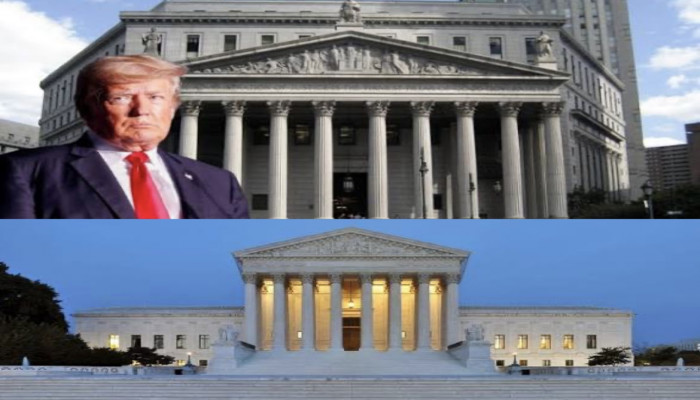
The US Supreme Court has delivered a landmark ruling that greatly expands the powers of President Donald Trump over independent federal agencies. The court ruled that a president can remove the heads of most independent federal agencies without showing any specific reason. However, it made one important exception by allowing Federal Reserve Governor Lisa Cook to remain in her position while she continues her legal battle against Trump's attempt to remove her.
The decision marks a major shift in presidential authority. The six conservative justices formed the majority and overturned the court's 91-year-old unanimous ruling in Humphrey's Executor. That earlier judgment had restricted a president's ability to dismiss members of independent federal agencies. The old ruling aimed to protect these agencies from political influence and allow them to make decisions independently.
Chief Justice John Roberts, writing for the majority, said, "We hold that such protection from removal is contrary to the separation of powers enshrined in the Constitution."
The case before the court involved former Federal Trade Commission member Rebecca Slaughter. Trump removed Slaughter from her position even though federal law states that a president must have a valid reason to dismiss FTC commissioners. The Supreme Court ruled in Trump's favour. The judgment also applies to several other independent agencies, including the National Labour Relations Board, the Merit Systems Protection Board, and the Consumer Product Safety Commission, where Trump had also removed board members.
Trump welcomed the ruling in a post on Truth Social. He wrote, "It is such an Honour to be the sitting President who won this Historic and Unprecedented Ruling, one of the most important ever given with respect to Presidential Powers."
The Supreme Court had already indicated its position earlier by allowing Slaughter and other agency officials to remain dismissed while their legal cases continued. The latest ruling makes that approach permanent for most independent agencies.
No previous US president had attempted to take control of independent agencies the way Trump did. These agencies regulate important sectors such as labour relations, nuclear energy, and consumer product safety. During arguments in Slaughter's case last December, the conservative justices appeared more focused on creating a long-lasting constitutional ruling than on deciding only Trump's immediate dispute.
That approach resembled the Supreme Court's 2024 presidential immunity ruling. In that case, the court protected Trump from criminal prosecution over his efforts to overturn the results of the 2020 presidential election, which he lost to Democrat Joe Biden. At the time, Justice Neil Gorsuch said the court was writing a decision "for the ages."
Justice Sonia Sotomayor strongly disagreed with the latest ruling. She read a summary of her dissent in the courtroom and warned that the decision could weaken democratic protections. She said the ruling could lead to "submission, instability, and even oppression."
"The president, to be sure, emerges with more power than ever before. That power was given to him by six justices on this court, not the people or the Constitution," Sotomayor said.
While the court expanded presidential power over most agencies, it treated the Federal Reserve differently. In a narrow 5-4 decision, the justices rejected the Trump administration's request to remove Lisa Cook from her post immediately. Chief Justice Roberts, Justice Brett Kavanaugh, and the court's three liberal justices formed the majority in this part of the ruling.
Roberts wrote, "would allow the President to remove a member of the Federal Reserve at any time, for any reason, without any notice before, and without any judicial check after. That would turn for-cause protection into little more than at-will employment."
Cook, whom former President Joe Biden nominated to the Federal Reserve Board of Governors, will continue serving while her lawsuit moves through the courts. The Trump administration has appealed a lower court decision that allowed her to remain in office.
Trump had also threatened to remove former Federal Reserve Chair Jerome Powell if he stayed on the board after his term as chairman ended in mid-May. Powell remained a member of the Board of Governors, while Kevin Warsh took over as chairman.
Lower courts had already allowed Cook to continue serving as one of the Federal Reserve's seven governors before the Supreme Court considered her case.
Critics of Trump's effort argue that his real goal is to gain greater control over US interest rate policy. If Cook loses her position, Trump could appoint his own replacement and secure a majority on the Federal Reserve board. Cook is the first Black woman to serve as a Federal Reserve governor. Financial markets and investors have closely watched the case due to its possible impact on the US economy.
Cook rejected the allegations against her and defended her actions in a statement. She said her case was "never about mortgage documents signed years before I became a Federal Reserve governor."
"It was an attempt to remove me on a manufactured pretext because I refused to bow to political pressure and continued to set interest rates based only on what would best serve the American people. That is the most fundamental obligation of a Federal Reserve governor," Cook said in a statement.
Trump has repeatedly argued for sharp cuts in interest rates. He believes lower rates would reduce government borrowing costs and make loans for homes, cars, and other purchases more affordable for Americans. He has also dismissed concerns that lower interest rates could increase inflation.
The Federal Reserve has kept its main interest rate unchanged this year. However, several policymakers have expressed concern over continuing inflation. Some officials have suggested that the central bank may raise interest rates later this year or leave them unchanged.
During the legal battle over Cook's position, Trump increased pressure on the Federal Reserve. The Justice Department opened a criminal investigation into Jerome Powell and issued subpoenas to the central bank. The department later announced that it had ended the investigation in late April. That decision removed a major obstacle to Kevin Warsh's confirmation as Powell's successor.
The case against Cook centres on allegations that she listed two homes, one in Michigan and another in Georgia, as primary residences in mortgage applications submitted in June and July 2021 before she joined the Federal Reserve. Such declarations can qualify applicants for lower mortgage rates and smaller down payments than those available for second homes or rental properties.
Solicitor General D. John Sauer argued in January that those mortgage applications showed "gross negligence at best" and gave Trump sufficient grounds to dismiss Cook. He also argued that courts should not review the president's decision and that Cook had no right to a hearing.
Cook has denied all allegations. Authorities have not charged her with any crime.



 Loading...please wait
Comments