




US strikes five Iranian tankers, Tehran retaliates with an attack on US base in Jordan
- In Reports
- 01:45 PM, Sep 09, 2026
- Myind Staff
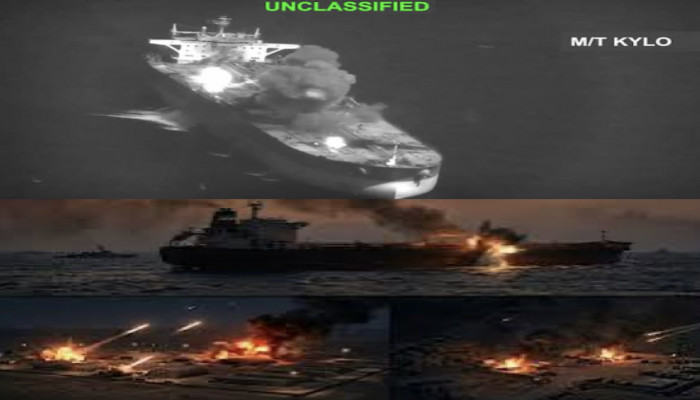
The United States struck five Iranian oil tankers in the Gulf of Oman and near Iran’s Kharg Island on Tuesday after accusing Tehran of attempting to attack a US Navy warship with ballistic missiles. Iran responded with missile strikes on a US military base in Jordan, marking another sharp escalation in the ongoing conflict.
The US Central Command (CENTCOM) said an American warship successfully avoided two Iranian missile attacks over the past two days. The warship continued operating in regional waters after the attacks. No US personnel were injured.
CENTCOM said US forces then targeted five vessels that were allegedly connected to an oil-smuggling network run by Iran’s Islamic Revolutionary Guard Corps (IRGC). The vessels were identified as M/T Kaviz, M/T Charminar, M/T Horizon 1 and M/T Riesco in the Gulf of Oman, along with M/T Derya near Kharg Island.
The US military said crews on the five vessels were ordered to leave before carrying out strikes. The attacks left the tankers inoperable. CENTCOM said the operation was a response to Iran’s failed attempts to strike US naval forces.
"The US warship successfully evaded the attempted Iranian attacks and continued to patrol regional waters. No American personnel were harmed," CENTCOM said.
The US military accused Iran of using the tankers as part of a multibillion-dollar “shadow fleet” to generate funds for the IRGC and its regional proxy groups. CENTCOM said Iran did not have the means to defend the vessels targeted in the operation.
Iran responded by firing missiles at US forces stationed at the Al Azraq air base in Jordan, according to Al Jazeera. Jordanian authorities said their air defence systems intercepted and destroyed 18 of the 20 missiles. The remaining two missiles landed in open areas, Al Jazeera reported.
The IRGC claimed it launched “fierce missile strikes” on Al Azraq and said hangars used by US fighter jets were destroyed. These claims have not been independently verified. It has issued a warning to oil tanker crews in Kuwaiti and Bahraini ports and called on them to leave their vessels immediately, saying the ships could come under attack.
"We warn all the crews of oil tankers in the Kuwaiti and Bahraini ports... to immediately abandon their vessels, whether at anchor or at the ports, because they will be targeted," the IRGC said.
The warning came after Iran’s Armed Forces chief of staff Ali Abdollahi had earlier threatened to target US military installations across the region if Iranian oil tankers were attacked.
"The US aggressor army has given Iranian oil tankers an evacuation warning to hit them, so I announce that any attack on Iranian oil tankers will result in the targeting of US bases in the region by the Armed Forces of the Islamic Republic of Iran," Abdollahi said on state television.
Iranian state media later confirmed that two Iranian oil tankers were hit during the latest US operation. One was struck near the southern port of Jask, while the other was hit close to Kharg Island. State media said the crews were evacuated safely and no casualties were reported.
Iran’s state broadcaster IRIB also confirmed the strike near Kharg Island, which handled around 90 per cent of Iran’s oil exports before the war. The IRGC separately said that “several” Iranian commercial ships had been hit.
The latest operation came days after another US strike on Iranian oil carriers on September 5. CENTCOM said it destroyed three Iranian crude oil tankers after the IRGC allegedly attempted to attack a US aircraft carrier and a guided-missile destroyer.
The US military has maintained that all recent Iranian attempts to attack American Navy warships have failed. US Secretary of State Marco Rubio said Washington would continue responding to such attempts. "Iran keeps trying to strike US Navy ships, and every time it does – or attempts to – it will lose more tankers," Rubio told reporters during a visit to Colombia on Tuesday. "I think you'll see that again today."
The latest exchange of attacks has also raised concerns about global energy supplies. Oil prices briefly rose to USD 99.46, or around Rs 8,700, on Tuesday as markets reacted to the growing tensions.
The conflict began on February 28 and has already affected traffic through the Strait of Hormuz, one of the world’s most important routes for oil shipments. Iran has kept the strait closed to regular traffic, while the US has imposed a naval blockade on Iranian ports, according to Al Jazeera.
The latest fighting is the most intense since hostilities resumed a week ago after around a month of relative calm. A 60-day ceasefire formally ended last month without a wider diplomatic agreement.
Washington has also announced sanctions against 36 Iranian entities, including 27 airlines, to isolate Iran’s aviation sector.
Iran’s threat against tankers in Kuwaiti and Bahraini ports, along with the US warning of further strikes on Iranian oil carriers, has increased fears of a wider regional conflict. The continued attacks could also put further pressure on global oil supplies and regional security.



 Loading...please wait
Comments